
Grey-bellied Squirrel
Callosciurus caniceps
Red List assessment
Least Concernon the IUCN Red List
- EXExtinct
- EWExtinct in the Wild
- CRCritically Endangered
- ENEndangered
- VUVulnerable
- NTNear Threatened
- LCLeast Concern
The Grey-bellied Squirrel is recorded in 6 countries across Asia. The IUCN Red List assesses the Grey-bellied Squirrel as Least Concern. No precise global population estimate exists, but the species is described as common to abundant throughout much of its range, with a presumed stable population trend.
- Family
- Sciuridae
- Order
- Rodentia
- Genus
- Callosciurus
- Countries recorded
- 6
- Continents
- Asia
- Red List category
- Least Concern
- Data updated
- August 9, 2026
What is the Grey-bellied Squirrel?
The Grey-bellied Squirrel is a small arboreal rodent native to mainland Southeast Asia, notable for its variable fur coloration ranging from grey to reddish tones. It is a common and adaptable species found in a wide variety of forested and semi-forested habitats. Its ecological plasticity has allowed it to thrive even in human-modified landscapes such as gardens and plantations. It is one of the most frequently observed squirrel species within its range.
Where does the Grey-bellied Squirrel live?
Southeast Asia, including Thailand, Myanmar, Laos, Cambodia, Vietnam, and Malaysia
Found throughout mainland Southeast Asia, including Thailand, Myanmar, Laos, Cambodia, Vietnam, and parts of Peninsular Malaysia. Its range covers both lowland and hill forest regions across this area.
Altitude and depth
Typically found from sea level up to around 1,200 meters elevation.
Seasonal movements
No true hibernation or migration; breeding activity may show slight seasonal peaks correlated with fruiting seasons.
Habitat of the Grey-bellied Squirrel
Inhabits tropical and subtropical forests, including primary and secondary forests, bamboo groves, mangroves, and forest edges. Also adapts well to disturbed habitats such as plantations, orchards, and urban parks.
Adaptations to its environment
Possesses sharp curved claws and strong hind limbs for agile climbing and jumping between branches. Its coloration provides camouflage in dappled forest light, and its flexible diet allows it to exploit diverse food sources across habitat types.
Conservation status and numbers
Listed as Least Concern (LC) by the IUCN due to its wide distribution, adaptability to various habitats, and presumed large population size without significant range-wide decline.
Estimated population
No precise global population estimate exists, but the species is described as common to abundant throughout much of its range, with a presumed stable population trend.
What threatens the Grey-bellied Squirrel?
Localized threats include deforestation, habitat fragmentation, and hunting for food or pet trade in some areas, though these do not currently threaten the species at a global level.
Diseases and parasites
Susceptible to common rodent ectoparasites such as fleas and mites, as well as endoparasitic nematodes; not known to be a major disease reservoir affecting humans.
What is being done to protect it?
No specific conservation programs target this species due to its stable status; it benefits indirectly from protected areas and forest reserves within its range countries.
Recommended actions
Continued monitoring of population trends in areas experiencing rapid deforestation, and maintaining forest connectivity to support genetic diversity across its range.
What the Grey-bellied Squirrel looks like
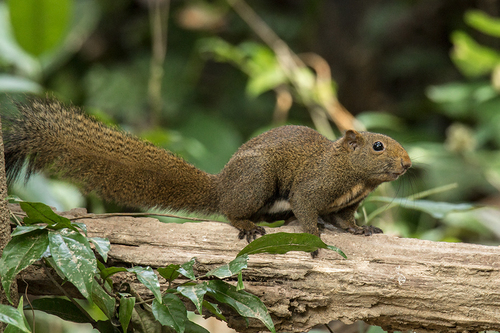
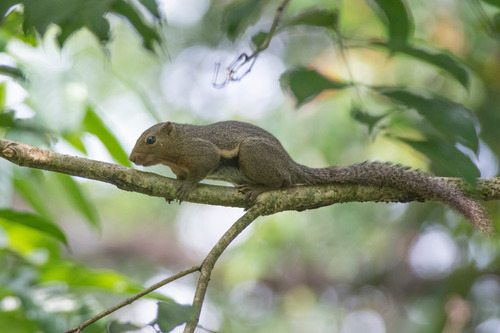
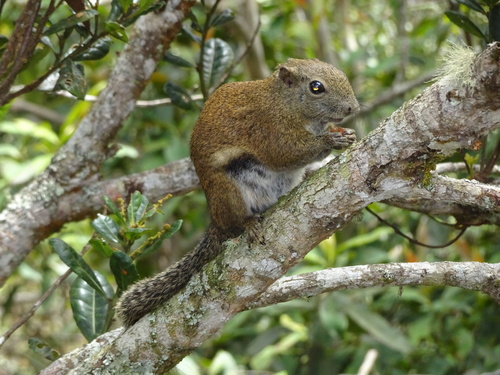
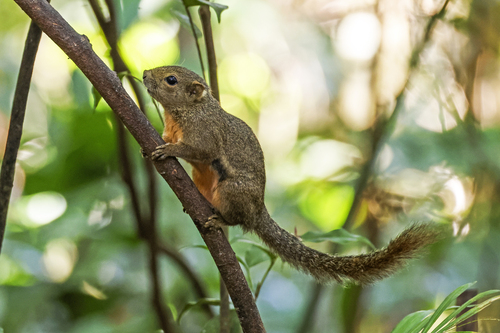
Fur coloration is highly variable, ranging from grizzled grey to reddish-brown on the back, with a pale grey to whitish underside. The tail is bushy and often shows a mix of grey and black banding.
Size
Body length typically ranges from 18 to 23 cm, with a tail of similar or slightly greater length.
Weight
Adults typically weigh between 150 and 300 grams.
Distinctive features
Distinguished from similar Callosciurus species by its typically greyish venter (hence the name) and variable dorsal coloration, which can make field identification challenging without close observation.
Differences between males and females
No significant sexual dimorphism; males and females are similar in size and coloration.
Behaviour and diet of the Grey-bellied Squirrel
Generally solitary or found in loose associations, though individuals may share overlapping home ranges, especially in resource-rich areas.
When it is active
Diurnal, most active during early morning and late afternoon, resting during the hottest part of the day.
Diet
Omnivorous, feeding primarily on fruits, seeds, nuts, and flowers, but also consuming insects, bird eggs, and occasionally small invertebrates.
How it feeds and hunts
Forages opportunistically in trees and on the ground, using keen senses of smell and sight to locate fruits, seeds, and occasional animal prey.
Communication
Communicates through vocal chatters and tail-flicking displays, as well as scent marking to establish territory and signal reproductive status.
Interactions with other species
Preyed upon by raptors, snakes, and small carnivores; competes with other squirrel species and arboreal mammals for food resources such as fruits and seeds.
Role in its ecosystem
Plays an important role in seed dispersal and forest regeneration by caching and dropping seeds, as well as contributing to pollination through flower feeding.
Reproduction and lifecycle
Breeding can occur year-round with possible peaks tied to fruiting seasons; gestation lasts approximately 40-45 days, with litters typically of 2-3 young.
Raising the young
Females raise young alone in tree nests or tree hollows, nursing and protecting them until weaning at around 8-10 weeks of age.
Maturity and lifespan
Reaches sexual maturity around 1 year of age; lifespan in the wild is typically 3-5 years, with captive individuals potentially living longer.
Taxonomy and naming of the Grey-bellied Squirrel
Classification
Class Mammalia > Order Rodentia > Family Sciuridae > Genus Callosciurus > Species Callosciurus caniceps
Subspecies
Several subspecies recognized, including C. c. caniceps, C. c. bocourti, C. c. rufoniger, and others distributed across mainland Southeast Asia, differing mainly in fur coloration and geographic range.
Scientific synonyms
Sciurus caniceps (original combination)
What research says
Recent studies
Recent taxonomic revisions have focused on clarifying subspecies boundaries and phylogenetic relationships within the Callosciurus genus using mitochondrial DNA analysis.
Genome and DNA
Limited specific genomic studies exist, though general Sciuridae chromosome counts and phylogenetic placements have been used to clarify its taxonomic relationships within Callosciurus.
Compared with similar species
Similar to other Callosciurus species such as the Pallas's Squirrel (Callosciurus erythraeus), but generally distinguished by its greyer underside and more subdued dorsal coloration.
The Grey-bellied Squirrel and people
Despite its name, the 'grey belly' trait can vary considerably between individuals and populations, making some populations nearly indistinguishable from related species without genetic testing. It is also known for its acrobatic leaps between tree canopies, sometimes covering several meters in a single jump.
Where and how to see it
Best observed in early morning in forested parks and reserves across Thailand or Cambodia, particularly in areas with abundant fruiting trees; patience and quiet movement improve chances of sightings.
Risks to humans
No notable risk to humans; occasionally considered a minor agricultural pest due to fruit feeding.
Human uses
Sometimes kept as pets in parts of its range and occasionally hunted for local subsistence, though it holds no major commercial or medicinal value.
Countries where the Grey-bellied Squirrel is recorded
The 6 countries named in the range description of its IUCN Red List assessment.
Questions about the Grey-bellied Squirrel
Where does the Grey-bellied Squirrel live?
The Grey-bellied Squirrel is recorded in Cambodia, Laos, Malaysia, Myanmar and Thailand, among 6 countries in total across Asia. These countries come from the range description of its IUCN Red List assessment, and they are what place the species on the interactive map.
Is the Grey-bellied Squirrel endangered?
The IUCN Red List assesses the Grey-bellied Squirrel as Least Concern. The species is widespread and abundant enough not to qualify for any threatened category. It does not mean the species is safe forever, only that nothing in the current data raises an alarm.
How many are left in the wild?
No precise global population estimate exists, but the species is described as common to abundant throughout much of its range, with a presumed stable population trend. This figure comes from the species assessment on the IUCN Red List; population estimates for wild mammals are ranges, not counts, and are revised at each assessment.
What habitat does the Grey-bellied Squirrel live in?
Inhabits tropical and subtropical forests, including primary and secondary forests, bamboo groves, mangroves, and forest edges.
What is the scientific name of the Grey-bellied Squirrel?
The Grey-bellied Squirrel is Callosciurus caniceps, in the family Sciuridae, order Rodentia.
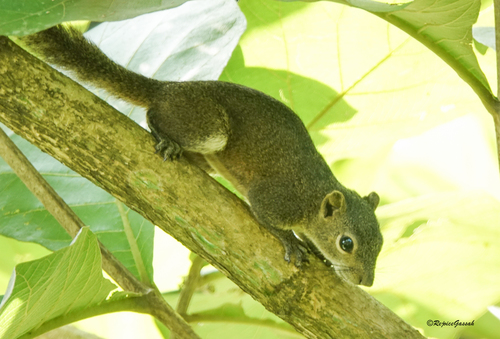
Other species in the genus Callosciurus
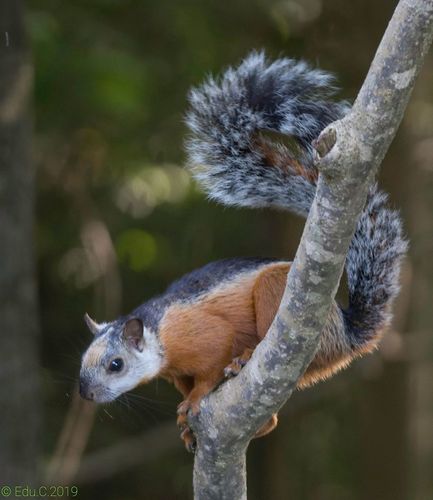
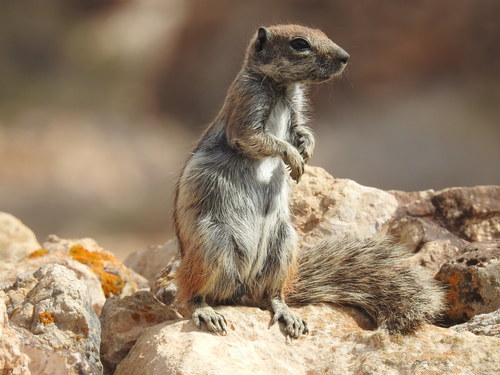
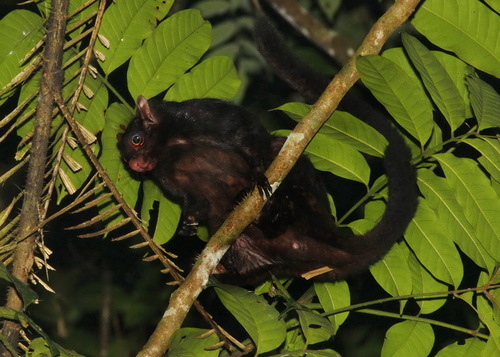
Other species in the family Sciuridae
Sources
Conservation status, range description and population estimate come from the IUCN Red List assessment for Callosciurus caniceps. Countries are derived from that range description, not from a mapped country list. Last refreshed on .
The distribution map is drawn from the IUCN Red List spatial data compiled in 2008. IUCN (International Union for Conservation of Nature)