
Eastern Gray Squirrel
Sciurus carolinensis
Red List assessment
Least Concernon the IUCN Red List
- EXExtinct
- EWExtinct in the Wild
- CRCritically Endangered
- ENEndangered
- VUVulnerable
- NTNear Threatened
- LCLeast Concern
The Eastern Gray Squirrel is recorded in 6 countries across Africa, Europe and North America. The IUCN Red List assesses the Eastern Gray Squirrel as Least Concern. Population is large and stable to increasing across most of its native range, with millions of individuals estimated; precise global figures are not tracked due to its abundance.
- Family
- Sciuridae
- Order
- Rodentia
- Genus
- Sciurus
- Countries recorded
- 6
- Continents
- Africa, Europe and North America
- Red List category
- Least Concern
- Data updated
- August 9, 2026
What is the Eastern Gray Squirrel?
The Eastern Gray Squirrel is a medium-sized tree squirrel native to deciduous and mixed forests of eastern North America. It is highly adaptable, thriving in both wild woodlands and urban parks, and is one of the most recognizable and studied rodents in North America. Its success in colonizing Europe as an introduced species has made it ecologically significant, often outcompeting native red squirrels. The species is known for its intelligence, memory for cached food, and remarkable agility in trees.
Where does the Eastern Gray Squirrel live?
Eastern and central United States, southern Ontario and Quebec in Canada; introduced populations in the UK, Ireland, Italy, and South Africa
Native range covers the eastern United States from Maine to Florida and west to the Great Plains, plus southern Ontario and Quebec in Canada. Introduced and established populations exist in the United Kingdom, Ireland, Italy, and South Africa.
Altitude and depth
Typically found from sea level up to about 1,500 meters in elevation, depending on suitable forest cover.
Seasonal movements
No true hibernation; the species remains active year-round but reduces activity during severe winter storms, relying on cached food (scatter-hoarding) to survive winter months.
Habitat of the Eastern Gray Squirrel
Primarily found in mature deciduous and mixed hardwood forests with abundant mast-producing trees like oak and hickory; also thrives in urban and suburban parks, gardens, and woodlots with sufficient tree cover.
Adaptations to its environment
Sharp curved claws and strong hind legs enable exceptional climbing and jumping between branches; a bushy tail aids balance, acts as a rudder while jumping, and provides insulation in cold weather. Scatter-hoarding behavior with spatial memory allows survival through food-scarce winters.
Conservation status and numbers
Listed as Least Concern by the IUCN due to a large, stable, and widespread population across its native range with no major range-wide threats.
Estimated population
Population is large and stable to increasing across most of its native range, with millions of individuals estimated; precise global figures are not tracked due to its abundance.
What threatens the Eastern Gray Squirrel?
Habitat fragmentation from urban development, vehicle collisions, and in some areas competition or disease transmission dynamics; in its introduced European range, it is considered an invasive threat to native red squirrels rather than being threatened itself.
Diseases and parasites
Susceptible to mange mites, fleas, ticks, and can carry squirrelpox virus, which is harmless to gray squirrels but lethal to red squirrels in Europe.
What is being done to protect it?
No significant conservation programs are needed in its native range due to its abundance; conversely, in the UK and Ireland, management programs exist to control its invasive spread and protect native red squirrels.
Recommended actions
In native range, monitoring urban population dynamics and maintaining forest connectivity; in introduced ranges, continued population control and habitat management to protect native squirrel species.
What the Eastern Gray Squirrel looks like
Fur is predominantly grizzled gray on the back with a whitish to pale gray underside, though some populations show brown or reddish tinges; the tail is long, bushy, and frosted with white-tipped hairs. Melanistic (black) and rarely white/albino individuals occur in some populations.
Size
Body length of 40-52 cm including a tail of 15-25 cm.
Weight
Typically weighs between 400-600 grams, with males and females similar in size.
Distinctive features
Distinguished from the American Red Squirrel by its larger size and gray coloration versus the red squirrel's smaller, reddish-brown coat; distinguished from fox squirrels by generally smaller size and less orange/rusty coloring.
Behaviour and diet of the Eastern Gray Squirrel
Generally solitary but tolerant of overlapping home ranges, especially where food is abundant; may form loose aggregations at feeding sites and share nests in cold weather for warmth.
When it is active
Diurnal, with peak activity in early morning and late afternoon; less active during midday heat or severe weather.
Diet
Omnivorous, feeding primarily on nuts, seeds, acorns, fruits, buds, and fungi, supplemented occasionally with insects, bird eggs, and nestlings.
How it feeds and hunts
Forages by searching leaf litter and tree canopies for nuts and seeds, using scatter-hoarding to cache food individually in numerous shallow holes for later retrieval using spatial memory and smell.
Communication
Communicates through a variety of vocalizations including barks, chattering, and quaas, as well as tail-flagging and foot-stamping to signal alarm or territorial warnings.
Interactions with other species
Preyed upon by hawks, owls, foxes, bobcats, and domestic cats and dogs; competes with other squirrel species and birds for mast crops, and in Europe has displaced native red squirrels partly through resource competition and squirrelpox virus transmission.
Role in its ecosystem
Plays an important ecological role as a seed disperser, particularly for oak and hickory trees, since cached nuts that are not retrieved can germinate into new trees.
Reproduction and lifecycle
Breeding occurs twice yearly, typically in late winter (December-February) and again in summer (May-June); gestation lasts about 44 days, producing litters of 2-4 young that are weaned around 8-10 weeks of age.
Raising the young
Females raise young alone in tree cavities or leaf nests (dreys), nursing and protecting them until weaning; young remain with the mother for several months before dispersing to establish their own territories.
Maturity and lifespan
Reaches sexual maturity around 1 year of age; lifespan in the wild averages 6 years but can reach up to 12-20 years in captivity.
Taxonomy and naming of the Eastern Gray Squirrel
Classification
Class Mammalia > Order Rodentia > Family Sciuridae > Genus Sciurus > Species Sciurus carolinensis
Subspecies
Several subspecies recognized including S. c. carolinensis (southeastern US), S. c. pennsylvanicus (northeastern US), S. c. hypophaeus, S. c. fuliginosus, and others differentiated mainly by minor coat color and size variation across their range.
Scientific synonyms
Sciurus leucotis, Sciurus cinereus (older historical synonyms no longer in use)
What research says
Recent studies
Recent studies have focused on cognitive abilities such as spatial memory for cache retrieval, as well as genetic and ecological impacts of gray squirrel invasions on European red squirrel populations.
Genome and DNA
Diploid chromosome number is 2n=40; genetic studies have been used to trace the invasive European populations back to specific North American source populations.
Compared with similar species
Similar in general form to the Fox Squirrel (Sciurus niger) but generally smaller with grayer fur; compared to the Eurasian Red Squirrel (Sciurus vulgaris), it is larger and more robust, giving it a competitive advantage in shared habitats.
The Eastern Gray Squirrel and people
Eastern Gray Squirrels can remember the locations of thousands of buried nut caches using spatial memory and can even use deceptive caching behavior to mislead potential food thieves. They are also capable of impressive jumps of over 6 meters horizontally between tree branches.
Where and how to see it
Best observed in parks, woodlands, and suburban gardens during early morning or late afternoon in fall when they are actively foraging and caching acorns; approaching quietly and remaining still increases chances of close observation.
Risks to humans
No notable risk to humans, though bites can occur if the animal is handled or cornered, and they may carry parasites like fleas or ticks.
Human uses
Historically hunted for meat and fur by early American settlers; today mainly valued for recreational wildlife watching, urban wildlife studies, and occasionally as a nuisance species requiring management in gardens and attics.
Myths and legends
In some Native American folklore, squirrels symbolize preparedness and resourcefulness due to their food-storing habits; in modern Western culture, they are commonly seen as cheeky, industrious urban wildlife icons.
Countries where the Eastern Gray Squirrel is recorded
The 6 countries named in the range description of its IUCN Red List assessment.
Questions about the Eastern Gray Squirrel
Where does the Eastern Gray Squirrel live?
The Eastern Gray Squirrel is recorded in Canada, Ireland, Italy, South Africa and United Kingdom, among 6 countries in total across Africa, Europe and North America. These countries come from the range description of its IUCN Red List assessment, and they are what place the species on the interactive map.
Is the Eastern Gray Squirrel endangered?
The IUCN Red List assesses the Eastern Gray Squirrel as Least Concern. The species is widespread and abundant enough not to qualify for any threatened category. It does not mean the species is safe forever, only that nothing in the current data raises an alarm.
How many are left in the wild?
Population is large and stable to increasing across most of its native range, with millions of individuals estimated; precise global figures are not tracked due to its abundance. This figure comes from the species assessment on the IUCN Red List; population estimates for wild mammals are ranges, not counts, and are revised at each assessment.
What habitat does the Eastern Gray Squirrel live in?
Primarily found in mature deciduous and mixed hardwood forests with abundant mast-producing trees like oak and hickory; also thrives in urban and suburban parks, gardens, and woodlots with sufficient tree cover.
What is the scientific name of the Eastern Gray Squirrel?
The Eastern Gray Squirrel is Sciurus carolinensis, in the family Sciuridae, order Rodentia.
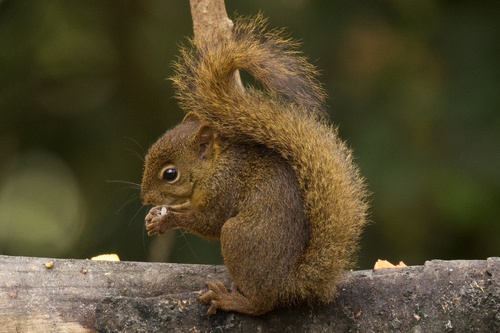
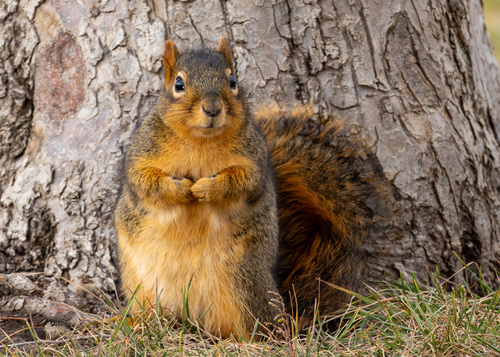
Other species in the genus Sciurus
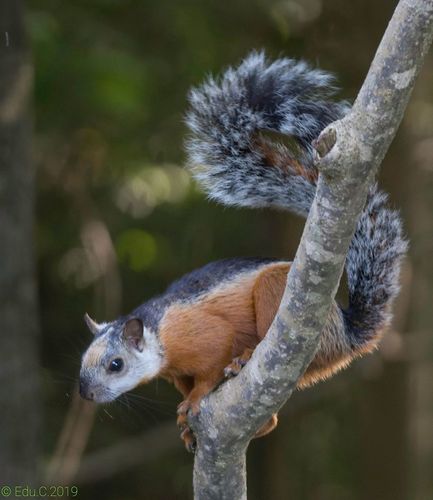
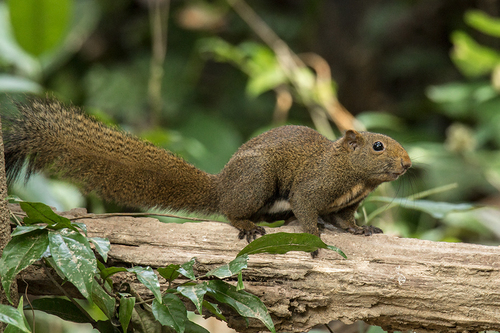
Other species in the family Sciuridae
Sources
Conservation status, range description and population estimate come from the IUCN Red List assessment for Sciurus carolinensis. Countries are derived from that range description, not from a mapped country list. Last refreshed on .
The distribution map is drawn from the IUCN Red List spatial data compiled in 2008. International Union for Conservation of Nature (IUCN), NatureServe