
Ear-spot Squirrel
Callosciurus adamsi
Red List assessment
Near Threatenedon the IUCN Red List
- EXExtinct
- EWExtinct in the Wild
- CRCritically Endangered
- ENEndangered
- VUVulnerable
- NTNear Threatened
- LCLeast Concern
The Ear-spot Squirrel is recorded in 2 countries across Asia. The IUCN Red List assesses the Ear-spot Squirrel as Near Threatened. No precise global population estimate exists, but the species is considered to have a declining population trend correlating with the rate of Bornean forest loss.
- Family
- Sciuridae
- Order
- Rodentia
- Genus
- Callosciurus
- Countries recorded
- 2
- Continents
- Asia
- Red List category
- Near Threatened
- Data updated
- August 9, 2026
What is the Ear-spot Squirrel?
The Ear-spot Squirrel is a small tree squirrel endemic to the island of Borneo, named for the distinctive pale spot behind each ear. It inhabits lowland and hill forests where it forages among the canopy and understory. This species is relatively poorly studied compared to other Callosciurus squirrels, making detailed ecological data limited. Its restricted island endemism makes it of particular interest for Bornean biodiversity conservation.
Where does the Ear-spot Squirrel live?
Borneo, specifically northern and eastern Borneo including Sabah (Malaysia) and parts of Kalimantan (Indonesia)
Endemic to the island of Borneo, with records concentrated in northern Borneo (Sabah, Malaysia) and adjacent regions of Kalimantan, Indonesia. Its range is more restricted compared to other widespread Callosciurus species.
Altitude and depth
Generally found from sea level up to around 1000-1200 meters in lowland and hill forests.
Seasonal movements
No known migratory behavior or hibernation; the species is active year-round, though breeding activity may show slight seasonal peaks linked to fruiting cycles.
Habitat of the Ear-spot Squirrel
Primarily found in primary and secondary lowland tropical rainforest, as well as hill dipterocarp forest. It also occurs in forest edges and sometimes disturbed or logged forest areas with sufficient canopy cover.
Adaptations to its environment
Sharp curved claws and strong hind limbs allow agile arboreal locomotion through the forest canopy. Its coloration provides camouflage against tree bark and foliage, while a bushy tail aids in balance during jumps between branches.
Conservation status and numbers
Listed as Near Threatened (NT) by the IUCN due to ongoing habitat loss from deforestation and its relatively restricted range within Borneo. Population trends are believed to be declining as forest cover continues to shrink.
Estimated population
No precise global population estimate exists, but the species is considered to have a declining population trend correlating with the rate of Bornean forest loss.
What threatens the Ear-spot Squirrel?
Major threats include deforestation for logging, oil palm plantations, and agricultural expansion, which fragment and reduce suitable forest habitat. Forest fires and illegal logging further exacerbate habitat degradation.
Diseases and parasites
Specific disease and parasite data for this species are limited, though like other squirrels it likely hosts ectoparasites such as fleas and mites, and may carry certain zoonotic pathogens.
What is being done to protect it?
The species benefits indirectly from protected areas in Borneo such as Kinabalu Park and other forest reserves in Sabah. However, there are no species-specific conservation programs currently in place.
Recommended actions
Priority actions include expanding protected forest areas, enforcing anti-logging regulations, and conducting further population surveys to better understand its distribution and ecological needs.
What the Ear-spot Squirrel looks like
The Ear-spot Squirrel has a grizzled brownish-grey to reddish-brown dorsal coat, with paler underparts, and a bushy tail. Its most notable feature is a distinct pale or whitish spot located behind each ear, giving the species its common name.
Size
Body length typically ranges from about 18-22 cm, with a tail of similar or slightly greater length, giving a total length of roughly 35-45 cm.
Weight
Weighs approximately 250-350 grams, similar to other medium-sized Callosciurus species.
Distinctive features
The pale ear-spot marking is the key distinguishing feature separating it from other similar-looking Callosciurus species found in Borneo, such as the Prevost's squirrel or plantain squirrel.
Differences between males and females
Minimal sexual dimorphism; males and females are similar in size and coloration, making them difficult to distinguish visually in the field.
Behaviour and diet of the Ear-spot Squirrel
Generally solitary or found in loose pairs, typical of many Callosciurus species, with limited social interaction outside of breeding periods.
When it is active
Diurnal, being most active during daylight hours when foraging for food in the forest canopy and understory.
Diet
Omnivorous diet consisting mainly of fruits, seeds, nuts, and flowers, supplemented occasionally with insects and other small invertebrates.
How it feeds and hunts
As primarily a forager rather than a hunter, it uses its dexterous forepaws to manipulate fruits and seeds, and it opportunistically searches bark crevices for insects.
Communication
Likely communicates through vocal chirps and chatters similar to related squirrel species, along with tail flicking and scent marking to signal territory or alarm.
Interactions with other species
Faces predation from arboreal snakes, birds of prey, and small carnivores; may also compete with other squirrel species and arboreal mammals for food resources in shared habitats.
Role in its ecosystem
Plays an important ecological role as a seed disperser and occasional pollinator, contributing to forest regeneration and plant diversity within its Bornean habitat.
Reproduction and lifecycle
Breeding details are not well documented, but like related Callosciurus species, it likely breeds year-round with peaks tied to fruit abundance, with litters of 1-3 young after a gestation of about 5 weeks.
Raising the young
Females are presumed to be the primary caregivers, nursing and protecting the young in a nest built in tree hollows or dense foliage until they are weaned and independent.
Maturity and lifespan
Sexual maturity is estimated to occur around 1 year of age, with a wild lifespan likely ranging from 5-8 years, though captive data is scarce.
Taxonomy and naming of the Ear-spot Squirrel
Classification
Mammalia > Rodentia > Sciuridae > Callosciurus > Callosciurus adamsi
Subspecies
Several subspecies have been described including C. a. adamsi and C. a. ereupelis, differing mainly in coloration and distributed across different parts of Borneo, though taxonomy remains somewhat unsettled.
Scientific synonyms
Sciurus adamsi (original combination)
What research says
Recent studies
Recent taxonomic and phylogenetic studies on Bornean Callosciurus species have helped clarify relationships within the genus, though species-specific research on C. adamsi remains limited.
Compared with similar species
Compared to the more widespread and variably colored Callosciurus prevostii, the Ear-spot Squirrel is generally less vividly patterned and is distinguished mainly by its namesake ear spot rather than tricolor fur patterns.
The Ear-spot Squirrel and people
This squirrel's name comes from a unique pale patch behind its ears found in no other closely related species, making it a useful field identification marker. Despite being relatively unknown, it is one of many unique squirrel species that highlight Borneo's status as a biodiversity hotspot.
Where and how to see it
Best observed early morning in lowland or hill forests of Sabah, particularly in protected areas with intact canopy, where patient observers may spot it foraging quietly among branches.
Risks to humans
No notable risk to humans; it is a shy, non-aggressive species that avoids direct contact with people.
Countries where the Ear-spot Squirrel is recorded
The 2 countries named in the range description of its IUCN Red List assessment.
Questions about the Ear-spot Squirrel
Where does the Ear-spot Squirrel live?
The Ear-spot Squirrel is recorded in Indonesia and Malaysia across Asia. These countries come from the range description of its IUCN Red List assessment, and they are what place the species on the interactive map.
Is the Ear-spot Squirrel endangered?
The IUCN Red List assesses the Ear-spot Squirrel as Near Threatened. The species does not qualify as threatened today, but it is close to the thresholds and likely to cross them soon. It is the category that most often changes at the next assessment.
How many are left in the wild?
No precise global population estimate exists, but the species is considered to have a declining population trend correlating with the rate of Bornean forest loss. This figure comes from the species assessment on the IUCN Red List; population estimates for wild mammals are ranges, not counts, and are revised at each assessment.
What habitat does the Ear-spot Squirrel live in?
Primarily found in primary and secondary lowland tropical rainforest, as well as hill dipterocarp forest.
What is the scientific name of the Ear-spot Squirrel?
The Ear-spot Squirrel is Callosciurus adamsi, in the family Sciuridae, order Rodentia.
Other species in the genus Callosciurus
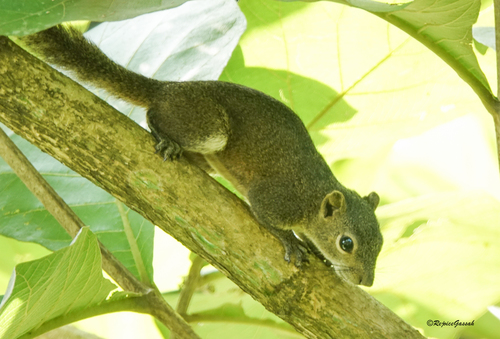
Other species in the family Sciuridae
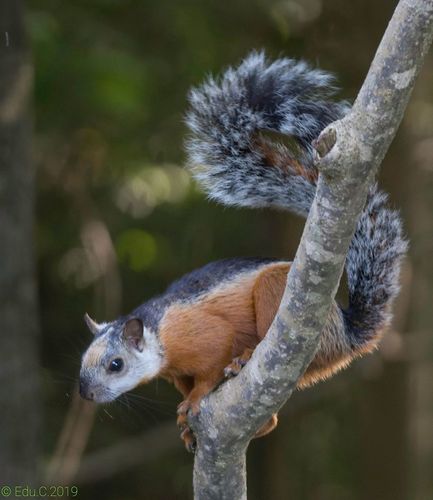
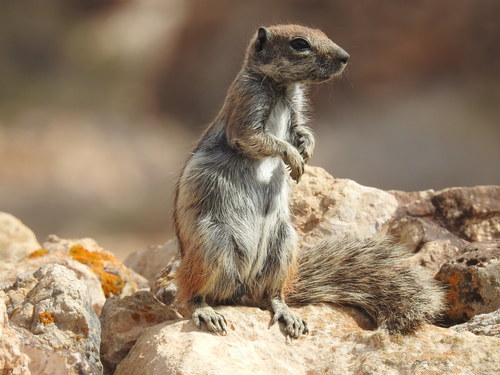
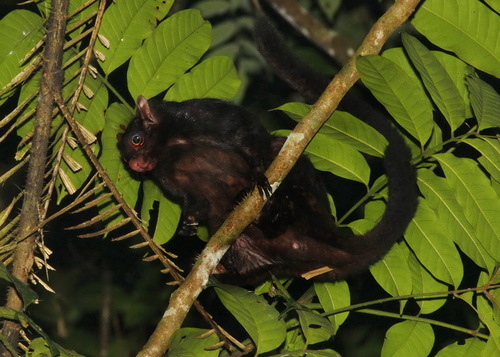

Sources
Conservation status, range description and population estimate come from the IUCN Red List assessment for Callosciurus adamsi. Countries are derived from that range description, not from a mapped country list. Last refreshed on .
The distribution map is drawn from the IUCN Red List spatial data compiled in 2016. IUCN SSC Small Mammal Specialist Group