
Hoary-bellied Squirrel
Callosciurus pygerythrus
Red List assessment
Least Concernon the IUCN Red List
- EXExtinct
- EWExtinct in the Wild
- CRCritically Endangered
- ENEndangered
- VUVulnerable
- NTNear Threatened
- LCLeast Concern
The Hoary-bellied Squirrel is recorded in 7 countries across Asia. The IUCN Red List assesses the Hoary-bellied Squirrel as Least Concern. No precise global population estimate exists, but the species is considered common and widespread with a presumed stable population.
- Family
- Sciuridae
- Order
- Rodentia
- Genus
- Callosciurus
- Countries recorded
- 7
- Continents
- Asia
- Red List category
- Least Concern
- Data updated
- August 9, 2026
What is the Hoary-bellied Squirrel?
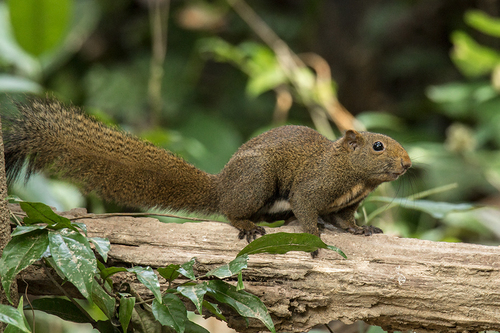
The Hoary-bellied Squirrel is a medium-sized tree squirrel native to the foothills of the Himalayas and adjacent lowlands of South and Southeast Asia. It is named for the grizzled, pale grayish-white underside contrasting with its darker dorsal fur. This species is common in forested and semi-forested habitats and plays an important ecological role in seed dispersal. It is one of many Callosciurus species that are notoriously difficult to distinguish visually due to high color variation.
Where does the Hoary-bellied Squirrel live?
South and Southeast Asia, primarily northeastern India, Nepal, Bhutan, Bangladesh, and Myanmar
Ranges across northeastern India (Assam, Manipur, Nagaland, Meghalaya), Nepal, Bhutan, Bangladesh, and Myanmar, extending into parts of southern China and northern Thailand in some classifications.
Altitude and depth
Typically found from lowlands up to about 1500-2000 meters elevation in hill forests.
Seasonal movements
No true hibernation or long-distance migration; activity levels may increase during fruiting seasons when food is abundant.
Habitat of the Hoary-bellied Squirrel
Found in tropical and subtropical evergreen and deciduous forests, secondary growth, bamboo stands, and forest edges; also adapts well to gardens, plantations, and areas near human settlements.
Adaptations to its environment
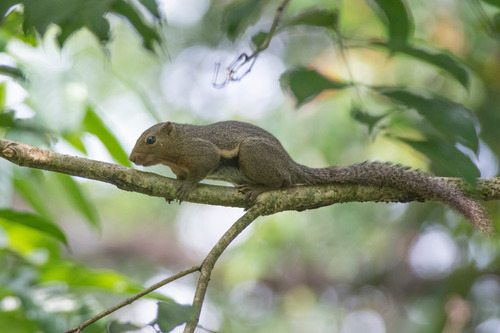
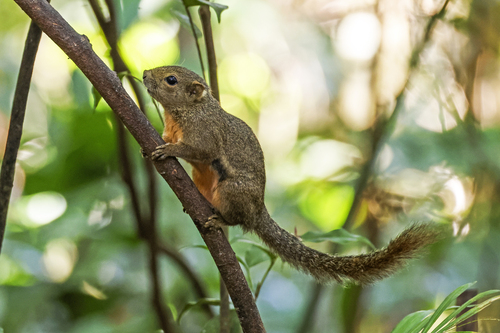
Possesses strong curved claws and a long balancing tail suited for arboreal locomotion; its coloration provides camouflage among tree bark and foliage, and its flexible diet allows survival in both undisturbed forest and human-modified landscapes.
Conservation status and numbers
Listed as Least Concern (LC) by the IUCN due to its wide distribution, presumed large population, and tolerance of varied and degraded habitats.
Estimated population
No precise global population estimate exists, but the species is considered common and widespread with a presumed stable population.
What threatens the Hoary-bellied Squirrel?
Habitat loss from deforestation, agricultural expansion, and logging in parts of its range; some localized hunting or trapping for pet trade also occurs.
Diseases and parasites
Susceptible to common rodent ectoparasites such as fleas, ticks, and mites; specific disease studies on this species are limited.
What is being done to protect it?
No species-specific conservation programs exist; the squirrel benefits indirectly from protected areas and national parks within its range such as reserves in Assam and Nepal's Terai region.
Recommended actions
Continued habitat protection in northeastern India and Nepal, monitoring of subspecies taxonomy, and regulation of pet trade in some regions.
What the Hoary-bellied Squirrel looks like
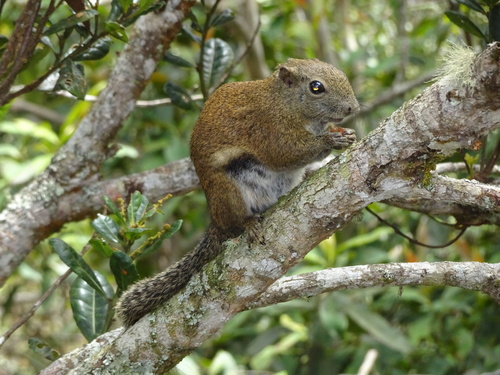
Upperparts are typically olive-brown to grayish-brown, sometimes with reddish or rufous tones, while the underparts show a distinctive grizzled hoary (pale gray-white) coloration that gives the species its name; the tail is bushy and often darker than the body.
Size
Head-body length approximately 20-24 cm, with a tail of similar or slightly greater length (20-25 cm).
Weight
Approximately 200-350 grams.
Distinctive features
Distinguished from other Callosciurus species mainly by its pale, grizzled venter and moderate body size; overall coloration is highly variable geographically, making field identification sometimes challenging without genetic or detailed morphological comparison.
Behaviour and diet of the Hoary-bellied Squirrel
Generally solitary or seen in loose pairs, though multiple individuals may share overlapping home ranges and occasionally forage near each other in fruiting trees.
When it is active
Diurnal, most active during early morning and late afternoon, resting during the hottest midday hours.
Diet
Omnivorous, feeding mainly on fruits, seeds, nuts, flowers, and tender shoots, supplemented occasionally with insects, bird eggs, or small invertebrates.
Communication
Uses a range of chattering and chirping vocalizations for alarm and territorial signaling, along with scent marking and tail-flicking displays to communicate with conspecifics.
Interactions with other species
Preyed upon by raptors, small carnivores (civets, martens), and snakes; competes with other squirrel and rodent species for food resources in shared forest habitats.
Role in its ecosystem
Plays a role as a seed disperser and occasional pollinator by feeding on flowers and fruits, contributing to forest regeneration and plant diversity.
Reproduction and lifecycle
Breeding can occur year-round in favorable climates but often peaks with fruiting seasons; gestation lasts approximately 40-45 days, with litters typically of 2-3 young.
Raising the young
Females build nests in tree cavities or leaf nests and provide sole care for the altricial young, nursing them for several weeks until they are weaned and able to forage independently.
Maturity and lifespan
Sexual maturity is generally reached around 1 year of age; lifespan in the wild is estimated at 4-6 years, with captive individuals potentially living longer under favorable conditions.
Taxonomy and naming of the Hoary-bellied Squirrel
Classification
Class Mammalia > Order Rodentia > Family Sciuridae > Genus Callosciurus > Species Callosciurus pygerythrus
Subspecies
Several subspecies recognized including C. p. pygerythrus (northeastern India), C. p. lokroides (Nepal, Sikkim), C. p. blythii, and C. p. stevensi (Myanmar); taxonomy remains debated with some authorities lumping or splitting differently.
Scientific synonyms
Sciurus pygerythrus (original combination); Callosciurus pygerythraeus (alternate spelling seen in some literature)
What research says
Recent studies
Recent taxonomic studies using molecular data have helped clarify relationships within the Callosciurus genus, though genetic studies specific to C. pygerythrus remain limited.
Compared with similar species
Similar to other Callosciurus species like the Pallas's squirrel (Callosciurus erythraeus) but distinguished by the hoary underside; overall body proportions and habits are comparable across the genus, differing mainly in coloration patterns.
The Hoary-bellied Squirrel and people
The 'hoary' in its name refers to its frosty, grizzled belly fur, which is unusual among tropical tree squirrels; it is also one of the most taxonomically complex squirrel species due to extensive regional color variation.
Where and how to see it
Best observed early morning in forest edges or garden areas of northeastern India, Nepal's Terai lowlands, or protected forests in Myanmar; look for movement in fruiting trees and listen for chattering calls.
Risks to humans
No notable risk to humans; occasional minor crop or garden damage can occur due to foraging behavior.
Human uses
Not significantly used commercially, though occasionally kept informally as pets in parts of its range; it may indirectly benefit local ecosystems used for ecotourism and wildlife observation.
Countries where the Hoary-bellied Squirrel is recorded
The 7 countries named in the range description of its IUCN Red List assessment.
Questions about the Hoary-bellied Squirrel
Where does the Hoary-bellied Squirrel live?
The Hoary-bellied Squirrel is recorded in Bangladesh, Bhutan, China, India and Myanmar, among 7 countries in total across Asia. These countries come from the range description of its IUCN Red List assessment, and they are what place the species on the interactive map.
Is the Hoary-bellied Squirrel endangered?
The IUCN Red List assesses the Hoary-bellied Squirrel as Least Concern. The species is widespread and abundant enough not to qualify for any threatened category. It does not mean the species is safe forever, only that nothing in the current data raises an alarm.
How many are left in the wild?
No precise global population estimate exists, but the species is considered common and widespread with a presumed stable population. This figure comes from the species assessment on the IUCN Red List; population estimates for wild mammals are ranges, not counts, and are revised at each assessment.
What habitat does the Hoary-bellied Squirrel live in?
Found in tropical and subtropical evergreen and deciduous forests, secondary growth, bamboo stands, and forest edges; also adapts well to gardens, plantations, and areas near human settlements.
What is the scientific name of the Hoary-bellied Squirrel?
The Hoary-bellied Squirrel is Callosciurus pygerythrus, in the family Sciuridae, order Rodentia.
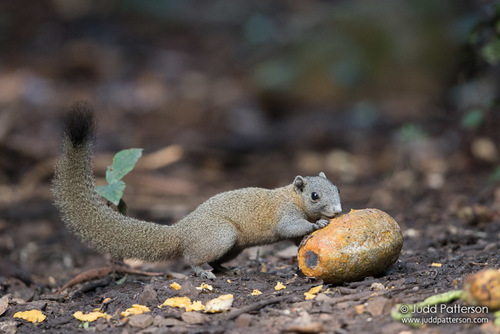
Other species in the genus Callosciurus
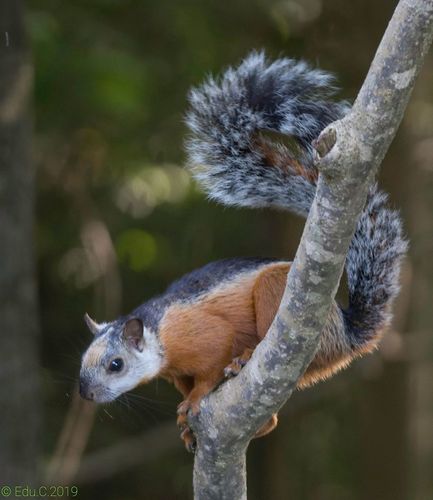
Other species in the family Sciuridae
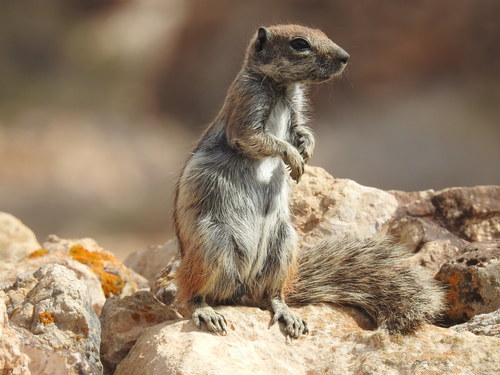
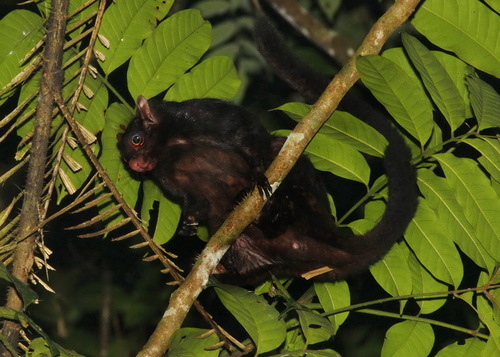
Sources
Conservation status, range description and population estimate come from the IUCN Red List assessment for Callosciurus pygerythrus. Countries are derived from that range description, not from a mapped country list. Last refreshed on .
The distribution map is drawn from the IUCN Red List spatial data compiled in 2008. IUCN (International Union for Conservation of Nature)