
Olrog's Pericote
Andalgalomys olrogi
Red List assessment
Least Concernon the IUCN Red List
- EXExtinct
- EWExtinct in the Wild
- CRCritically Endangered
- ENEndangered
- VUVulnerable
- NTNear Threatened
- LCLeast Concern
The Olrog's Pericote is recorded in one country, Argentina across South America. The IUCN Red List assesses the Olrog's Pericote as Least Concern. No precise global population estimate is available; the species is considered locally uncommon to rare based on trapping records, but population trend is presumed stable given the LC status.
- Family
- Cricetidae
- Order
- Rodentia
- Genus
- Andalgalomys
- Countries recorded
- 1
- Continents
- South America
- Red List category
- Least Concern
- Data updated
- August 9, 2026
What is the Olrog's Pericote?
Olrog's Pericote is a small, desert-adapted sigmodontine rodent endemic to the arid Monte desert valleys of northwestern Argentina. It was named in honor of the Argentine naturalist Claes Christian Olrog. It inhabits thorny scrubland and sandy soils where it forages primarily for seeds and plant material. Despite its restricted range and specialized habitat, it is currently classified as Least Concern by the IUCN.
Where does the Olrog's Pericote live?
Northwestern Argentina, primarily in the Monte desert region of Catamarca and La Rioja provinces, with possible occurrence in adjacent Salta and Tucumán provinces.
Endemic to Argentina; known mainly from the provinces of Catamarca and La Rioja in the Monte desert biome, with the type locality near Andalgalá, Catamarca. Possibly extends marginally into Salta and Tucumán provinces.
Altitude and depth
Typically found between 500 and 1,500 m above sea level, within the valley floors and lower slopes of the Andean foothills.
Seasonal movements
No large-scale seasonal migrations reported; activity patterns may shift seasonally in response to temperature extremes and seed availability, but the species is considered year-round resident within its range.
Habitat of the Olrog's Pericote
Primarily arid and semi-arid Monte desert scrubland, characterized by sandy or rocky soils with sparse vegetation dominated by jarilla (Larrea spp.) and other xerophytic shrubs. It also occupies dry thorn-scrub valleys (quebradas) at moderate elevations.
Adaptations to its environment
Pale sandy pelage provides camouflage against the desert substrate. Large eyes support nocturnal vision in low-light conditions. Efficient renal function is presumed to reduce water loss, a common adaptation in Monte desert rodents. Its relatively long hind limbs may assist in rapid locomotion across open sandy terrain.
Conservation status and numbers
Least Concern (LC) on the IUCN Red List. The species has a restricted but apparently stable range with no evidence of a significant population decline. Its specialized habitat in the Monte desert is relatively intact across much of its known range.
Estimated population
No precise global population estimate is available; the species is considered locally uncommon to rare based on trapping records, but population trend is presumed stable given the LC status.
What threatens the Olrog's Pericote?
Potential threats include habitat degradation from livestock overgrazing, agricultural expansion at desert margins, and climate change-driven aridification which could further reduce or fragment suitable habitat. Small mammal trapping for local pest control may also pose a minor risk.
Diseases and parasites
No specific diseases or parasites have been documented for this species. Like other wild rodents in South America, it may harbor hantaviruses and ectoparasites (fleas, mites, ticks), though this has not been confirmed for A. olrogi specifically.
What is being done to protect it?
The species benefits indirectly from general biodiversity protection in some Argentine provincial nature reserves within the Monte desert. Argentina's National Parks Administration provides some framework for small mammal conservation, though no species-specific program targets this rodent.
Recommended actions
Systematic population surveys across the known and potential range are needed. Long-term monitoring of Monte desert ecosystems to detect habitat change is recommended. Inclusion in regional mammal inventories and protection of key scrubland habitats in Catamarca and La Rioja would be beneficial.
What the Olrog's Pericote looks like
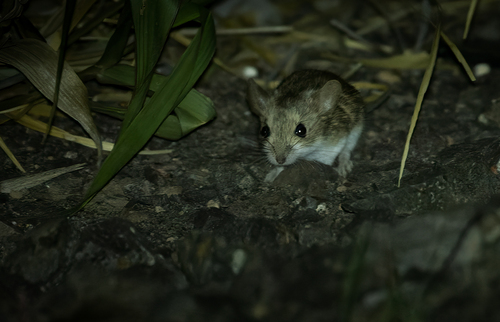
Dorsal fur is pale buff to sandy-ochre, blending well with desert soils. The ventral surface is white or cream. The tail is bicolored, darker above and paler below, and is moderately long. Eyes are large and dark, and ears are relatively prominent and rounded.
Size
Head-body length approximately 80–115 mm; tail length approximately 90–130 mm, roughly equal to or slightly exceeding body length. Hind foot length approximately 22–27 mm.
Weight
Estimated at 20–40 g for adults; no notable sexual dimorphism in body mass has been documented.
Distinctive features
Compared to the closely related Andalgalomys pearsoni, A. olrogi tends to have a more restricted distribution and slightly different cranial proportions. Within the genus, species are distinguished by subtle differences in skull morphology, pelage coloration, and geographic range rather than dramatic external features.
Differences between males and females
Sexual dimorphism is minimal or absent in external morphology, as is typical for small sigmodontine rodents. Males and females are similar in size and coloration.
Behaviour and diet of the Olrog's Pericote
Presumed to be largely solitary outside the breeding season, consistent with most small desert sigmodontines. Home ranges may overlap to some degree. Social structure has not been rigorously studied in the field.
When it is active
Nocturnal; forages at night to avoid daytime heat and predator exposure in the open desert environment. Rests in burrows or dense shrub cover during daylight hours.
Diet
Primarily granivorous (seed-eating), supplemented with plant material such as leaves, stems, and possibly small invertebrates. Seeds from Larrea and other Monte shrubs likely form the dietary staple.
How it feeds and hunts
Forages on the ground, searching under shrubs and in sandy substrate for seeds and plant fragments. May use sensitive vibrissae (whiskers) to detect food items in low-light conditions. No active predation on vertebrates is known.
Communication
Likely uses ultrasonic vocalizations for intraspecific communication (as in most Sigmodontinae), as well as scent marking via urine and glandular secretions to demarcate territories or signal reproductive status.
Interactions with other species
Predated upon by owls (particularly barn owls, Tyto alba, and burrowing owls), small foxes (Pseudalopex spp.), and snakes. Competes for seeds with other granivorous rodents of the Monte desert, including Eligmodontia and Graomys species.
Role in its ecosystem
Functions as a seed predator and potential seed disperser within the Monte desert ecosystem. As prey, it constitutes part of the food web supporting medium-sized carnivores and raptors. Its burrowing activity may contribute to soil aeration.
Reproduction and lifecycle
Reproductive biology is poorly documented. Like other sigmodontines in seasonal desert environments, breeding likely peaks during spring–summer (September–January in the Southern Hemisphere) when plant productivity and seed availability are higher. Litter size is estimated at 2–5 young.
Raising the young
Presumed to follow the typical sigmodontine pattern where the female provides primary parental care in a nest within a burrow. Young are altricial at birth and are weaned after several weeks.
Maturity and lifespan
Sexual maturity is likely reached at approximately 2–3 months of age, as in related small sigmodontines. Lifespan in the wild is estimated at 1–2 years; captive longevity data are not available for this species.
Taxonomy and naming of the Olrog's Pericote
Classification
Mammalia > Rodentia > Cricetidae (Sigmodontinae) > Andalgalomys > Andalgalomys olrogi
Scientific synonyms
Originally described by Williams and Mares (1978); Andalgalomys roigi has been considered by some authors as a closely related or synonymous taxon, but is now generally treated as a distinct species.
What research says
Recent studies
Phylogenetic studies on Phyllotini rodents have helped clarify the systematic relationships of Andalgalomys, confirming it as a distinct genus from Phyllotis and Graomys. Detailed ecological or behavioral studies specifically targeting A. olrogi remain scarce.
Genome and DNA
Specific chromosome number and karyotype for Andalgalomys olrogi have not been widely published. The genus Andalgalomys belongs to the tribe Phyllotini, a group with extensive cytogenetic diversity across its members.
Compared with similar species
Andalgalomys olrogi is most closely related to A. pearsoni (Pearson's Pericote) from Paraguay and Bolivia, and A. roigi from Argentina. All three species share a similar body plan, pale desert coloration, and granivorous habits, but differ in geographic range and minor craniodental characters. The genus Andalgalomys is part of the Phyllotini tribe, related to Phyllotis (leaf-eared mice).
The Olrog's Pericote and people
The genus name Andalgalomys references Andalgalá, a small town in Catamarca where the type specimens were collected, making it one of the few mammal genera named after an Argentine municipality. Like many desert rodents worldwide, Olrog's Pericote likely derives most of its water from the seeds it eats rather than from free-standing water. The species was described scientifically as recently as 1978, highlighting how much of South America's small mammal diversity was still being formally documented in the late 20th century.
Where and how to see it
Best observed at night in the Monte desert scrublands of Catamarca province, Argentina, particularly in the Andalgalá valley region. Live-trapping surveys by researchers using Sherman traps baited with seeds have been the primary means of detection. Amateur naturalists visiting dry quebradas with dense jarilla scrub during the austral spring or summer have the best chance of an encounter.
Risks to humans
No notable risk to humans. Like all wild rodents, it should not be handled without proper precautions due to potential ectoparasites or zoonotic pathogens, but it poses no significant danger.
Countries where the Olrog's Pericote is recorded
The 1 countries named in the range description of its IUCN Red List assessment.
Questions about the Olrog's Pericote
Where does the Olrog's Pericote live?
The Olrog's Pericote is recorded in Argentina across South America. These countries come from the range description of its IUCN Red List assessment, and they are what place the species on the interactive map.
Is the Olrog's Pericote endangered?
The IUCN Red List assesses the Olrog's Pericote as Least Concern. The species is widespread and abundant enough not to qualify for any threatened category. It does not mean the species is safe forever, only that nothing in the current data raises an alarm.
How many are left in the wild?
No precise global population estimate is available; the species is considered locally uncommon to rare based on trapping records, but population trend is presumed stable given the LC status. This figure comes from the species assessment on the IUCN Red List; population estimates for wild mammals are ranges, not counts, and are revised at each assessment.
What habitat does the Olrog's Pericote live in?
Primarily arid and semi-arid Monte desert scrubland, characterized by sandy or rocky soils with sparse vegetation dominated by jarilla (Larrea spp.) and other xerophytic shrubs.
What is the scientific name of the Olrog's Pericote?
The Olrog's Pericote is Andalgalomys olrogi, in the family Cricetidae, order Rodentia.
Other species in the genus Andalgalomys
Other species in the family Cricetidae
Species that share its range
Sources
Conservation status, range description and population estimate come from the IUCN Red List assessment for Andalgalomys olrogi. Countries are derived from that range description, not from a mapped country list. Last refreshed on .
The distribution map is drawn from the IUCN Red List spatial data compiled in 2008. IUCN (International Union for Conservation of Nature)