
Pearson's Chaco Mouse
Andalgalomys pearsoni
Red List assessment
Least Concernon the IUCN Red List
- EXExtinct
- EWExtinct in the Wild
- CRCritically Endangered
- ENEndangered
- VUVulnerable
- NTNear Threatened
- LCLeast Concern
The Pearson's Chaco Mouse is recorded in 3 countries across South America. The IUCN Red List assesses the Pearson's Chaco Mouse as Least Concern. No reliable global population estimate exists.
- Family
- Cricetidae
- Order
- Rodentia
- Genus
- Andalgalomys
- Countries recorded
- 3
- Continents
- South America
- Red List category
- Least Concern
- Data updated
- August 9, 2026
What is the Pearson's Chaco Mouse?
Pearson's Chaco Mouse is a small sigmodontine rodent endemic to the semi-arid Gran Chaco of South America, one of the most threatened tropical dry forests on Earth. It belongs to the genus Andalgalomys, a group of long-tailed, large-eared mice adapted to arid and semi-arid scrublands. Named in honor of the eminent American mammalogist Oliver P. Pearson, it is a rarely encountered and poorly studied species. Its biology closely mirrors that of other Chaco-endemic small mammals, characterized by specialization to harsh, seasonally extreme environments.
Where does the Pearson's Chaco Mouse live?
Primarily found in Paraguay (Gran Chaco region, departments of Boquerón and Presidente Hayes), with possible range extensions into adjacent northwestern Argentina (Formosa province) and southeastern Bolivia.
The confirmed range is largely restricted to the western Paraguayan Chaco (Boquerón and Presidente Hayes departments), with the species possibly occurring in adjacent Formosa and Salta provinces of Argentina and southeastern Bolivia. Its precise range limits remain poorly defined due to limited field surveys in this remote region.
Altitude and depth
Primarily found at low elevations, ranging from approximately 50 to 400 meters above sea level, consistent with the flat, low-lying topography of the Gran Chaco basin.
Seasonal movements
No documented seasonal migrations. Activity patterns and reproduction may be influenced by the Chaco's highly seasonal rainfall (wet season: November–March; dry season: April–October), with possible breeding peaks tied to resource availability after rains.
Habitat of the Pearson's Chaco Mouse
The species inhabits the dry thorn-scrub and xerophytic shrublands of the Gran Chaco, characterized by quebracho trees (Schinopsis and Aspidosperma spp.), cacti, and dense thorny vegetation. It is found in low-lying, seasonally flooded and drought-prone plains with sandy or clay soils. The Chaco experiences extreme temperature swings, with summer heat exceeding 45°C and cold winter nights, demanding strong physiological resilience.
Adaptations to its environment
Like other Chaco rodents, Pearson's Chaco Mouse likely has physiological adaptations for water conservation in the xeric environment, including concentrated urine production. Its large eyes and ears suggest strong nocturnal sensory capabilities suited to predator avoidance. The pale sandy dorsal coloration provides effective camouflage against the dry, light-colored Chaco soils.
Conservation status and numbers
Listed as Least Concern (LC) on the IUCN Red List, as the species is presumed to maintain a sufficiently large and stable population across the Paraguayan Chaco. However, the assessment acknowledges significant data gaps, and ongoing rapid deforestation in the Gran Chaco may warrant future reassessment.
Estimated population
No reliable global population estimate exists. The trend is considered potentially declining due to ongoing habitat loss in the Gran Chaco, though the overall population is currently assumed to be large enough to avoid threatened status.
What threatens the Pearson's Chaco Mouse?
The primary threat is large-scale deforestation driven by soybean agriculture and cattle ranching, which has made the Gran Chaco one of the world's highest deforestation hotspots. Additional threats include habitat fragmentation, desiccation of wetlands, overgrazing, and fire management changes. Climate change may intensify drought cycles, further degrading its habitat.
Diseases and parasites
No specific disease or parasite studies have been published for this species. Sigmodontine rodents in the Gran Chaco are known to serve as reservoirs for hantaviruses and other zoonotic pathogens, which may apply to this species as well.
What is being done to protect it?
The species potentially benefits from protected areas within the Paraguayan Chaco, including the Médanos del Chaco National Park and the Teniente Agripino Enciso National Park. Paraguay's Law 352/94 governs protected areas, and international frameworks such as CITES and CBD indirectly support Chaco biodiversity conservation.
Recommended actions
Priority actions include targeted field surveys to accurately define the distribution and population size, long-term habitat monitoring in the Paraguayan Chaco, strengthening enforcement of existing forest protection laws, and expansion of the protected area network in the Gran Chaco. Inclusion in national biodiversity monitoring programs is also recommended.
What the Pearson's Chaco Mouse looks like
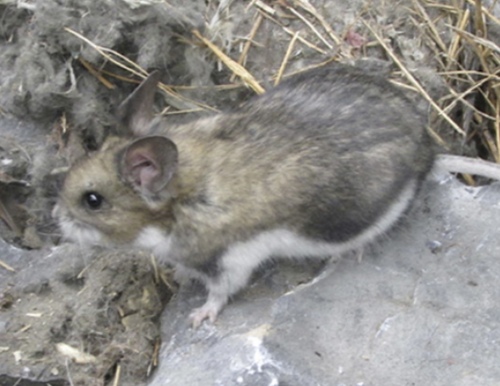
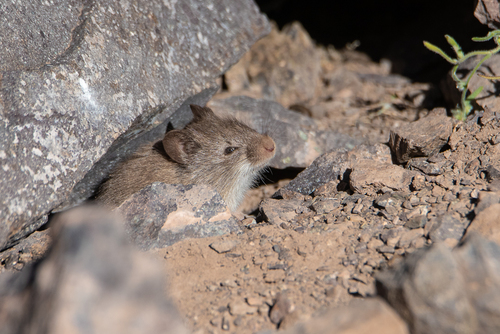
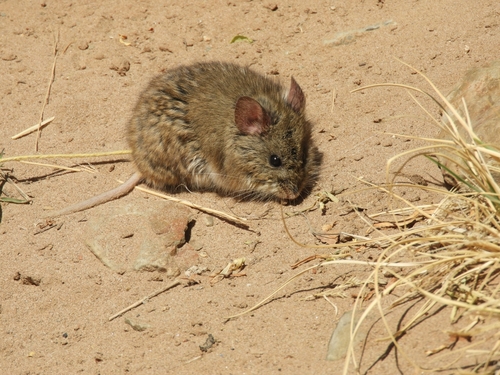
The dorsal fur is pale sandy-brown to ochraceous, blending well with dry Chaco soils and leaf litter. The ventral surface is whitish or pale gray. The tail is long, lightly haired, and bicolored (darker above, paler below). Eyes are relatively large and dark, and ears are moderately large and rounded.
Size
Head-body length approximately 80–105 mm; tail length typically 110–135 mm, exceeding the body length. Hindfoot length approximately 19–23 mm.
Weight
Estimated body mass between 15 and 30 grams, typical of small sigmodontine mice; no documented sexual size dimorphism data available.
Distinctive features
Andalgalomys pearsoni can be distinguished from its congener A. olrogi by subtle cranial and dental morphology differences, as well as slight differences in pelage color and geographic distribution. Its proportionally longer tail and overall paler coloration help distinguish it from sympatric Calomys and Eligmodontia species in the Chaco.
Differences between males and females
No significant sexual dimorphism has been documented in this species; males and females appear similar in size and coloration, as is typical for most small sigmodontine rodents.
Behaviour and diet of the Pearson's Chaco Mouse
Likely solitary outside of breeding season, as is common among small cricetid rodents. No detailed social structure studies are available. Home ranges are probably small and may overlap between individuals, with males potentially having larger ranges than females.
When it is active
Primarily nocturnal, with peak activity occurring during the early and late night hours to avoid the extreme daytime heat of the Gran Chaco. Like most small desert-adapted rodents, it likely rests in burrows or dense vegetation during the day.
Diet
Primarily granivorous, feeding on seeds of Chaco grasses, forbs, and shrubs; likely supplements diet with green plant material, tubers, and opportunistically with arthropods (insects and arachnids) for protein, particularly during the breeding season.
How it feeds and hunts
Forages on the ground using olfactory and vibrissae-guided searching to locate seeds and small invertebrates in leaf litter and soil. May cache seeds in burrows during periods of resource abundance.
Communication
Communication is thought to rely on ultrasonic vocalizations (common in Sigmodontinae), scent marking via urine and glandular secretions to delineate home ranges and signal reproductive status, and tactile communication during social encounters.
Interactions with other species
Natural predators likely include owls (especially barn owls, Tyto alba), snakes (e.g., Bothrops alternatus), and small carnivorous mammals (mustelids, foxes). It may compete with other small granivorous rodents such as Calomys laucha and Eligmodontia typus in shared microhabitats.
Role in its ecosystem
As a granivore, Pearson's Chaco Mouse plays a role in seed dispersal and predation within the Chaco ecosystem, influencing plant community structure. It also serves as prey for higher trophic levels, making it an important link in the Gran Chaco food web.
Reproduction and lifecycle
Breeding biology is poorly documented. Based on related sigmodontine species in the Chaco, gestation is likely around 20–25 days, with litter sizes of 2–5 young. Breeding may peak during or just after the wet season when food resources are most abundant.
Raising the young
Altricial young are presumably cared for by the female in a burrow nest. Weaning likely occurs at around 3 weeks of age, consistent with related species. The paternal role is unknown but likely minimal.
Maturity and lifespan
Sexual maturity is likely reached at approximately 6–8 weeks of age, typical of small sigmodontines. Wild lifespan is estimated at 1–2 years; captive lifespan data are unavailable for this species.
Taxonomy and naming of the Pearson's Chaco Mouse
Classification
Mammalia > Rodentia > Cricetidae (subfamily Sigmodontinae) > Andalgalomys > Andalgalomys pearsoni
Scientific synonyms
No widely recognized taxonomic synonyms; described by Myers and Carleton in 1981. The genus Andalgalomys was established by Williams and Mares in 1978.
What research says
Recent studies
Molecular phylogenetic analyses of Sigmodontinae (e.g., Parada et al., 2013; Salazar-Bravo et al.) have helped clarify the placement of Andalgalomys within the tribe Phyllotini. Broader biodiversity surveys in the Paraguayan Chaco have occasionally documented the species but detailed ecological studies remain absent.
Genome and DNA
The diploid chromosome number has not been specifically confirmed in published literature for A. pearsoni. Phylogenetic studies placing Andalgalomys within the tribe Phyllotini have used both mitochondrial and nuclear DNA markers.
Compared with similar species
Andalgalomys pearsoni is closely related to A. olrogi (Olrog's Chaco Mouse), which has a more restricted range in northwestern Argentina, and A. roigi (Roig's Chaco Mouse). Compared to the similar-looking Calomys species, Andalgalomys has a proportionally longer tail and more specialized cranial morphology. It shares habitat with phyllotine rodents but occupies a slightly distinct ecological niche.
The Pearson's Chaco Mouse and people
The Gran Chaco, home to this mouse, is the second-largest forest in South America after the Amazon and is sometimes called 'the impenetrable' due to its dense thorn scrub. Pearson's Chaco Mouse is so little studied that its entire life history essentially remains a scientific mystery. The genus Andalgalomys is named after Andalgalá, a town in the Catamarca province of Argentina, near where A. olrogi was first collected.
Where and how to see it
The best chance of encountering this species is during nighttime live-trapping surveys in the Paraguayan Chaco, particularly in thorn scrub near the town of Filadelfia or within Médanos del Chaco National Park. The dry season (May–September) is preferable as vegetation is lower and animals may be more concentrated near water sources. Use Sherman or Tomahawk traps baited with rolled oats and peanut butter.
Risks to humans
No notable direct risk to humans. As with other Chaco sigmodontine rodents, there is a theoretical risk of zoonotic pathogen transmission (e.g., hantavirus) through contact with feces or urine, so standard precautions should be taken when handling individuals or working in infested areas.
Countries where the Pearson's Chaco Mouse is recorded
The 3 countries named in the range description of its IUCN Red List assessment.
Questions about the Pearson's Chaco Mouse
Where does the Pearson's Chaco Mouse live?
The Pearson's Chaco Mouse is recorded in Argentina, Bolivia and Paraguay across South America. These countries come from the range description of its IUCN Red List assessment, and they are what place the species on the interactive map.
Is the Pearson's Chaco Mouse endangered?
The IUCN Red List assesses the Pearson's Chaco Mouse as Least Concern. The species is widespread and abundant enough not to qualify for any threatened category. It does not mean the species is safe forever, only that nothing in the current data raises an alarm.
How many are left in the wild?
No reliable global population estimate exists. This figure comes from the species assessment on the IUCN Red List; population estimates for wild mammals are ranges, not counts, and are revised at each assessment.
What habitat does the Pearson's Chaco Mouse live in?
The species inhabits the dry thorn-scrub and xerophytic shrublands of the Gran Chaco, characterized by quebracho trees (Schinopsis and Aspidosperma spp.), cacti, and dense thorny vegetation.
What is the scientific name of the Pearson's Chaco Mouse?
The Pearson's Chaco Mouse is Andalgalomys pearsoni, in the family Cricetidae, order Rodentia.
Other species in the genus Andalgalomys
Other species in the family Cricetidae
Species that share its range

Sources
Conservation status, range description and population estimate come from the IUCN Red List assessment for Andalgalomys pearsoni. Countries are derived from that range description, not from a mapped country list. Last refreshed on .
The distribution map is drawn from the IUCN Red List spatial data compiled in 2008. IUCN (International Union for Conservation of Nature)