
Olive Montane Mouse
Aepeomys lugens
Red List assessment
Least Concernon the IUCN Red List
- EXExtinct
- EWExtinct in the Wild
- CRCritically Endangered
- ENEndangered
- VUVulnerable
- NTNear Threatened
- LCLeast Concern
The Olive Montane Mouse is recorded in 2 countries across South America. The IUCN Red List assesses the Olive Montane Mouse as Least Concern. No precise global population estimate exists.
- Family
- Cricetidae
- Order
- Rodentia
- Genus
- Aepeomys
- Countries recorded
- 2
- Continents
- South America
- Red List category
- Least Concern
- Data updated
- August 9, 2026
What is the Olive Montane Mouse?
Aepeomys lugens is a small sigmodontine rodent endemic to the high-altitude zones of the Venezuelan Andes, with a possible range extension into Colombia. It inhabits montane cloud forests and páramo shrublands, making it well adapted to cold, mist-laden environments. The species is named lugens (Latin: 'mournful' or 'dusky') in reference to its subdued olive-brown pelage. It is notable as one of only a handful of species within the specialized Andean genus Aepeomys, whose members are rarely observed and remain poorly studied.
Where does the Olive Montane Mouse live?
Venezuelan Andes, primarily in Mérida, Táchira, and Trujillo states; possibly extending into adjacent Colombia
Primarily restricted to the Cordillera de Mérida (Venezuelan Andes), including the Sierra Nevada de Mérida and adjacent ranges in Mérida, Táchira, Trujillo, and Barinas states, Venezuela. Its presence in the Eastern Andes of Colombia is suspected but insufficiently documented.
Altitude and depth
Typically found between approximately 2,000 and 3,600 m above sea level, with highest densities reported around 2,400–3,200 m in the cloud forest–páramo transition zone.
Seasonal movements
No pronounced seasonal migration is known. Activity patterns may shift slightly with wet and dry season cycles influencing food availability, but the species is considered resident year-round in its altitudinal zone.
Habitat of the Olive Montane Mouse
Montane cloud forests and transitional zones between upper cloud forest and open páramo grasslands. It favors dense vegetation with abundant leaf litter, mossy ground cover, and tangled shrubs at treeline ecotones, where shelter and food resources are concentrated.
Adaptations to its environment
Its dense, soft pelage provides insulation against the cold and moist conditions of high Andean environments. Relatively broad hind feet aid in locomotion over uneven, moss-covered substrate. Like other sigmodontines at altitude, it likely has physiological adaptations for low-oxygen environments, including elevated blood oxygen affinity.
Conservation status and numbers
Least Concern (LC) on the IUCN Red List. The species occupies a restricted geographic range but is found within several protected areas, and no evidence of rapid population decline has been documented. Its specialized habitat does make it inherently vulnerable to long-term climate shifts.
Estimated population
No precise global population estimate exists. The population is considered stable at present, though likely naturally small given the species' restricted elevational and geographic range.
What threatens the Olive Montane Mouse?
Habitat degradation through agricultural encroachment (particularly potato cultivation and livestock grazing) into high-altitude zones represents the primary threat. Climate change is increasingly a concern, as upward shifts in the treeline and páramo boundary may compress or fragment available habitat. Introduced predators such as cats and rats may also pose localized pressure.
Diseases and parasites
No specific diseases or parasites have been documented for this species in the literature. Like other wild rodents, it is likely host to ectoparasites (mites, fleas, ticks) and endoparasites (nematodes, cestodes) typical of Neotropical small mammals.
What is being done to protect it?
The species benefits from its presence within the Sierra Nevada de Mérida National Park and the Sierra de la Culata National Park in Venezuela, both of which provide significant habitat protection. No species-specific conservation programs are known to exist.
Recommended actions
Systematic surveys are needed to clarify the full extent of the species' range, especially in Colombia. Long-term monitoring programs should be established to detect population trends. Strengthening enforcement of protected area boundaries and limiting agricultural expansion above 2,000 m would be beneficial.
What the Olive Montane Mouse looks like
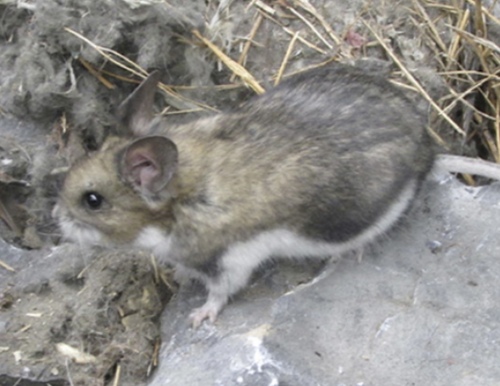
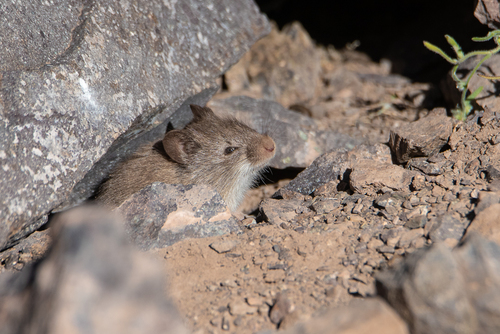
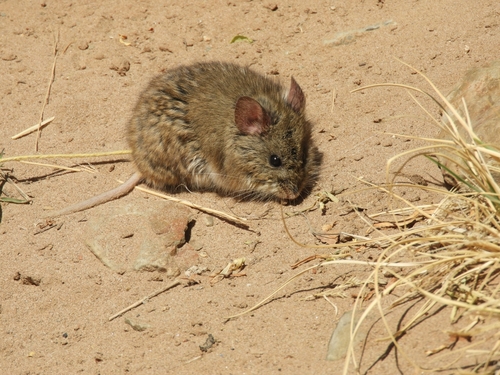
Dorsal fur is olive-brown to dusky brownish-gray, giving the species its common name. The ventral surface is paler, typically grayish-white or cream. The tail is bicolored (darker above, paler below), moderately haired, and not notably long relative to body size. Eyes are moderately large and dark.
Size
Head-body length approximately 80–115 mm; tail length approximately 85–110 mm (roughly equal to or slightly shorter than head-body length). A small, compact rodent.
Weight
Estimated body weight 20–40 g; no significant published data on sexual weight dimorphism.
Distinctive features
Distinguished from the related Aepeomys reigi by its generally lower altitudinal range, slightly different fur coloration, and cranial proportions. Differs from sympatric Thomasomys species by the shorter, less distinctly scaled tail and more compact skull morphology characteristic of Aepeomys.
Differences between males and females
Sexual dimorphism is considered minimal, as is typical for sigmodontine rodents of this size. Males and females are essentially similar in external appearance and size.
Behaviour and diet of the Olive Montane Mouse
Presumed to be largely solitary outside of the breeding season, consistent with the behavior of most small Andean sigmodontine mice. Home ranges are likely small, overlapping only moderately between individuals.
When it is active
Primarily nocturnal and possibly crepuscular. Activity is concentrated during the night hours when predation risk from diurnal raptors is reduced; daytime is spent resting in burrows or under dense vegetation and root systems.
Diet
Omnivorous, with a diet likely consisting of seeds, fruits, fungi, invertebrates (insects, earthworms), and plant material including roots and green shoots. The balance between plant and animal matter probably varies seasonally with availability in the high-altitude environment.
How it feeds and hunts
Forages opportunistically by searching through leaf litter, mossy substrate, and low vegetation. Small invertebrates are likely captured by pouncing or rapid pursuit at close range. Olfaction is likely the primary sense used in locating food items under dense ground cover.
Communication
Likely communicates through ultrasonic vocalizations (common in sigmodontines), scent marking via urine and glandular secretions, and tactile contact during social interactions. Alarm or distress calls may be produced when threatened.
Interactions with other species
Natural predators likely include small Andean owls (e.g., Glaucidium jardinii), diurnal raptors, Andean foxes (Lycalopex culpaeus), and mustelids. It may compete for resources with other sympatric small rodents such as Thomasomys species. Its role as a prey species is an important link in the high-altitude food web.
Role in its ecosystem
As a small omnivore, it contributes to seed dispersal and fungal spore dispersal in montane ecosystems. It also serves as a prey base for higher-order consumers, making it an important component of Andean cloud forest and páramo food webs.
Reproduction and lifecycle
Reproductive details are poorly documented for this species. Based on related Andean sigmodontines, breeding likely occurs year-round or peaks in the wet season when food resources are abundant. Gestation is estimated at 21–23 days, with litter sizes of 2–5 pups.
Raising the young
As with other small rodents, the female is likely the primary caregiver. Pups are born altricial (blind, hairless) and weaned at approximately 3–4 weeks. The male's parental involvement is unknown but suspected to be minimal.
Maturity and lifespan
Sexual maturity is likely reached at 6–8 weeks of age, consistent with related sigmodontines. Lifespan in the wild is estimated at 1–2 years; captive longevity data are not available for this species.
Taxonomy and naming of the Olive Montane Mouse
Classification
Mammalia > Rodentia > Cricetidae (subfamily Sigmodontinae) > Aepeomys > Aepeomys lugens (Bangs, 1900)
Scientific synonyms
Oryzomys lugens Bangs, 1900; previously placed in Thomasomys by some authors before generic revision.
What research says
Recent studies
Molecular phylogenetic studies of the tribe Thomasomyini (e.g., D'Elía and colleagues) have helped clarify the systematic position of Aepeomys within Sigmodontinae. Taxonomic revisions in the early 2000s confirmed the validity of the genus Aepeomys as distinct from Thomasomys based on morphological and genetic evidence.
Genome and DNA
Chromosome number has not been definitively published for Aepeomys lugens specifically. The broader genus Aepeomys belongs to a clade of Andean sigmodontines, and phylogenetic studies have placed it close to Thomasomys and Chilomys within tribe Thomasomyini.
Compared with similar species
Aepeomys lugens is closely related to A. reigi, which tends to occur at slightly higher elevations and was described more recently (1980). Both differ from the Brazilian A. paulacoutoi in geographic range and some cranial characteristics. The genus Aepeomys as a whole is distinguished from the much larger and more diverse genus Thomasomys by specific dental and cranial features.
The Olive Montane Mouse and people
Despite its small size, the Olive Montane Mouse thrives in one of South America's most challenging environments — the cold, oxygen-thin Andean páramo, where nighttime temperatures regularly drop near freezing. The genus Aepeomys is so poorly known that new specimens are rarely collected, making each museum record scientifically valuable. Its Latin species name lugens ('mournful') was likely inspired by its somber, dusky olive coloration rather than any melancholy behavior.
Where and how to see it
The best chance of encountering this species is in the cloud forest–páramo transition zone of the Sierra Nevada de Mérida or Sierra de la Culata National Parks in Venezuela. Sherman live traps placed along vegetation edges or near streams at night offer the most reliable detection method. Citizen science observations at these elevations during the wet season (April–October) may also yield sightings.
Risks to humans
No notable risk to humans. Like all wild rodents, it may carry zoonotic pathogens, so handling should be done with gloves and appropriate precautions. It does not bite aggressively unless cornered.
Countries where the Olive Montane Mouse is recorded
The 2 countries named in the range description of its IUCN Red List assessment.
Questions about the Olive Montane Mouse
Where does the Olive Montane Mouse live?
The Olive Montane Mouse is recorded in Colombia and Venezuela across South America. These countries come from the range description of its IUCN Red List assessment, and they are what place the species on the interactive map.
Is the Olive Montane Mouse endangered?
The IUCN Red List assesses the Olive Montane Mouse as Least Concern. The species is widespread and abundant enough not to qualify for any threatened category. It does not mean the species is safe forever, only that nothing in the current data raises an alarm.
How many are left in the wild?
No precise global population estimate exists. This figure comes from the species assessment on the IUCN Red List; population estimates for wild mammals are ranges, not counts, and are revised at each assessment.
What habitat does the Olive Montane Mouse live in?
Montane cloud forests and transitional zones between upper cloud forest and open páramo grasslands.
What is the scientific name of the Olive Montane Mouse?
The Olive Montane Mouse is Aepeomys lugens, in the family Cricetidae, order Rodentia.
Other species in the genus Aepeomys
Other species in the family Cricetidae
Species that share its range

Sources
Conservation status, range description and population estimate come from the IUCN Red List assessment for Aepeomys lugens. Countries are derived from that range description, not from a mapped country list. Last refreshed on .
The distribution map is drawn from the IUCN Red List spatial data compiled in 2008. IUCN (International Union for Conservation of Nature)