
Northern Grass Mouse
Necromys urichi
Red List assessment
Least Concernon the IUCN Red List
- EXExtinct
- EWExtinct in the Wild
- CRCritically Endangered
- ENEndangered
- VUVulnerable
- NTNear Threatened
- LCLeast Concern
The Northern Grass Mouse is recorded in 3 countries across North America and South America. The IUCN Red List assesses the Northern Grass Mouse as Least Concern. No precise global population estimate is available; the species is considered locally common within suitable habitats and the overall population trend is presumed stable.
- Family
- Cricetidae
- Order
- Rodentia
- Genus
- Necromys
- Countries recorded
- 3
- Continents
- North America and South America
- Red List category
- Least Concern
- Data updated
- August 9, 2026
What is the Northern Grass Mouse?
Necromys urichi is a small, terrestrial sigmodontine rodent endemic to the northern rim of South America and the nearby island of Trinidad. It inhabits open grassy landscapes, savannas, and forest edges, making it well adapted to disturbed and seasonal environments. As one of the northernmost representatives of its genus, it is of particular biogeographic interest, representing an isolated population of a lineage more broadly distributed across central and southern South America. The species was first formally described from Trinidad by J.A. Allen in 1899, and is named in honor of the Trinidadian naturalist F.W. Urich.
Where does the Northern Grass Mouse live?
Northern Venezuela, Trinidad and Tobago, and parts of northeastern Colombia; associated with the Llanos and adjacent lowland grasslands of northern South America
The species is known from northern Venezuela (including the Llanos lowlands and coastal cordillera foothills), the island of Trinidad (Trinidad and Tobago), and possibly extends into northeastern Colombia. Its range is limited to the northernmost zone of South America and the adjacent southern Caribbean.
Altitude and depth
Typically found from sea level to approximately 800 m elevation; most records are from lowland areas below 500 m, especially within the flat Llanos basin and coastal plain environments.
Seasonal movements
No long-distance migrations are recorded. However, in the Llanos region, activity and population densities may fluctuate with the pronounced wet and dry seasons; during flooding of the Llanos, individuals likely retreat to higher ground. Breeding may intensify during or after the wet season when food resources are most abundant.
Habitat of the Northern Grass Mouse
The Northern Grass Mouse primarily occupies lowland tropical grasslands, savannas, gallery forest edges, and shrubby open areas. It is closely associated with dense grass cover for both foraging and shelter, and is also found in disturbed habitats such as agricultural margins and roadsides. The seasonally flooded Llanos of Venezuela represent a key mainland habitat.
Adaptations to its environment
Like other Necromys species, N. urichi has robust hindlimbs suited for rapid movement through dense grass and open ground. Its coarse, bristly fur may provide camouflage among dry grasses and resist ectoparasite attachment. Physiologically, it tolerates high ambient temperatures and seasonal resource scarcity typical of tropical savannas.
Conservation status and numbers
Least Concern (LC) on the IUCN Red List. The species has a relatively stable population with no evidence of rapid decline, benefits from tolerance of disturbed habitats, and is present in multiple protected areas across its range. No immediate major threats are identified that would warrant a more threatened status.
Estimated population
No precise global population estimate is available; the species is considered locally common within suitable habitats and the overall population trend is presumed stable. Density fluctuates seasonally in the Llanos.
What threatens the Northern Grass Mouse?
Habitat conversion for agriculture and cattle ranching in the Venezuelan Llanos poses a long-term threat. Urban expansion around Trinidad and coastal Venezuela also reduces available grassland habitat. Introduced predators (cats, rats) on Trinidad may exert localized pressure on island populations.
Diseases and parasites
Like other Necromys species, it likely serves as a reservoir host for hantaviruses (genus Orthohantavirus), which are associated with multiple South American rodent species; however, specific serological data for N. urichi are limited. Ectoparasites including fleas (Siphonaptera), ticks (Ixodidae), and mites (Gamasida) have been recorded on related Necromys species and are expected to occur on N. urichi.
What is being done to protect it?
The species occurs within protected areas in Venezuela such as the Hatos (private nature reserves) of the Llanos and in parts of the Northern Range forests of Trinidad. It is listed on Appendix III and enjoys nominal protection under Venezuelan wildlife legislation. No species-specific conservation programs are currently in place.
Recommended actions
Long-term population monitoring across Venezuela and Trinidad is recommended to detect any decline. Preservation of lowland grassland corridors in the Llanos and management of invasive species on Trinidad would benefit this and many co-occurring small mammal species. Taxonomic and genetic surveys are needed to clarify the full extent of the species' range and possible cryptic diversity.
What the Northern Grass Mouse looks like
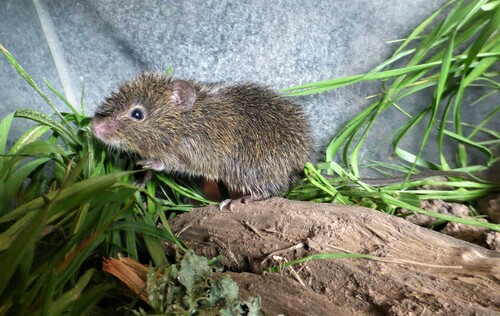
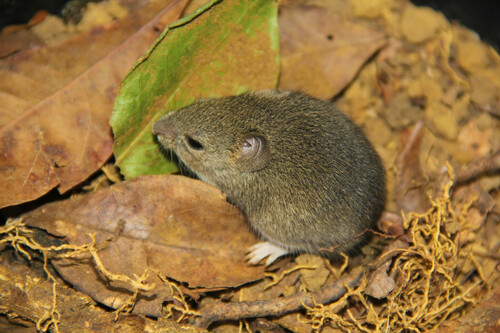
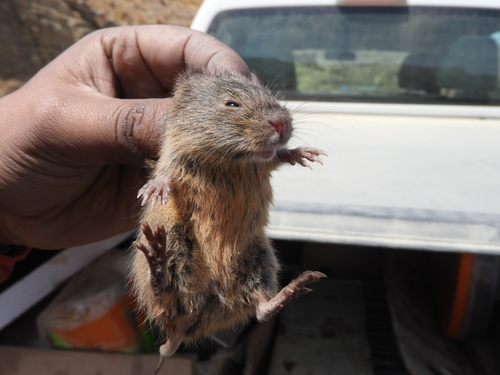
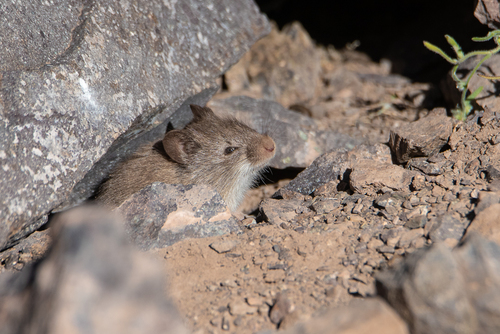
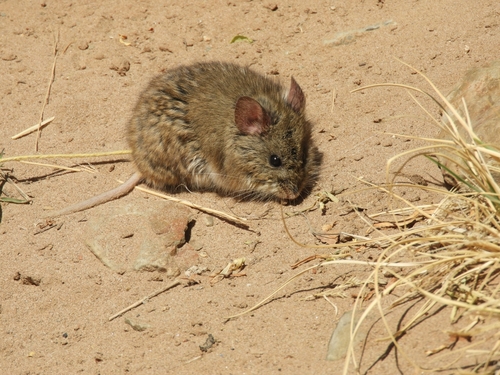
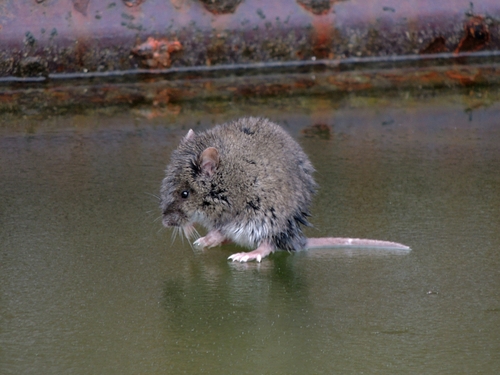
The dorsal pelage is coarse and somewhat bristly, grizzled brownish-gray to ochraceous-brown, often with darker mid-dorsal streaking produced by black-tipped guard hairs. The venter is pale grayish-white to buff. The tail is bicolored (darker above, paler below), sparsely haired, and scaly. The ears are moderately large and rounded.
Size
Head-body length approximately 85–120 mm; tail length approximately 70–100 mm (roughly 80–90% of head-body length); hind foot length 20–25 mm.
Weight
Approximately 20–45 g; no significant documented sexual size dimorphism, though males may average marginally heavier.
Distinctive features
Compared to the sympatric Oligoryzomys and Zygodontomys species, N. urichi has notably coarser, more bristly fur and a relatively shorter tail. It can be distinguished from the closely related Necromys lasiurus (found further south in Brazil) by its slightly smaller size, paler ventral coloration, and more northerly geographic distribution. The dental formula and molar morphology follow the typical Necromys pattern with laminar lophed molars.
Differences between males and females
Sexual dimorphism is minimal in this species; males and females are essentially similar in size and coloration. Females have three pairs of mammae.
Behaviour and diet of the Northern Grass Mouse
Largely solitary outside of the breeding season, with individuals maintaining small home ranges within grassland territories. Brief social interactions occur during mating. No complex social hierarchy is documented.
When it is active
Primarily nocturnal and crepuscular, with peak activity occurring in the first few hours after dusk and before dawn. During the day, individuals rest in burrows or dense grass tussocks. Occasional diurnal foraging has been observed in areas of low predation pressure.
Diet
Omnivorous; the diet consists primarily of seeds, grasses, and other plant material, supplemented with arthropods (beetles, grasshoppers, insect larvae) and occasionally small invertebrates. Seeds from grasses and forbs constitute the dietary staple, particularly during the dry season when invertebrate prey is scarcer.
How it feeds and hunts
Forages by moving through grass runways, using olfactory cues to locate seeds and invertebrates on or just below the soil surface. Arthropods may be actively pursued and subdued with the incisors. No caching behavior has been formally documented.
Communication
Communication includes ultrasonic vocalizations used between mother and pups, and possibly during mating encounters. Scent marking via urine and specialized flank glands demarcates home ranges and signals reproductive status. Tail and body postures convey threat and submission during conspecific encounters.
Interactions with other species
Predators include owls (especially Barn Owl, Tyto alba), snakes (Bothrops species, Boa constrictor), and small carnivores such as ocelots and weasels. It competes with sympatric small rodents (Zygodontomys brevicauda, Oligoryzomys spp.) for seeds and invertebrate prey. It may serve as a host for bot flies (Cuterebra spp.) and various ectoparasites.
Role in its ecosystem
As a seed consumer and invertebrate predator, N. urichi plays a role in seed dispersal and invertebrate population regulation within savanna ecosystems. It is an important prey item for raptors and snakes, forming a key link in the savanna food web. Its burrowing activity contributes modestly to soil aeration.
Reproduction and lifecycle
Breeding appears to occur year-round in Trinidad, with peaks correlated with rainy season resource pulses; in Venezuela it may be more seasonal. Gestation is approximately 20–23 days (estimated from related species). Litter size ranges from 3 to 6 pups. Females may produce multiple litters per year.
Raising the young
Altricial pups are born hairless and with eyes closed. The mother provides all direct parental care; pups are nursed in a grass-lined burrow nest and weaned at approximately 14–21 days. The male plays no documented role in pup rearing.
Maturity and lifespan
Sexual maturity is reached at approximately 6–8 weeks of age, consistent with other small sigmodontine rodents. Wild lifespan is typically 12–24 months due to high predation pressure; captive individuals of related species have survived up to 3 years.
Taxonomy and naming of the Northern Grass Mouse
Classification
Mammalia > Rodentia > Cricetidae > Necromys > Necromys urichi
Scientific synonyms
Formerly classified as Bolomys urichi (Tate, 1932) and Akodon urichi J.A. Allen, 1899; the genus Necromys was resurrected from synonymy with Bolomys following phylogenetic revisions in the early 2000s.
What research says
Recent studies
Phylogeographic studies of sigmodontine rodents in northern South America have highlighted N. urichi as a biogeographically significant species bridging the Trinidadian and mainland South American small mammal faunas. Morphological and molecular reassessments in the 2000s–2010s confirmed its placement in the resurrected genus Necromys rather than Bolomys or Akodon.
Genome and DNA
Chromosome number reported as 2n = 34 for Necromys urichi, consistent with other members of the genus. Phylogenetic studies using cytochrome b and nuclear gene sequences confirmed the placement of N. urichi within the Necromys clade and its closest affinities to other northern South American grass mice.
Compared with similar species
Necromys urichi is most closely related to other species within the Necromys genus, particularly N. lasiurus (Hairy-tailed Bolo Mouse) of Brazil and N. amoenus of Peru and Bolivia. Unlike the more southerly N. lasiurus, which has a distinctly hairy tail, N. urichi has a more sparsely haired tail and occurs exclusively in the northern Neotropics. It broadly resembles Zygodontomys brevicauda (Short-tailed Cane Mouse), with which it is sympatric, but can be distinguished by its coarser fur and shorter tail.
The Northern Grass Mouse and people
The species is named for Felix Walter Urich (1873–1936), a celebrated Trinidadian entomologist and naturalist who contributed broadly to the documentation of Trinidad's fauna, making this mouse a tribute to amateur natural history. Despite being called the 'Northern Grass Mouse,' N. urichi is actually capable of swimming across flooded grasslands during Llanos inundation events, showing remarkable adaptability. It is one of the very few endemic or near-endemic small rodents to appear on both a Caribbean island (Trinidad) and the South American mainland, reflecting the relatively recent geological connection between Trinidad and Venezuela.
Where and how to see it
The best opportunities to observe N. urichi are at dusk and dawn in open savanna habitats of the Venezuelan Llanos, particularly in protected ranching estates (Hatos) such as Hato El Cedral or Hato Piñero, where small mammal diversity is high. In Trinidad, grassland margins of the Nariva Swamp and the Caroni Plains offer potential sighting opportunities. Sherman live traps set along grass-runway trails at the edges of grassland patches are the most effective method used by researchers.
Risks to humans
As a potential reservoir of hantavirus and other zoonotic pathogens common to South American rodents, direct handling should be avoided by non-specialists. It is not aggressive and does not represent a direct physical threat to humans. Standard rodent-handling precautions (gloves, respiratory protection) are recommended for researchers.
Human uses
No significant direct use by humans is recorded. It is occasionally captured incidentally in live-trap studies by wildlife biologists and has served as a subject in mammalogical surveys of northern South American rodent communities. No traditional medicinal use or commercial trade is documented.
Countries where the Northern Grass Mouse is recorded
The 3 countries named in the range description of its IUCN Red List assessment.
Questions about the Northern Grass Mouse
Where does the Northern Grass Mouse live?
The Northern Grass Mouse is recorded in Colombia, Trinidad & Tobago and Venezuela across North America and South America. These countries come from the range description of its IUCN Red List assessment, and they are what place the species on the interactive map.
Is the Northern Grass Mouse endangered?
The IUCN Red List assesses the Northern Grass Mouse as Least Concern. The species is widespread and abundant enough not to qualify for any threatened category. It does not mean the species is safe forever, only that nothing in the current data raises an alarm.
How many are left in the wild?
No precise global population estimate is available; the species is considered locally common within suitable habitats and the overall population trend is presumed stable. This figure comes from the species assessment on the IUCN Red List; population estimates for wild mammals are ranges, not counts, and are revised at each assessment.
What habitat does the Northern Grass Mouse live in?
The Northern Grass Mouse primarily occupies lowland tropical grasslands, savannas, gallery forest edges, and shrubby open areas.
What is the scientific name of the Northern Grass Mouse?
The Northern Grass Mouse is Necromys urichi, in the family Cricetidae, order Rodentia.
Other species in the genus Necromys
Other species in the family Cricetidae
Sources
Conservation status, range description and population estimate come from the IUCN Red List assessment for Necromys urichi. Countries are derived from that range description, not from a mapped country list. Last refreshed on .
The distribution map is drawn from the IUCN Red List spatial data compiled in 2008. IUCN (International Union for Conservation of Nature)