
Dark Bolo Mouse
Necromys obscurus
Red List assessment
Least Concernon the IUCN Red List
- EXExtinct
- EWExtinct in the Wild
- CRCritically Endangered
- ENEndangered
- VUVulnerable
- NTNear Threatened
- LCLeast Concern
The Dark Bolo Mouse is recorded in 2 countries across South America. The IUCN Red List assesses the Dark Bolo Mouse as Least Concern. No precise global population estimate exists, but the species is considered common and abundant throughout its range with a stable trend.
- Family
- Cricetidae
- Order
- Rodentia
- Genus
- Necromys
- Countries recorded
- 2
- Continents
- South America
- Red List category
- Least Concern
- Data updated
- August 9, 2026
What is the Dark Bolo Mouse?
The Dark Bolo Mouse is a small sigmodontine rodent native to the temperate grasslands of southern South America. It is a common, abundant species in the Pampas ecoregion, playing an important role in grassland food webs. Its cryptic, dark brown coloration provides camouflage in dense grass and agricultural fields, and it is one of the more frequently trapped small mammals in regional ecological studies.
Where does the Dark Bolo Mouse live?
Central Argentina and Uruguay, primarily within the Pampas grassland region
Found in central and eastern Argentina (Buenos Aires, La Pampa, Córdoba, Santa Fe provinces) and extending into Uruguay; distribution is closely tied to the Pampas biome.
Altitude and depth
Generally found at low elevations, from sea level up to approximately 500 meters.
Seasonal movements
No true hibernation; activity and reproductive output increase during warmer months (spring-summer) and decrease during colder, drier periods.
Habitat of the Dark Bolo Mouse
Inhabits open grasslands, pampas, agricultural fields, pastures, and grassy margins of crops; prefers areas with dense herbaceous cover for shelter from predators.
Adaptations to its environment
Possesses a compact body and short limbs suited for moving through dense grass tussocks; dark pelage aids in camouflage against soil and shadowed vegetation, and burrowing behavior provides protection from predators and temperature extremes.
Conservation status and numbers
Listed as Least Concern by the IUCN due to its wide distribution, adaptability to agricultural landscapes, and presumed large stable population.
Estimated population
No precise global population estimate exists, but the species is considered common and abundant throughout its range with a stable trend.
What threatens the Dark Bolo Mouse?
Intensive agriculture and pesticide use can locally reduce populations, though the species tolerates disturbed habitats relatively well; habitat homogenization from monoculture farming is a moderate concern.
Diseases and parasites
Known to host various ectoparasites (mites, fleas) and endoparasites common to sigmodontine rodents, and has been studied as a potential reservoir for hantaviruses in the region.
What is being done to protect it?
No specific conservation programs target this species directly, as it is not threatened; general grassland conservation initiatives in the Pampas indirectly benefit its habitat.
Recommended actions
Continued monitoring of agricultural intensification impacts and preservation of natural grassland patches within farmland mosaics would help maintain healthy populations.
What the Dark Bolo Mouse looks like
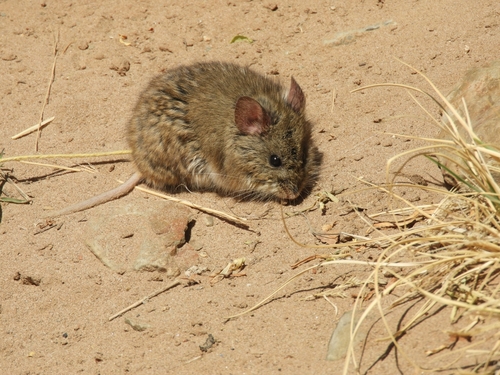
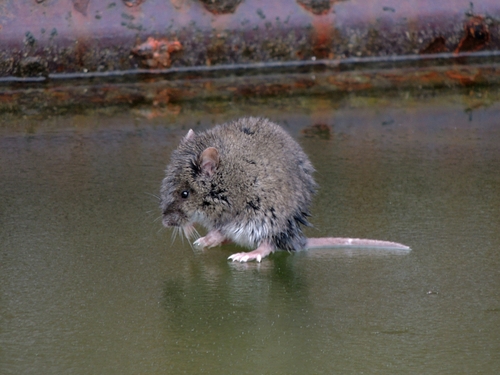
The fur is dark brown to blackish-brown dorsally, with slightly paler grayish underparts; the tail is bicolored and sparsely haired, and the eyes and ears are relatively small.
Size
Head-body length typically ranges from 8 to 11 cm, with a tail slightly shorter than the body, around 6 to 9 cm.
Weight
Adults typically weigh between 20 and 40 grams.
Distinctive features
Distinguished from related Necromys species by its notably darker overall pelage coloration and specific cranial measurements used in taxonomic identification.
Differences between males and females
Minimal sexual dimorphism; males and females are similar in size and coloration, with only slight average size differences.
Behaviour and diet of the Dark Bolo Mouse
Generally solitary or found in loose, low-density populations, though home ranges can overlap; not known to form complex social structures.
When it is active
Primarily nocturnal and crepuscular, being most active during dusk, dawn, and nighttime hours to avoid predators and daytime heat.
Diet
Omnivorous, feeding on seeds, grasses, herbaceous vegetation, and invertebrates such as insects when available.
How it feeds and hunts
Forages opportunistically on the ground among grass and leaf litter, using scent and tactile cues to locate seeds and small invertebrates.
Communication
Communicates primarily through olfactory cues such as scent marking, along with tactile and some vocal signals typical of small rodents.
Interactions with other species
Preyed upon by owls, foxes, and other small carnivores; competes with other sympatric sigmodontine rodents for food and habitat resources.
Role in its ecosystem
Serves as an important prey species in grassland ecosystems and contributes to seed dispersal and soil aeration through its burrowing activities.
Reproduction and lifecycle
Breeding occurs mainly during warmer months (spring through early autumn); gestation lasts approximately 21-23 days, with litters typically consisting of 3 to 6 pups.
Raising the young
Females provide sole parental care, nursing and protecting the altricial young in nest burrows until weaning, which occurs after a few weeks.
Maturity and lifespan
Reaches sexual maturity at around 2-3 months of age; lifespan in the wild is typically short, around 1 year, due to high predation pressure.
Taxonomy and naming of the Dark Bolo Mouse
Classification
Mammalia > Rodentia > Cricetidae > Necromys > Necromys obscurus
Scientific synonyms
Bolomys obscurus (former genus placement)
What research says
Recent studies
Recent regional studies have focused on its role as a potential hantavirus reservoir and its population dynamics in agricultural versus natural grassland habitats.
Genome and DNA
Chromosome number and genetic studies are limited but karyotype data exist within broader Sigmodontinae phylogenetic research.
Compared with similar species
Similar to other Necromys species such as Necromys lasiurus, but distinguished by darker pelage and geographic range restricted to the southern Pampas region.
The Dark Bolo Mouse and people
Despite its small size, this species is one of the most commonly captured small mammals in Pampas grassland surveys; its dark coloration makes it notably harder to spot than related paler rodent species.
Where and how to see it
Best observed through live-trapping surveys in grassland or agricultural field margins during dusk or nighttime hours in the Pampas region of Argentina or Uruguay.
Risks to humans
No notable risk, though as with many rodents, indirect disease transmission (e.g., hantavirus) is a minor public health consideration in areas of high rodent density.
Countries where the Dark Bolo Mouse is recorded
The 2 countries named in the range description of its IUCN Red List assessment.
Questions about the Dark Bolo Mouse
Where does the Dark Bolo Mouse live?
The Dark Bolo Mouse is recorded in Argentina and Uruguay across South America. These countries come from the range description of its IUCN Red List assessment, and they are what place the species on the interactive map.
Is the Dark Bolo Mouse endangered?
The IUCN Red List assesses the Dark Bolo Mouse as Least Concern. The species is widespread and abundant enough not to qualify for any threatened category. It does not mean the species is safe forever, only that nothing in the current data raises an alarm.
How many are left in the wild?
No precise global population estimate exists, but the species is considered common and abundant throughout its range with a stable trend. This figure comes from the species assessment on the IUCN Red List; population estimates for wild mammals are ranges, not counts, and are revised at each assessment.
What habitat does the Dark Bolo Mouse live in?
Inhabits open grasslands, pampas, agricultural fields, pastures, and grassy margins of crops; prefers areas with dense herbaceous cover for shelter from predators.
What is the scientific name of the Dark Bolo Mouse?
The Dark Bolo Mouse is Necromys obscurus, in the family Cricetidae, order Rodentia.
Other species in the genus Necromys
Other species in the family Cricetidae
Sources
Conservation status, range description and population estimate come from the IUCN Red List assessment for Necromys obscurus. Countries are derived from that range description, not from a mapped country list. Last refreshed on .
The distribution map is drawn from the IUCN Red List spatial data compiled in 2019. IUCN SSC Small Mammal Specialist Group