
Pleasant Bolo Mouse
Necromys amoenus
Red List assessment
Least Concernon the IUCN Red List
- EXExtinct
- EWExtinct in the Wild
- CRCritically Endangered
- ENEndangered
- VUVulnerable
- NTNear Threatened
- LCLeast Concern
The Pleasant Bolo Mouse is recorded in 2 countries across South America. The IUCN Red List assesses the Pleasant Bolo Mouse as Least Concern. No precise global population estimate exists, but the species is considered common and stable within its range based on trapping surveys.
- Family
- Cricetidae
- Order
- Rodentia
- Genus
- Necromys
- Countries recorded
- 2
- Continents
- South America
- Red List category
- Least Concern
- Data updated
- August 9, 2026
What is the Pleasant Bolo Mouse?
Necromys amoenus, commonly known as the Pleasant Bolo Mouse, is a small terrestrial rodent native to the high-altitude grasslands of the central Andes. It belongs to the diverse Sigmodontinae subfamily, which radiated extensively across South America. This species is notable for its adaptation to cold, high-elevation puna habitats and its role in Andean grassland ecosystems. It is generally considered common within its range and poses no particular threat to humans.
Where does the Pleasant Bolo Mouse live?
Northwestern Argentina and southern Bolivia, primarily in the high Andean regions
Found in northwestern Argentina (provinces of Jujuy, Salta, Tucumán, and Catamarca) and southern Bolivia, along the eastern slopes and high plateaus of the Andes.
Altitude and depth
Typically found between 2000 and 4500 meters above sea level
Seasonal movements
No true hibernation, but activity and breeding are reduced during the cold, dry Andean winter months and increase during the warmer, wetter season.
Habitat of the Pleasant Bolo Mouse
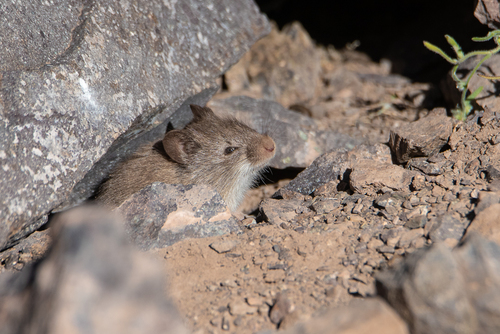
Inhabits high-altitude puna grasslands, Andean steppe, and shrubby areas with dense grass cover, often near rocky outcrops or streams. It prefers open, cold habitats with tussock grasses that provide cover from predators.
Adaptations to its environment
Possesses dense, insulating fur to cope with cold high-altitude temperatures and a compact body shape that minimizes heat loss. Its burrowing behavior provides shelter from extreme temperature fluctuations and predators in open grassland habitats.
Conservation status and numbers
Listed as Least Concern by the IUCN due to its relatively wide distribution and presumed large, stable population across suitable Andean habitats. No significant range-wide declines have been documented.
Estimated population
No precise global population estimate exists, but the species is considered common and stable within its range based on trapping surveys.
What threatens the Pleasant Bolo Mouse?
Localized threats include habitat degradation from overgrazing by livestock, agricultural expansion, and potential climate change effects on high-altitude grassland ecosystems.
Diseases and parasites
Like many wild rodents, it likely hosts various ectoparasites (fleas, mites) and endoparasites (nematodes), though specific studies on this species are limited.
What is being done to protect it?
No species-specific conservation programs are in place; however, portions of its range overlap with protected areas in the Andean highlands of Argentina and Bolivia that indirectly benefit the species.
Recommended actions
Continued monitoring of population trends, protection of high-altitude grassland habitats from overgrazing, and further taxonomic and ecological research to clarify distribution limits.
What the Pleasant Bolo Mouse looks like
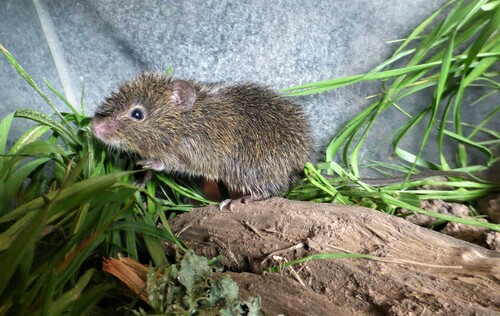
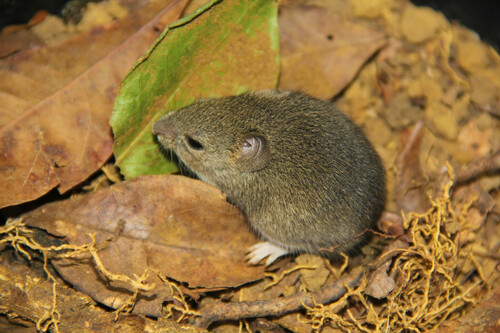
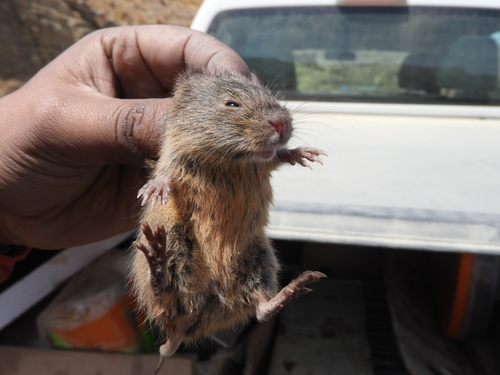
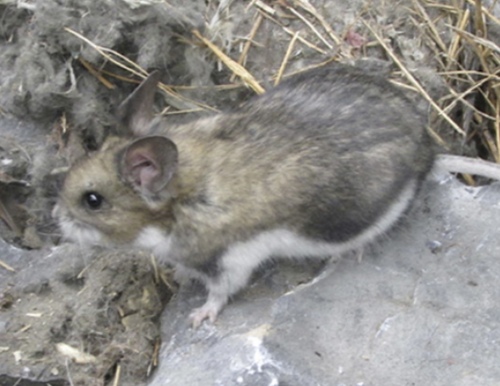
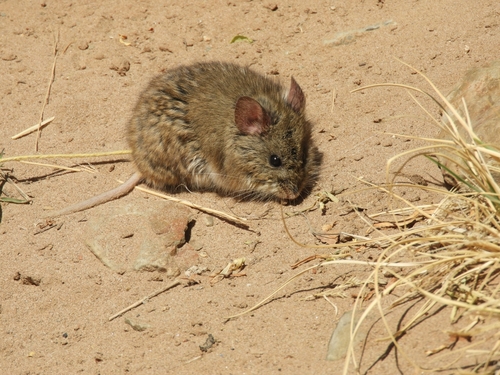
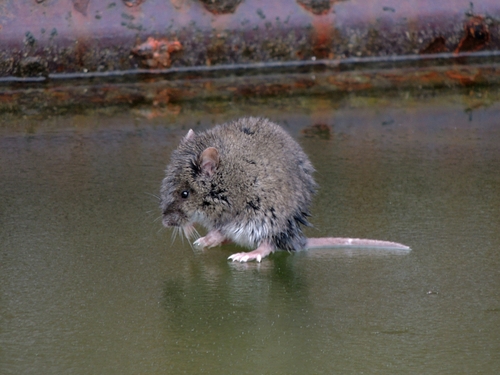
The Pleasant Bolo Mouse has soft, dense grayish-brown to olive-brown dorsal fur, with paler, grayish-white underparts. It has a moderately long tail, small rounded ears, and a pointed snout typical of sigmodontine rodents.
Size
Head-body length approximately 8-11 cm, with a tail length of about 6-9 cm
Weight
Approximately 15-30 grams
Distinctive features
Distinguished from closely related Necromys species by subtle differences in skull morphology, tail-to-body ratio, and pelage coloration, often requiring cranial examination for confident identification.
Differences between males and females
Minimal sexual dimorphism; males and females are similar in size and coloration, with only slight size differences reported in some populations.
Behaviour and diet of the Pleasant Bolo Mouse
Generally solitary or found in loose, low-density populations, with limited social interaction outside of breeding encounters.
When it is active
Primarily nocturnal to crepuscular, foraging during dusk, dawn, and nighttime hours to avoid diurnal predators and temperature extremes.
Diet
Omnivorous, feeding mainly on seeds, grasses, and other plant material, supplemented occasionally with insects and other small invertebrates.
How it feeds and hunts
Forages on the ground among grass tussocks, using its keen sense of smell to locate seeds, plant matter, and occasional invertebrate prey.
Communication
Communicates primarily through scent marking via urine and glandular secretions, along with ultrasonic vocalizations typical of small rodents for social and reproductive signaling.
Interactions with other species
Preyed upon by Andean raptors, foxes, and small carnivorous mammals; competes with other sympatric rodent species for food resources and shelter in grassland habitats.
Role in its ecosystem
Plays an important ecological role as a seed disperser and as a prey base supporting Andean predator populations, contributing to nutrient cycling in high-altitude grassland ecosystems.
Reproduction and lifecycle
Breeding likely occurs during the warmer, wetter months of the Andean summer, with females producing litters of approximately 3-6 young after a gestation period typical of small cricetid rodents (around 21-25 days).
Raising the young
As with most sigmodontine rodents, females provide sole parental care, nursing and protecting the altricial young in a nest until they are weaned and independent within a few weeks.
Maturity and lifespan
Sexual maturity is typically reached within 2-3 months; wild lifespan is estimated at around 1-2 years, consistent with similar small sigmodontine rodents.
Taxonomy and naming of the Pleasant Bolo Mouse
Classification
Mammalia > Rodentia > Cricetidae > Necromys > Necromys amoenus
Scientific synonyms
Akodon amoenus, Bolomys amoenus
What research says
Recent studies
Recent taxonomic revisions using molecular phylogenetics have helped clarify the placement of this species within Necromys, resolving earlier confusion with the genus Bolomys.
Genome and DNA
Karyotype studies place it within the diverse chromosomal variation seen in Necromys and related Akodontini genera, though detailed genomic studies specific to this species are limited.
Compared with similar species
Similar in size and habitat preference to other Necromys and Akodon species, but distinguishable through cranial measurements and mitochondrial DNA analysis rather than external appearance alone.
The Pleasant Bolo Mouse and people
Despite its wide distribution across some of the highest grasslands in South America, this species remains poorly studied compared to lowland rodents. Its species name 'amoenus' means 'pleasant' or 'charming' in Latin, likely referring to its appearance.
Where and how to see it
Best observed during dusk or nighttime hours in high-altitude puna grasslands of northwestern Argentina, using small mammal trapping methods, as sightings in the wild are uncommon due to its secretive nocturnal habits.
Risks to humans
No notable risk to humans, though like other wild rodents it could theoretically carry zoonotic pathogens through contact with feces or ectoparasites.
Countries where the Pleasant Bolo Mouse is recorded
The 2 countries named in the range description of its IUCN Red List assessment.
Questions about the Pleasant Bolo Mouse
Where does the Pleasant Bolo Mouse live?
The Pleasant Bolo Mouse is recorded in Argentina and Bolivia across South America. These countries come from the range description of its IUCN Red List assessment, and they are what place the species on the interactive map.
Is the Pleasant Bolo Mouse endangered?
The IUCN Red List assesses the Pleasant Bolo Mouse as Least Concern. The species is widespread and abundant enough not to qualify for any threatened category. It does not mean the species is safe forever, only that nothing in the current data raises an alarm.
How many are left in the wild?
No precise global population estimate exists, but the species is considered common and stable within its range based on trapping surveys. This figure comes from the species assessment on the IUCN Red List; population estimates for wild mammals are ranges, not counts, and are revised at each assessment.
What habitat does the Pleasant Bolo Mouse live in?
Inhabits high-altitude puna grasslands, Andean steppe, and shrubby areas with dense grass cover, often near rocky outcrops or streams.
What is the scientific name of the Pleasant Bolo Mouse?
The Pleasant Bolo Mouse is Necromys amoenus, in the family Cricetidae, order Rodentia.
Other species in the genus Necromys
Other species in the family Cricetidae
Sources
Conservation status, range description and population estimate come from the IUCN Red List assessment for Necromys amoenus. Countries are derived from that range description, not from a mapped country list. Last refreshed on .
The distribution map is drawn from the IUCN Red List spatial data compiled in 2008. IUCN (International Union for Conservation of Nature)