
Hairy-tailed Bolo Mouse
Necromys lasiurus
Red List assessment
Least Concernon the IUCN Red List
- EXExtinct
- EWExtinct in the Wild
- CRCritically Endangered
- ENEndangered
- VUVulnerable
- NTNear Threatened
- LCLeast Concern
The Hairy-tailed Bolo Mouse is recorded in 4 countries across South America. The IUCN Red List assesses the Hairy-tailed Bolo Mouse as Least Concern. No precise global population estimate exists, but the species is considered abundant and common throughout its range with a stable population trend.
- Family
- Cricetidae
- Order
- Rodentia
- Genus
- Necromys
- Countries recorded
- 4
- Continents
- South America
- Red List category
- Least Concern
- Data updated
- August 9, 2026
What is the Hairy-tailed Bolo Mouse?
The Hairy-tailed Bolo Mouse is a small terrestrial rodent native to the open grasslands and savannas of central South America, especially the Brazilian Cerrado. It is one of the most abundant small mammals in its range and plays a key ecological role as prey for many predators. The species is notable for its adaptability to disturbed and agricultural habitats, making it a common study subject for hantavirus and rodent-borne disease research.
Where does the Hairy-tailed Bolo Mouse live?
Central and eastern South America, primarily Brazil, with range extending into Bolivia, Paraguay, and northern Argentina
Widely distributed across central Brazil (Cerrado and adjacent biomes), extending into eastern Bolivia, Paraguay, and northern Argentina, with the core of its range in the Brazilian highlands.
Altitude and depth
Typically found from near sea level up to about 1500 meters elevation
Seasonal movements
Reproductive activity and population density fluctuate seasonally, often peaking during and after the rainy season when food availability increases
Habitat of the Hairy-tailed Bolo Mouse
Primarily inhabits open grasslands, savannas (especially Cerrado biome), and shrublands; also found in agricultural fields, pastures, and secondary growth areas with dense grass cover.
Adaptations to its environment
Possesses a robust, compact body suited for burrowing and moving through dense grass; its diet flexibility and high reproductive rate allow rapid population recovery after disturbances such as fire, which is common in Cerrado ecosystems.
Conservation status and numbers
Listed as Least Concern by the IUCN due to its wide distribution, large population, presumed large overall population, and tolerance of habitat modification.
Estimated population
No precise global population estimate exists, but the species is considered abundant and common throughout its range with a stable population trend.
What threatens the Hairy-tailed Bolo Mouse?
Habitat conversion for agriculture and cattle ranching in the Cerrado, though the species often persists or even benefits from such disturbed habitats; localized threats include pesticide use.
Diseases and parasites
Known to be a natural reservoir for hantavirus (including Araraquara virus), as well as host to various ectoparasites such as mites, fleas, and ticks.
What is being done to protect it?
No species-specific conservation programs exist; benefits indirectly from protected areas within the Cerrado biome such as national parks and biological reserves.
Recommended actions
Continued monitoring of Cerrado habitat loss, maintaining protected grassland areas, and further research into its role as a disease reservoir for hantavirus.
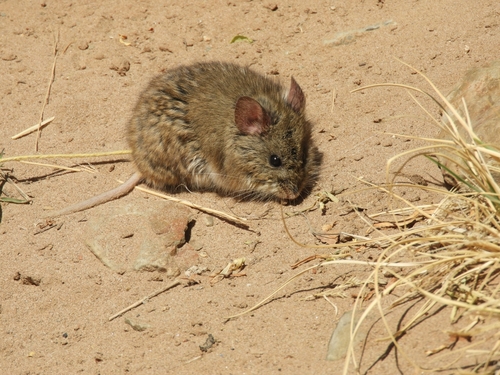
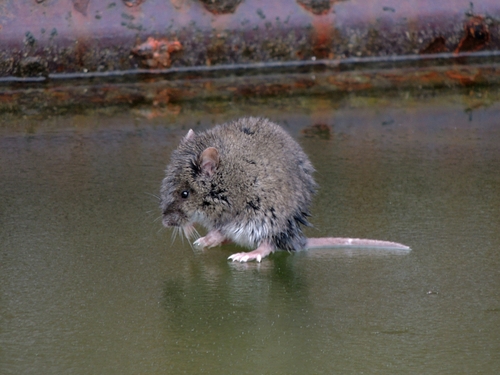
What the Hairy-tailed Bolo Mouse looks like
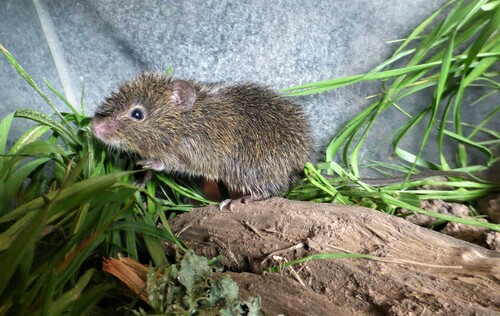
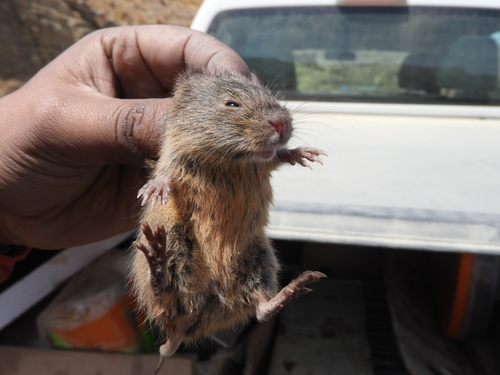
Has short, dense fur that is grayish-brown to reddish-brown on the dorsal side and paler, whitish-gray underneath; the tail is notably hairy, giving the species its common name, and is generally shorter than the head-body length.
Size
Head-body length ranges from approximately 80-130 mm, with a tail length of about 60-100 mm
Weight
Typically weighs between 20-60 grams, with some regional variation
Distinctive features
Distinguished from related Necromys and Akodon species by its relatively hairy tail, robust skull morphology, and specific dental characteristics used in taxonomic identification.
Differences between males and females
Minimal sexual dimorphism; males and females are similar in size and coloration, though males may be slightly larger on average.
Behaviour and diet of the Hairy-tailed Bolo Mouse
Generally solitary or loosely social outside of breeding periods, though population densities can be high in favorable habitat, leading to overlapping home ranges.
When it is active
Primarily nocturnal and crepuscular, though some diurnal activity has been documented depending on predation pressure and season.
Diet
Omnivorous diet consisting mainly of seeds, grasses, and other plant material, supplemented with insects and other small invertebrates.
How it feeds and hunts
Forages on the ground, using its sense of smell to locate seeds, plant matter, and insects; not a specialized hunter but an opportunistic feeder.
Communication
Communicates through scent marking via urine and glandular secretions, as well as ultrasonic vocalizations typical of small rodents, used especially between mothers and pups.
Interactions with other species
Serves as an important prey species for owls, hawks, snakes, and small carnivorous mammals; competes with other small rodents for food and burrow resources in shared habitats.
Role in its ecosystem
Plays a significant ecological role as a primary prey species in Cerrado food webs and contributes to seed dispersal and soil aeration through its burrowing and foraging activities.
Reproduction and lifecycle
Breeds primarily during the wet season with gestation lasting approximately 21-23 days; litter size typically ranges from 3-6 pups, and females can produce multiple litters per year.
Raising the young
Females provide sole parental care, nursing and protecting the altricial young in a nest until weaning at around 3 weeks of age.
Maturity and lifespan
Reaches sexual maturity at around 2-3 months of age; lifespan in the wild is short, typically less than 1 year, due to high predation and environmental pressures.
Taxonomy and naming of the Hairy-tailed Bolo Mouse
Classification
Class Mammalia > Order Rodentia > Family Cricetidae > Genus Necromys > Species Necromys lasiurus
Scientific synonyms
Bolomys lasiurus, Akodon lasiurus, Zygodontomys lasiurus
What research says
Recent studies
Recent studies have focused on its role as a hantavirus reservoir in Brazil, as well as phylogeographic research clarifying its taxonomic relationships within the genus Necromys.
Genome and DNA
Karyotype studies have shown chromosome numbers varying among populations (2n commonly reported around 34-40), reflecting some degree of chromosomal polymorphism within the species.
Compared with similar species
Similar in size and habits to other Necromys and Akodon species, but distinguished by its notably hairier tail and specific cranial features; it is often confused with Bolomys species due to past taxonomic overlap.
The Hairy-tailed Bolo Mouse and people
This species was once classified under multiple different genera (Zygodontomys, Bolomys, Akodon) before molecular studies clarified its placement in Necromys; it is also one of the most frequently trapped rodents in Cerrado ecological studies, making it a model species for small mammal research in Brazil.
Where and how to see it
Best observed at dusk or night in open grassland and Cerrado habitats using live-trapping methods typical of rodent field studies; not easily seen due to its small size and nocturnal habits.
Risks to humans
Can pose a health risk as a reservoir for hantavirus, which can be transmitted to humans through contact with rodent droppings, urine, or saliva; direct bite risk is low.
Human uses
Not used commercially or traditionally by humans, but is significant in scientific research related to rodent-borne disease ecology and Cerrado biodiversity studies.
Countries where the Hairy-tailed Bolo Mouse is recorded
The 4 countries named in the range description of its IUCN Red List assessment.
Questions about the Hairy-tailed Bolo Mouse
Where does the Hairy-tailed Bolo Mouse live?
The Hairy-tailed Bolo Mouse is recorded in Argentina, Bolivia, Brazil and Paraguay across South America. These countries come from the range description of its IUCN Red List assessment, and they are what place the species on the interactive map.
Is the Hairy-tailed Bolo Mouse endangered?
The IUCN Red List assesses the Hairy-tailed Bolo Mouse as Least Concern. The species is widespread and abundant enough not to qualify for any threatened category. It does not mean the species is safe forever, only that nothing in the current data raises an alarm.
How many are left in the wild?
No precise global population estimate exists, but the species is considered abundant and common throughout its range with a stable population trend. This figure comes from the species assessment on the IUCN Red List; population estimates for wild mammals are ranges, not counts, and are revised at each assessment.
What habitat does the Hairy-tailed Bolo Mouse live in?
Primarily inhabits open grasslands, savannas (especially Cerrado biome), and shrublands; also found in agricultural fields, pastures, and secondary growth areas with dense grass cover.
What is the scientific name of the Hairy-tailed Bolo Mouse?
The Hairy-tailed Bolo Mouse is Necromys lasiurus, in the family Cricetidae, order Rodentia.
Other species in the genus Necromys
Other species in the family Cricetidae
Sources
Conservation status, range description and population estimate come from the IUCN Red List assessment for Necromys lasiurus. Countries are derived from that range description, not from a mapped country list. Last refreshed on .
The distribution map is drawn from the IUCN Red List spatial data compiled in 2014. IUCN (International Union for Conservation of Nature)