
Large Long-clawed Mouse
Chelemys megalonyx
Red List assessment
Near Threatenedon the IUCN Red List
- EXExtinct
- EWExtinct in the Wild
- CRCritically Endangered
- ENEndangered
- VUVulnerable
- NTNear Threatened
- LCLeast Concern
The Large Long-clawed Mouse is recorded in 2 countries across South America. The IUCN Red List assesses the Large Long-clawed Mouse as Near Threatened. No precise global population estimate exists, but the population is presumed to be declining in line with ongoing habitat loss across its range in Chile and Argentina.
- Family
- Cricetidae
- Order
- Rodentia
- Genus
- Chelemys
- Countries recorded
- 2
- Continents
- South America
- Red List category
- Near Threatened
- Data updated
- August 9, 2026
What is the Large Long-clawed Mouse?
Chelemys megalonyx is a burrowing rodent endemic to the temperate forests and shrublands of southern South America. It is notable for its unusually large, robust front claws, which are highly adapted for digging through soil in search of invertebrate prey. This species is one of the largest members of the long-clawed mouse genus and plays a specialized ecological role as a subterranean insectivore-omnivore.
Where does the Large Long-clawed Mouse live?
Chile and Argentina, primarily in the temperate Andean and Patagonian regions of South America
Distributed along the Andes and adjacent lowlands of central-southern Chile and western Argentina, spanning roughly from the Biobío/Neuquén region south to Patagonian areas near Aysén and Chubut.
Altitude and depth
Typically found between 200 and 1500 meters elevation, though it can occur at higher altitudes in Andean foothill habitats.
Seasonal movements
No long-distance migration; activity may decrease slightly during cold winter months when soil freezing limits digging opportunities, though the species remains active year-round in most of its range.
Habitat of the Large Long-clawed Mouse
Found in temperate Nothofagus forests, Andean scrublands, and humid grasslands with loose, friable soils suitable for digging. Often associated with areas near streams, bogs, or moist meadows that support abundant soil invertebrates.
Adaptations to its environment
Possesses enlarged, curved foreclaws and strong forelimb musculature specialized for excavating burrows and searching for buried prey. Its dense, water-resistant fur and compact body shape help it cope with the cool, humid climate of southern temperate forests.
Conservation status and numbers
Classified as Near Threatened (NT) by the IUCN due to a restricted and fragmented range combined with ongoing habitat degradation, though it does not yet meet criteria for a more severe threat category.
Estimated population
No precise global population estimate exists, but the population is presumed to be declining in line with ongoing habitat loss across its range in Chile and Argentina.
What threatens the Large Long-clawed Mouse?
Habitat loss from logging of native Nothofagus forests, conversion of land to agriculture and livestock grazing, and fragmentation of remaining forest patches are the primary threats. Climate change affecting soil moisture and invertebrate prey availability may pose an emerging risk.
What is being done to protect it?
Some populations occur within protected areas in the Chilean and Argentine Andes, including national parks and reserves that preserve native temperate forest. Broader conservation is largely incidental to general forest protection rather than species-specific programs.
Recommended actions
Expanding protected forest habitat, conducting population surveys to refine conservation status, and mitigating deforestation and grazing pressure in key regions are recommended priorities. Further ecological research on distribution and habitat requirements would help target conservation efforts.
What the Large Long-clawed Mouse looks like
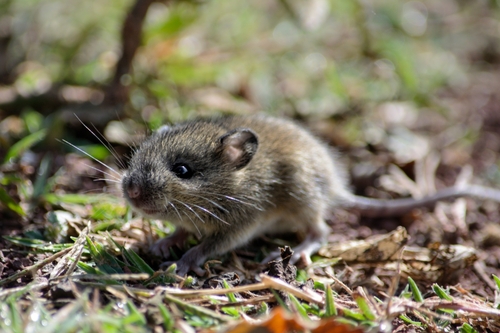
The fur is soft and dense, typically dark grayish-brown to blackish on the dorsal side, with slightly paler underparts. The most distinctive feature is the set of large, robust, curved claws on the forefeet, disproportionately larger than in most sigmodontine rodents.
Size
Body length (head to base of tail) typically ranges from 11 to 14 cm, with a tail length of approximately 7 to 9 cm.
Weight
Adults typically weigh between 40 and 65 grams.
Distinctive features
Distinguished from related Chelemys species and other akodontine rodents by its notably larger body size and disproportionately enlarged foreclaws, which are used for extensive digging.
Differences between males and females
Sexual dimorphism is minimal, with males and females showing similar body size and coloration.
Behaviour and diet of the Large Long-clawed Mouse
Generally solitary and secretive, spending much of its time underground or under dense vegetation; direct social interaction data is limited due to its cryptic lifestyle.
When it is active
Primarily active during the night and twilight hours (nocturnal to crepuscular), though some daytime activity may occur underground.
Diet
Diet consists mainly of soil-dwelling invertebrates such as insect larvae, earthworms, and other arthropods, supplemented occasionally with roots, fungi, and plant material.
How it feeds and hunts
Uses its powerful foreclaws to dig through soil and leaf litter, exposing hidden invertebrate prey which it then captures and consumes.
Communication
Communication likely involves scent marking of burrows and trails, along with limited vocalizations typical of small rodents, though specific studies on this species are scarce.
Interactions with other species
Likely preyed upon by owls, small mustelids, and foxes native to the region; it may compete for soil invertebrate resources with other insectivorous small mammals sharing its habitat.
Role in its ecosystem
Functions as a soil-disturbing insectivore, contributing to nutrient cycling and soil aeration within temperate forest ecosystems, while also serving as a prey source for regional predators.
Reproduction and lifecycle
Breeding likely occurs during the austral spring and summer months, with females producing small litters of a few pups per breeding event, though detailed reproductive data for this species remains limited.
Raising the young
As is typical for cricetid rodents, females are presumed to provide the primary parental care, nursing and sheltering the young in burrows until they are weaned and independent.
Maturity and lifespan
Specific data is limited, but sexual maturity in similar sigmodontine rodents typically occurs within a few months of age, with a wild lifespan likely ranging from 1 to 3 years.
Taxonomy and naming of the Large Long-clawed Mouse
Classification
Class Mammalia > Order Rodentia > Family Cricetidae > Subfamily Sigmodontinae > Genus Chelemys > Species Chelemys megalonyx
Scientific synonyms
Chelemyscus megalonyx; Euneomys megalonyx (older combinations used before genus revision)
What research says
Recent studies
Recent taxonomic revisions within the genus Chelemys have clarified species boundaries using molecular phylogenetics, helping to better delineate Chelemys megalonyx from closely related taxa.
Compared with similar species
Compared to its congener Chelemys macronyx, C. megalonyx is generally larger in body size with even more pronounced claw development, reflecting a greater specialization toward digging behavior.
The Large Long-clawed Mouse and people
Its genus name and common name both reference its remarkably oversized claws, among the largest relative to body size of any South American rodent. Despite being a rodent, its digging lifestyle and morphology parallel that of small insectivorous moles in unrelated mammal groups, an example of convergent evolution.
Where and how to see it
Best observed at dusk or during nighttime hours in intact temperate Nothofagus forest habitats of southern Chile and Argentina; searching near soft, moist soil areas increases chances of spotting burrow entrances or digging activity.
Risks to humans
No notable risk to humans.
Countries where the Large Long-clawed Mouse is recorded
The 2 countries named in the range description of its IUCN Red List assessment.
Questions about the Large Long-clawed Mouse
Where does the Large Long-clawed Mouse live?
The Large Long-clawed Mouse is recorded in Argentina and Chile across South America. These countries come from the range description of its IUCN Red List assessment, and they are what place the species on the interactive map.
Is the Large Long-clawed Mouse endangered?
The IUCN Red List assesses the Large Long-clawed Mouse as Near Threatened. The species does not qualify as threatened today, but it is close to the thresholds and likely to cross them soon. It is the category that most often changes at the next assessment.
How many are left in the wild?
No precise global population estimate exists, but the population is presumed to be declining in line with ongoing habitat loss across its range in Chile and Argentina. This figure comes from the species assessment on the IUCN Red List; population estimates for wild mammals are ranges, not counts, and are revised at each assessment.
What habitat does the Large Long-clawed Mouse live in?
Found in temperate Nothofagus forests, Andean scrublands, and humid grasslands with loose, friable soils suitable for digging.
What is the scientific name of the Large Long-clawed Mouse?
The Large Long-clawed Mouse is Chelemys megalonyx, in the family Cricetidae, order Rodentia.
Other species in the genus Chelemys
Other species in the family Cricetidae
Species that share its range

Sources
Conservation status, range description and population estimate come from the IUCN Red List assessment for Chelemys megalonyx. Countries are derived from that range description, not from a mapped country list. Last refreshed on .
The distribution map is drawn from the IUCN Red List spatial data compiled in 2019. IUCN SSC Small Mammal Specialist Group