
Large Fruit-eating Bat
Artibeus amplus
Red List assessment
Least Concernon the IUCN Red List
- EXExtinct
- EWExtinct in the Wild
- CRCritically Endangered
- ENEndangered
- VUVulnerable
- NTNear Threatened
- LCLeast Concern
The Large Fruit-eating Bat is recorded in 5 countries across North America and South America. The IUCN Red List assesses the Large Fruit-eating Bat as Least Concern. No precise global population estimate is available.
- Family
- Phyllostomidae
- Order
- Chiroptera
- Genus
- Artibeus
- Countries recorded
- 5
- Continents
- North America and South America
- Red List category
- Least Concern
- Data updated
- August 9, 2026
What is the Large Fruit-eating Bat?
Artibeus amplus is one of the larger members of the genus Artibeus, a diverse group of New World leaf-nosed fruit bats in the family Phyllostomidae. It inhabits tropical lowland and montane forests of northern South America, where it plays a critical ecological role as a frugivore and seed disperser. Like all phyllostomids, it bears a conspicuous noseleaf used in conjunction with echolocation. It is remarkable for its robust build relative to its congeners and its dependence on mature tropical forest fruit resources.
Where does the Large Fruit-eating Bat live?
Northern South America, primarily Venezuela, Colombia, Trinidad and Tobago, Guyana, and adjacent regions
Known from northern and central Venezuela, northeastern and central Colombia (including the Antioquia and Orinoco basin regions), Trinidad and Tobago, Guyana, and possibly adjacent areas of northwestern Brazil. Its range largely overlaps with Amazonian and Orinoco drainage ecosystems.
Altitude and depth
Typically recorded from sea level up to approximately 1,500 m, with most records from lowland tropical zones below 1,000 m.
Seasonal movements
No major seasonal migrations documented. Like many tropical Artibeus, activity patterns may shift with fruit availability across dry and wet seasons, but the species is present year-round within its range.
Habitat of the Large Fruit-eating Bat
Primarily tropical moist lowland forest and tropical montane forest. It also uses forest edges, secondary growth, and gallery forests. The species favors areas with abundant fruiting trees such as figs (Ficus spp.) and other soft-fruited vegetation.
Adaptations to its environment
Possesses a strong, robust skull and dentition adapted for processing hard and fibrous fruits. Its noseleaf and sophisticated echolocation system allow precise navigation in dense forest understory. Broad wings enable maneuverable flight through closed-canopy environments, and its digestive tract processes seeds rapidly, aiding seed dispersal.
Conservation status and numbers
Least Concern (LC) on the IUCN Red List. The species has a sufficiently wide range and is not believed to be experiencing rapid population declines meeting thresholds for a threatened category. However, ongoing deforestation across its range warrants continued monitoring.
Estimated population
No precise global population estimate is available. The population trend is considered stable, though localized declines likely occur in heavily deforested areas.
What threatens the Large Fruit-eating Bat?
Deforestation and habitat fragmentation due to agricultural expansion, cattle ranching, logging, and urbanization are the primary threats. Pesticide use reducing insect and fruit availability may also be a secondary concern in agricultural zones.
Diseases and parasites
Likely hosts ectoparasites such as batflies (Streblidae, Nycteribiidae) and mites, as reported in related Artibeus species. May carry rabies virus asymptomatically at low prevalence, consistent with New World bat populations generally. No specific parasite studies for A. amplus are confirmed.
What is being done to protect it?
The species benefits indirectly from protected areas such as national parks and biological reserves across Colombia and Venezuela. No species-specific conservation programs are known, but general bat conservation initiatives in the Neotropics contribute to its protection.
Recommended actions
Expansion and enforcement of protected areas within its range, reduction of deforestation rates in Venezuela and Colombia, long-term population monitoring, and inclusion in national biodiversity inventories and bat diversity surveys.
What the Large Fruit-eating Bat looks like
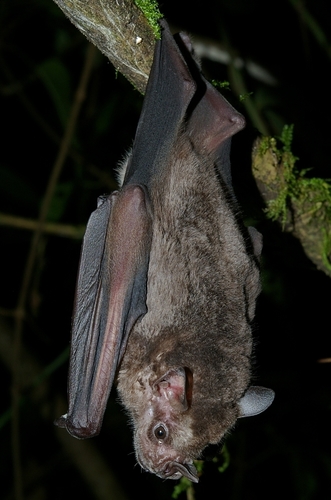
Dorsal fur is medium to dark brown, while the ventral surface is paler grayish-brown. The face bears faint whitish facial stripes above and below the eye, characteristic of the genus Artibeus. The noseleaf is well-developed and triangular, and the ears are short and rounded. No external tail is present, and the interfemoral membrane (uropatagium) is narrow.
Size
Forearm length approximately 63–68 mm; total body length approximately 80–100 mm. No functional external tail. Wingspan estimated at approximately 35–42 cm.
Weight
Approximately 45–70 g; slight variation possible between sexes, with females sometimes heavier when pregnant or lactating.
Distinctive features
Distinguished from the closely related Artibeus lituratus by its slightly more robust build and subtle differences in facial stripe intensity and skull morphology. Larger than A. obscurus and A. planirostris, with a relatively broader rostrum. Differentiation from A. lituratus can require careful morphometric analysis.
Differences between males and females
Sexual dimorphism is minimal in external morphology. Females may be slightly heavier than males during reproductive periods. No significant differences in coloration or structure have been reported.
Behaviour and diet of the Large Fruit-eating Bat
Typically roosts in small groups, often organized as harem units consisting of a dominant male and several females, with peripheral bachelor males roosting separately. Group sizes generally range from a few individuals to small colonies of up to 20–30 individuals depending on roost site.
When it is active
Strictly nocturnal. Foraging activity peaks in the first half of the night, consistent with patterns observed in other large Artibeus. Roosts during the day in tree cavities, dense foliage, or under large palm fronds.
Diet
Primarily frugivorous, with figs (Ficus spp.) constituting a dietary staple, as is common across the genus Artibeus. Also consumes other soft fruits, and may occasionally ingest nectar, pollen, or insects as dietary supplements.
How it feeds and hunts
Locates fruiting trees using echolocation combined with olfaction and visual cues. It plucks fruit in flight or while hanging briefly from a branch, often transporting larger fruits to a feeding roost away from the fruiting tree to consume in relative safety.
Communication
Uses frequency-modulated echolocation calls for navigation and object detection. Produces social vocalizations for intra-group communication, including contact calls and agonistic signals at roost sites. Scent glands may contribute to olfactory communication, particularly in reproductive contexts.
Interactions with other species
Predated upon by nocturnal raptors (e.g., barn owls, spectacled owls) and arboreal snakes. Competes for fruit resources with other large Artibeus species and with birds. Acts as a mutualistic seed disperser for many tropical tree species, particularly pioneer and fig species.
Role in its ecosystem
A keystone frugivore and seed disperser in tropical forest ecosystems. By transporting seeds away from parent trees and depositing them in feces, it facilitates forest regeneration and plant gene flow. It may also contribute marginally to pollination of certain plant species.
Reproduction and lifecycle
Exhibits bimodal polyestry in some parts of its range, with birth peaks corresponding to the onset of rainy seasons. Gestation lasts approximately 3.5–4 months. Litter size is typically one pup per birth event. Weaning occurs at approximately 2–3 months of age.
Raising the young
Maternal care is primary; females nurse and transport the pup for the first weeks of life. The pup clings to the mother and is left at the roost during foraging once sufficiently developed. Males do not provide direct parental care.
Maturity and lifespan
Sexual maturity is likely reached at 8–12 months of age, consistent with related large Artibeus. Wild lifespan is estimated at 5–10 years; data specific to A. amplus in captivity are not well documented.
Taxonomy and naming of the Large Fruit-eating Bat
Classification
Mammalia > Chiroptera > Phyllostomidae > Artibeus > Artibeus amplus
Scientific synonyms
Historically confused or partially synonymized with Artibeus lituratus in some taxonomic treatments; described by Rehn in 1902. No formally accepted synonyms are currently recognized.
What research says
Recent studies
Phylogeographic and morphometric studies within the Artibeus lituratus species complex have helped clarify the species boundaries and independent status of A. amplus. Broader Neotropical bat surveys continue to yield new locality records, refining our understanding of its distribution.
Genome and DNA
Karyotype data for A. amplus are not well established in the literature. Related large Artibeus species typically have a diploid chromosome number of 2n=30–31. Molecular phylogenetic studies place A. amplus within the large-bodied Artibeus clade closely allied to A. lituratus.
Compared with similar species
Very similar to Artibeus lituratus (Great Fruit-eating Bat), from which it was distinguished mainly by morphological and later molecular evidence. Both are among the largest Artibeus, but A. lituratus has a broader distribution extending into Central America and the Caribbean. A. amplus is less studied and has a more restricted, South American-centered range.
The Large Fruit-eating Bat and people
Artibeus amplus, like its relatives, can consume fruits weighing nearly as much as itself in a single night of foraging. Figs, which it favors, are among the most important 'keystone' resources in tropical forests, and this bat is one of their primary dispersers. Despite having no visible tail, it uses its flexible interfemoral membrane like a basket to carry fruit during flight.
Where and how to see it
Best observed during the first hours after dusk near fruiting fig trees or forest edges in Venezuela's llanos or Colombia's Andean foothills. Mist-netting surveys conducted by researchers in protected areas such as the Sierra Nevada de Santa Marta or the Orinoco basin offer the best opportunities for close-up study. Amateur bat detectors tuned to lower ultrasonic frequencies can detect its echolocation passes.
Risks to humans
No significant direct risk to humans. As with all wild bats, handling without proper protection should be avoided due to the theoretical risk of rabies transmission. Bites from captured individuals are possible if mishandled.
Human uses
No documented significant human uses. Not commercially traded. Occasionally studied for its echolocation properties and role in seed dispersal, which has indirect economic value for tropical forest conservation and reforestation efforts.
Myths and legends
Bats in general carry rich symbolic meaning across indigenous Amazonian and Andean cultures, often associated with the night, death, and transition between worlds. No specific legends tied exclusively to A. amplus are documented, though large fruit bats in northern South America are sometimes viewed with superstition in rural communities.
Countries where the Large Fruit-eating Bat is recorded
The 5 countries named in the range description of its IUCN Red List assessment.
Questions about the Large Fruit-eating Bat
Where does the Large Fruit-eating Bat live?
The Large Fruit-eating Bat is recorded in Brazil, Colombia, Guyana, Trinidad & Tobago and Venezuela across North America and South America. These countries come from the range description of its IUCN Red List assessment, and they are what place the species on the interactive map.
Is the Large Fruit-eating Bat endangered?
The IUCN Red List assesses the Large Fruit-eating Bat as Least Concern. The species is widespread and abundant enough not to qualify for any threatened category. It does not mean the species is safe forever, only that nothing in the current data raises an alarm.
How many are left in the wild?
No precise global population estimate is available. This figure comes from the species assessment on the IUCN Red List; population estimates for wild mammals are ranges, not counts, and are revised at each assessment.
What habitat does the Large Fruit-eating Bat live in?
Primarily tropical moist lowland forest and tropical montane forest.
What is the scientific name of the Large Fruit-eating Bat?
The Large Fruit-eating Bat is Artibeus amplus, in the family Phyllostomidae, order Chiroptera.
Other species in the genus Artibeus
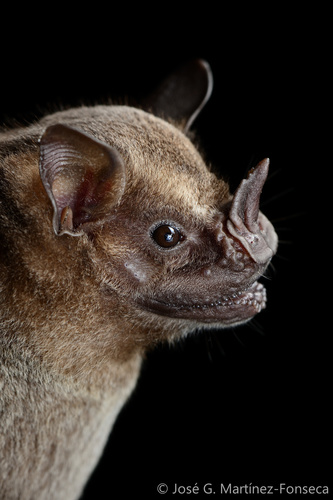
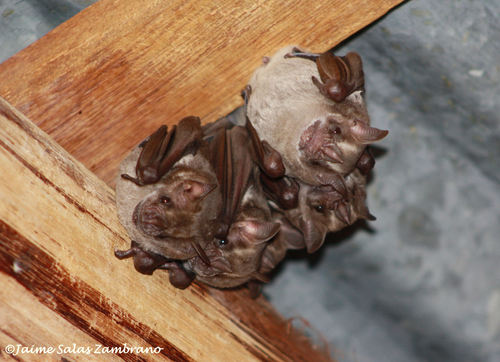
Other species in the family Phyllostomidae
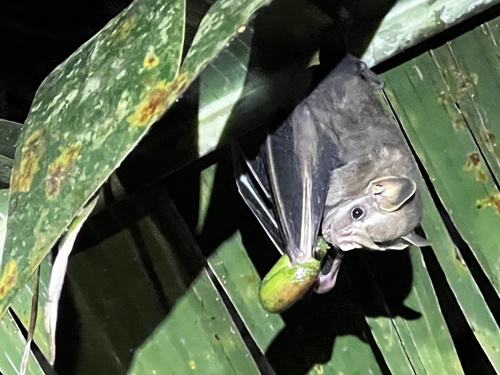
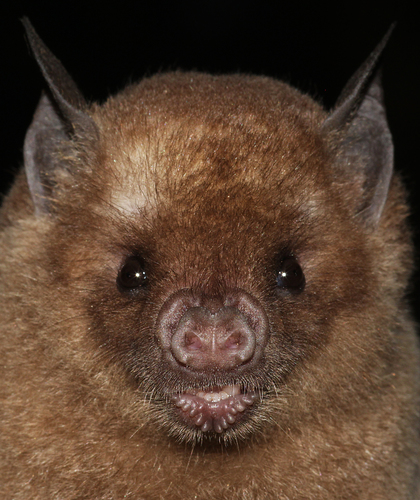
Sources
Conservation status, range description and population estimate come from the IUCN Red List assessment for Artibeus amplus. Countries are derived from that range description, not from a mapped country list. Last refreshed on .
The distribution map is drawn from the IUCN Red List spatial data compiled in 2018. IUCN (International Union for Conservation of Nature)