
Kinkajou
Potos flavus
Red List assessment
Least Concernon the IUCN Red List
- EXExtinct
- EWExtinct in the Wild
- CRCritically Endangered
- ENEndangered
- VUVulnerable
- NTNear Threatened
- LCLeast Concern
The Kinkajou is recorded in 13 countries across North America and South America. The IUCN Red List assesses the Kinkajou as Least Concern. No precise global population estimate exists, but the species is considered common throughout much of its extensive range; overall trend is believed to be stable to slightly declining due to habitat loss.
- Family
- Procyonidae
- Order
- Carnivora
- Genus
- Potos
- Countries recorded
- 13
- Continents
- North America and South America
- Red List category
- Least Concern
- Data updated
- August 9, 2026
What is the Kinkajou?
The kinkajou is a small, arboreal, nocturnal mammal native to the rainforests of Central and South America, related to raccoons and coatis. Despite its carnivore classification, it feeds mostly on fruit and nectar, playing an important role as a seed disperser and pollinator. It is notable for its prehensile tail, an unusual trait among carnivorans, and its golden, wooly fur which has earned it the nickname 'honey bear'.
Where does the Kinkajou live?
Central and South America, from Mexico through Central America to the Amazon Basin of Brazil, Peru, and Bolivia
Ranges from central Mexico through Central America (Belize, Guatemala, Honduras, Nicaragua, Costa Rica, Panama) and into South America across Colombia, Venezuela, the Guianas, Ecuador, Peru, Bolivia, and Brazil, mainly within the Amazon Basin.
Altitude and depth
Sea level up to approximately 2,500 meters, though most common below 1,500 meters
Seasonal movements
No true migration or hibernation; activity is consistently nocturnal year-round, though foraging patterns shift somewhat with fruit availability across seasons
Habitat of the Kinkajou
Primarily found in tropical lowland and montane rainforests, including primary and secondary forest, as well as forest edges and plantations near forested areas.
Adaptations to its environment
Possesses a fully prehensile tail for arboreal locomotion, flexible ankle joints that rotate 180 degrees allowing it to run backward along branches, and a long tongue adapted for extracting nectar and honey. Its large eyes are adapted for excellent night vision in the forest canopy.
Conservation status and numbers
Listed as Least Concern by the IUCN due to its wide distribution and adaptability, though local populations face pressure from habitat loss and hunting in parts of its range.
Estimated population
No precise global population estimate exists, but the species is considered common throughout much of its extensive range; overall trend is believed to be stable to slightly declining due to habitat loss.
What threatens the Kinkajou?
Deforestation and habitat fragmentation for agriculture and logging, hunting for the illegal pet trade, and hunting for fur and meat in some regions.
Diseases and parasites
Susceptible to rabies, and hosts various endoparasites and ectoparasites including ticks, mites, and intestinal worms.
What is being done to protect it?
Protected under CITES Appendix III in some countries (Honduras), present in numerous protected areas and national parks throughout its range, and benefiting indirectly from broader rainforest conservation initiatives.
Recommended actions
Strengthen enforcement against illegal pet trade, protect and connect fragmented forest habitats, and conduct further population monitoring studies to better assess local declines.
What the Kinkajou looks like
Soft, short, woolly fur that is golden-brown to olive on the back and lighter, yellowish underneath. It has a rounded head, large dark eyes, short rounded ears, and a long prehensile tail used for climbing and balance.
Size
Body length of 40-60 cm, with a prehensile tail nearly equal in length (40-57 cm)
Weight
1.4 to 4.6 kg, with males slightly larger on average than females
Distinctive features
Distinguished from similar procyonids like olingos by its shorter snout, fully prehensile tail, lack of visible tail rings, and a distinctive long extensible tongue used for feeding on nectar.
Differences between males and females
Minimal sexual dimorphism; males are only slightly larger than females on average, with no notable color or pattern differences
Behaviour and diet of the Kinkajou
Generally solitary foragers but social within loose group structures, often resting in groups of 2-5 individuals and engaging in mutual grooming; adults may form small social bonds with related individuals.
When it is active
Strictly nocturnal, active from dusk until dawn, spending daylight hours sleeping in tree hollows or dense foliage
Diet
Omnivorous but predominantly frugivorous, feeding on ripe fruit, flowers, and nectar, supplemented occasionally with insects, small vertebrates, and eggs.
How it feeds and hunts
Forages methodically through the canopy using its prehensile tail and reversible feet to reach fruit clusters and flowers, using its long tongue to lap nectar and its dexterous hands to manipulate food.
Communication
Communicates through a range of vocalizations including barks, screams, and chattering sounds, along with scent marking using glands on the abdomen, throat, and chin.
Interactions with other species
Predators include large birds of prey (harpy eagles), ocelots, jaguars, and margays; kinkajous compete with olingos and other arboreal frugivores for fruit resources, and they play a mutualistic role with flowering plants through pollination.
Role in its ecosystem
Serves as an important seed disperser and pollinator in tropical forest ecosystems, contributing to forest regeneration by spreading seeds of numerous fruiting tree species across the canopy.
Reproduction and lifecycle
Breeding can occur year-round with no strict seasonality; females have a gestation period of about 112-118 days and typically give birth to a single offspring, occasionally twins.
Raising the young
Mothers provide most of the parental care, nursing and carrying the young for several months; juveniles become independent at around 1.5 to 2 years of age.
Maturity and lifespan
Reaches sexual maturity around 1.5 to 2.5 years of age; lifespan in the wild is typically 20-25 years, with captive individuals recorded living over 30 years.
Taxonomy and naming of the Kinkajou
Classification
Mammalia > Carnivora > Procyonidae > Potos > Potos flavus
Subspecies
Several subspecies recognized including P. f. flavus (northern South America), P. f. chiriquensis (Panama/Costa Rica), P. f. isthmicus, and P. f. nocturnus (western Amazon), differing slightly in size and coloration.
Scientific synonyms
Lemur flavus, Cercoleptes caudivolvulus
What research says
Recent studies
Recent studies have used camera-trap and GPS-collar data to better understand kinkajou movement ecology and its role in seed dispersal networks within fragmented tropical forests.
Genome and DNA
Diploid chromosome number of 2n=38; limited but growing genetic research has helped clarify its phylogenetic placement within Procyonidae.
Compared with similar species
Often confused with olingos (Bassaricyon spp.) due to similar size and arboreal habits, but kinkajous are distinguished by their prehensile tail, rounder head, and lack of tail rings.
The Kinkajou and people
Kinkajous can rotate their feet 180 degrees to run backward along branches; they have a tongue that can extend up to 13 cm to reach deep into flowers for nectar; and despite belonging to the order Carnivora, over 90% of their diet consists of fruit.
Where and how to see it
Best observed at night in tropical forests of Central and South America, particularly in national parks like Corcovado (Costa Rica) or the Amazon Basin, using red-filtered flashlights and looking for eyeshine in the canopy during guided night walks.
Risks to humans
Generally low risk to humans, though bites can occur when handled and may carry rabies risk; wild individuals are typically shy and avoid human contact.
Human uses
Occasionally kept as exotic pets due to their docile nature and appealing appearance, and historically hunted for fur and bushmeat in some rural areas of its range.
Myths and legends
In some Latin American folklore, kinkajous are associated with nighttime spirits due to their nocturnal habits and eerie vocalizations; they are sometimes kept as exotic pets and have gained popular attention from celebrity ownership.
Countries where the Kinkajou is recorded
The 13 countries named in the range description of its IUCN Red List assessment.
Questions about the Kinkajou
Where does the Kinkajou live?
The Kinkajou is recorded in Belize, Bolivia, Brazil, Colombia and Costa Rica, among 13 countries in total across North America and South America. These countries come from the range description of its IUCN Red List assessment, and they are what place the species on the interactive map.
Is the Kinkajou endangered?
The IUCN Red List assesses the Kinkajou as Least Concern. The species is widespread and abundant enough not to qualify for any threatened category. It does not mean the species is safe forever, only that nothing in the current data raises an alarm.
How many are left in the wild?
No precise global population estimate exists, but the species is considered common throughout much of its extensive range; overall trend is believed to be stable to slightly declining due to habitat loss. This figure comes from the species assessment on the IUCN Red List; population estimates for wild mammals are ranges, not counts, and are revised at each assessment.
What habitat does the Kinkajou live in?
Primarily found in tropical lowland and montane rainforests, including primary and secondary forest, as well as forest edges and plantations near forested areas.
What is the scientific name of the Kinkajou?
The Kinkajou is Potos flavus, in the family Procyonidae, order Carnivora.
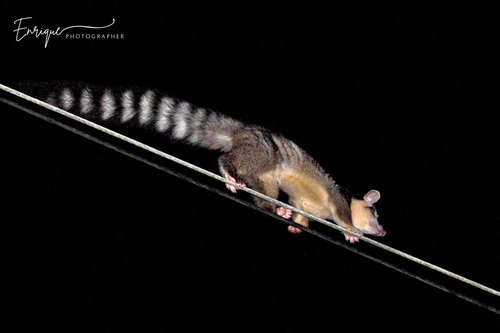
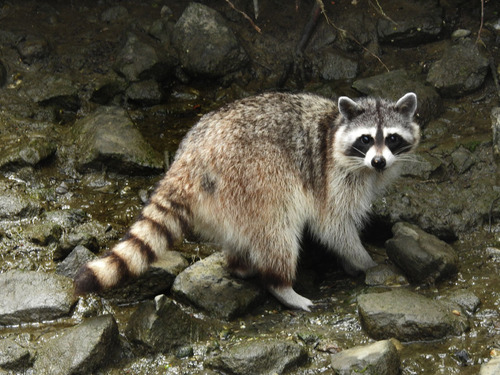
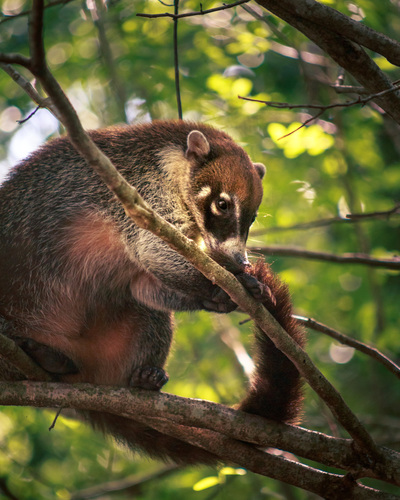
Other species in the family Procyonidae
Species that share its range
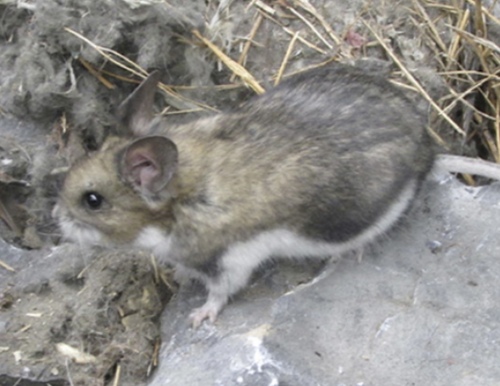


Sources
Conservation status, range description and population estimate come from the IUCN Red List assessment for Potos flavus. Countries are derived from that range description, not from a mapped country list. Last refreshed on .
The distribution map is drawn from the IUCN Red List spatial data compiled in 2016. IUCN (International Union for Conservation of Nature)