
Northern Raccoon
Procyon lotor
Red List assessment
Least Concernon the IUCN Red List
- EXExtinct
- EWExtinct in the Wild
- CRCritically Endangered
- ENEndangered
- VUVulnerable
- NTNear Threatened
- LCLeast Concern
The Northern Raccoon is recorded in 6 countries across Asia, Europe and North America. The IUCN Red List assesses the Northern Raccoon as Least Concern. Population numbers are not precisely quantified but are considered large and stable or increasing across most of its range, with millions of individuals estimated in North America alone.
- Family
- Procyonidae
- Order
- Carnivora
- Genus
- Procyon
- Countries recorded
- 6
- Continents
- Asia, Europe and North America
- Red List category
- Least Concern
- Data updated
- August 9, 2026
What is the Northern Raccoon?
The Northern Raccoon is a medium-sized, highly adaptable omnivorous mammal native to North America, easily recognized by its black facial mask and ringed tail. It thrives in a remarkable range of habitats from forests to urban centers, showcasing exceptional intelligence and dexterity with its front paws. Its adaptability has allowed it to become one of the most successful mammals in human-altered landscapes, and it has also been introduced to parts of Europe and Japan.
Where does the Northern Raccoon live?
North America, from southern Canada through the United States to Central America
Native range spans from southern Canada through the continental United States to Panama in Central America; introduced populations exist in Germany, France, and other parts of Europe, as well as Japan and the Caucasus region.
Altitude and depth
Sea level to approximately 2,000-3,000 meters, though most populations occur at lower elevations near water sources.
Seasonal movements
In northern parts of its range, raccoons undergo a period of reduced activity (torpor) during the coldest winter months, though this is not true hibernation; they may sleep for weeks in dens but wake periodically to forage on warmer days.
Habitat of the Northern Raccoon
Highly adaptable, inhabiting deciduous and mixed forests, wetlands, marshes, and riverine areas, but also thriving in agricultural land and urban/suburban environments. Prefers areas near water sources with access to trees for denning and refuge.
Adaptations to its environment
Highly dexterous front paws with sensitive tactile capabilities allow manipulation of food and objects, often appearing as 'washing' behavior. Their omnivorous diet and behavioral flexibility enable exploitation of diverse food sources, and a thick, insulating fur coat supports survival in cold climates.
Conservation status and numbers
Least Concern (LC) according to the IUCN Red List, reflecting a widespread and stable to increasing population with no major range-wide threats. The species has successfully adapted to human-modified landscapes, contributing to its conservation security.
Estimated population
Population numbers are not precisely quantified but are considered large and stable or increasing across most of its range, with millions of individuals estimated in North America alone.
What threatens the Northern Raccoon?
Vehicle collisions, hunting and trapping for fur, conflict with humans due to property damage or perceived nuisance behavior, and diseases such as rabies and canine distemper are the primary threats at local levels.
Diseases and parasites
Susceptible to rabies, canine distemper, and raccoon roundworm (Baylisascaris procyonis), which can pose zoonotic risks to humans and other animals; also hosts various ectoparasites including fleas, ticks, and mites.
What is being done to protect it?
No major dedicated conservation programs exist due to its stable status; however, regulated trapping seasons and wildlife management practices help control populations in areas of human conflict. Urban wildlife management programs address raccoon-human interactions.
Recommended actions
Continued monitoring of disease transmission (especially rabies) to prevent spillover to humans and pets, management of introduced populations in Europe and Japan to limit ecological impact, and public education to reduce human-wildlife conflict.
What the Northern Raccoon looks like
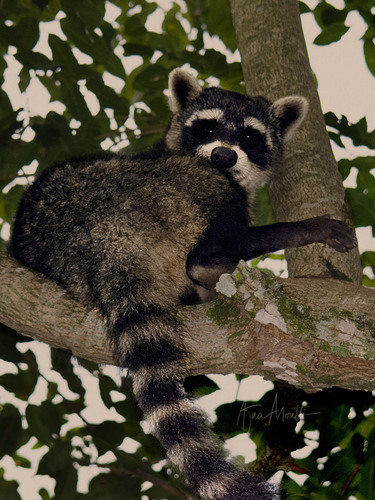
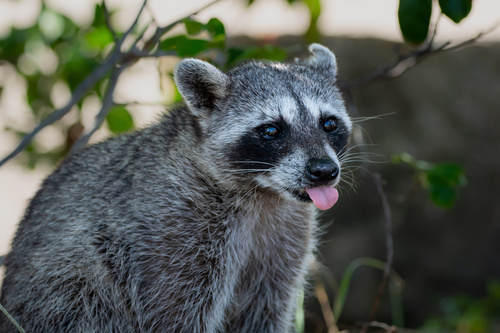
Grizzled grayish-brown fur covers the body, with a distinctive black facial mask outlined in white and a bushy tail marked with 4-6 alternating black and brown/gray rings. The body is stocky with a somewhat hunched appearance, short legs, and a pointed snout.
Size
Body length of 40-70 cm (16-28 inches) excluding tail, with tail length of 20-40 cm (8-16 inches); shoulder height approximately 23-30 cm.
Weight
Typically 3.5-9 kg (8-20 lbs), with some larger individuals reaching up to 12-15 kg, particularly in northern populations before winter; males are generally slightly larger than females.
Distinctive features
The black facial mask and ringed tail are the most recognizable features, distinguishing it from other Procyonidae; its highly dexterous front paws with long, sensitive fingers are unique among North American mammals of similar size.
Differences between males and females
Sexual dimorphism is modest, with males (boars) typically 15-20% larger and heavier than females (sows), though coloration and markings are similar between sexes.
Behaviour and diet of the Northern Raccoon
Generally solitary foragers, though females may form loose social groups with related females, and males sometimes form small bachelor coalitions. Social structure is fluid, with individuals maintaining overlapping home ranges rather than strict territories.
When it is active
Primarily nocturnal, with peak activity occurring after dusk and before dawn, though some individuals, especially in areas with abundant food or reduced human disturbance, may be active during crepuscular or even daytime hours.
Diet
Opportunistic omnivore with a highly varied diet including fruits, nuts, insects, crayfish, frogs, eggs, small vertebrates, and human refuse. Diet composition shifts seasonally, with more animal matter consumed in spring and summer and more plant material in fall.
How it feeds and hunts
Forages primarily by touch, using sensitive front paws to probe water, soil, and crevices for food; often 'dabbles' at water's edge searching for aquatic prey like crayfish and mollusks, and readily raids human food sources and garbage.
Communication
Communicates through a variety of vocalizations including purrs, whistles, snarls, growls, and screams, alongside body language such as arched backs and bristled fur; scent marking via urine and feces at latrine sites also conveys information to conspecifics.
Interactions with other species
Natural predators include coyotes, bobcats, great horned owls, and occasionally domestic dogs, though adult raccoons have few significant predators due to their size and defensive capabilities. They compete with other omnivores like opossums and skunks for food resources and den sites.
Role in its ecosystem
Plays an important ecological role as both predator and prey, helping control insect and small vertebrate populations while serving as a food source for larger carnivores and birds of prey. Its seed dispersal through fruit consumption also contributes to forest regeneration.
Reproduction and lifecycle
Breeding season typically occurs from January to March, with gestation lasting 63-65 days; litters average 2-5 kits (cubs) born in spring, usually in a den in a tree hollow or similar sheltered location.
Raising the young
Females provide sole parental care, nursing kits for about 10-12 weeks and teaching foraging skills before gradual independence at around 8-10 months; males play no role in raising offspring.
Maturity and lifespan
Sexual maturity is reached at approximately 1 year of age, though males may not breed successfully until 2 years old. Average lifespan in the wild is 2-5 years due to predation and human-related mortality, while captive individuals can live 15-20 years.
Taxonomy and naming of the Northern Raccoon
Classification
Mammalia > Carnivora > Procyonidae > Procyon > Procyon lotor
Subspecies
Around 20-25 subspecies have been described, including Procyon lotor lotor (eastern US/Canada), P. l. hirtus (northern US), P. l. varius (Gulf Coast), and P. l. pumilus (Florida Keys), though many are considered doubtfully distinct by modern taxonomists.
Scientific synonyms
Ursus lotor (original Linnaean classification, 1758)
What research says
Recent studies
Recent research has focused on raccoon cognitive abilities, including problem-solving skills comparable to primates in some tasks, and studies on urban adaptation revealing behavioral and even morphological changes in city-dwelling populations compared to rural counterparts.
Genome and DNA
The raccoon genome has been sequenced, revealing a diploid chromosome number of 2n=38; genetic studies have provided insights into their adaptability and immune system function relevant to disease resistance research.
Compared with similar species
Unlike the closely related Crab-eating Raccoon (Procyon cancrivorus) of South America, the Northern Raccoon has denser fur suited to colder climates and a broader dietary flexibility; it is also distinguished from the unrelated Red Panda by its Carnivora classification and North American origin.
The Northern Raccoon and people
Raccoons can rotate their hind feet 180 degrees, allowing them to climb down trees headfirst; their front paws have as many touch receptors as human hands, making them exceptionally skilled at manipulating objects. Studies show raccoons can remember solutions to tasks for up to three years.
Where and how to see it
Best observed at dusk or during nighttime hours near wooded areas, wetlands, or urban parks with water sources, using red-filtered flashlights to minimize disturbance. Autumn is often ideal as raccoons are more active foraging for winter fat reserves.
Risks to humans
Can carry rabies and other zoonotic diseases, and may bite or scratch if cornered or threatened; generally avoids human contact but can become bold in urban areas when habituated to human food sources.
Human uses
Historically trapped and farmed for fur used in coats and hats, particularly popular in early 20th century North America; also occasionally kept as exotic pets, though this practice is discouraged due to behavioral and legal concerns.
Myths and legends
In some Native American folklore, the raccoon is portrayed as a clever trickster figure, similar to the coyote in other traditions, often outwitting other animals through cunning. Its intelligence and dexterity have made it a symbol of adaptability and resourcefulness in North American culture.
Countries where the Northern Raccoon is recorded
The 6 countries named in the range description of its IUCN Red List assessment.
Questions about the Northern Raccoon
Where does the Northern Raccoon live?
The Northern Raccoon is recorded in Canada, France, Germany, Japan and Panama, among 6 countries in total across Asia, Europe and North America. These countries come from the range description of its IUCN Red List assessment, and they are what place the species on the interactive map.
Is the Northern Raccoon endangered?
The IUCN Red List assesses the Northern Raccoon as Least Concern. The species is widespread and abundant enough not to qualify for any threatened category. It does not mean the species is safe forever, only that nothing in the current data raises an alarm.
How many are left in the wild?
Population numbers are not precisely quantified but are considered large and stable or increasing across most of its range, with millions of individuals estimated in North America alone. This figure comes from the species assessment on the IUCN Red List; population estimates for wild mammals are ranges, not counts, and are revised at each assessment.
What habitat does the Northern Raccoon live in?
Highly adaptable, inhabiting deciduous and mixed forests, wetlands, marshes, and riverine areas, but also thriving in agricultural land and urban/suburban environments.
What is the scientific name of the Northern Raccoon?
The Northern Raccoon is Procyon lotor, in the family Procyonidae, order Carnivora.
Other species in the genus Procyon
Other species in the family Procyonidae
Species that share its range

Sources
Conservation status, range description and population estimate come from the IUCN Red List assessment for Procyon lotor. Countries are derived from that range description, not from a mapped country list. Last refreshed on .
The distribution map is drawn from the IUCN Red List spatial data compiled in 2008. IUCN (International Union for Conservation of Nature)