
South American Coati
Nasua nasua
Red List assessment
Least Concernon the IUCN Red List
- EXExtinct
- EWExtinct in the Wild
- CRCritically Endangered
- ENEndangered
- VUVulnerable
- NTNear Threatened
- LCLeast Concern
The South American Coati is recorded in 7 countries across South America. The IUCN Red List assesses the South American Coati as Least Concern. No precise global estimate exists; population considered stable overall, with some regional declines in heavily deforested areas.
- Family
- Procyonidae
- Order
- Carnivora
- Genus
- Nasua
- Countries recorded
- 7
- Continents
- South America
- Red List category
- Least Concern
- Data updated
- August 9, 2026
What is the South American Coati?
The South American coati is a medium-sized omnivorous mammal in the raccoon family, recognizable by its long flexible snout and ringed tail held upright while walking. It inhabits forests and savannas across most of South America east of the Andes. Highly social among females and juveniles, it forms bands that forage together during the day, making it one of the more visible and adaptable Neotropical carnivorans.
Where does the South American Coati live?
Tropical and subtropical South America, including Brazil, Argentina, Paraguay, Uruguay, Bolivia, Colombia, Venezuela, and the Guianas
Widely distributed across South America east of the Andes, from Colombia and Venezuela through the Guianas, Brazil, Bolivia, Paraguay, Uruguay, to northern Argentina.
Altitude and depth
Sea level up to approximately 2500 meters in Andean foothills
Seasonal movements
No true hibernation or migration; some seasonal shifts in ranging behavior tied to fruit availability during wet and dry seasons.
Habitat of the South American Coati
Found in tropical rainforest, dry forest, gallery forest, cerrado savanna, and secondary growth habitats; highly adaptable to disturbed and edge habitats near human settlements.
Adaptations to its environment
Flexible snout used to probe leaf litter and crevices for invertebrates; strong claws and semi-plantigrade feet allow excellent climbing and ground foraging; reversible hind ankles enable head-first descent from trees.
Conservation status and numbers
Listed as Least Concern by IUCN due to wide distribution, adaptability, and generally stable populations, though local declines occur from habitat loss and hunting.
Estimated population
No precise global estimate exists; population considered stable overall, with some regional declines in heavily deforested areas.
What threatens the South American Coati?
Deforestation and habitat fragmentation, hunting for meat and fur in some regions, road mortality, and conflict with humans near agricultural areas.
Diseases and parasites
Susceptible to rabies, canine distemper, and various endo- and ectoparasites including ticks and intestinal worms.
What is being done to protect it?
Present in numerous protected areas and national parks across its range, including the Amazon and Atlantic Forest reserves; benefits from broader Neotropical forest conservation initiatives.
Recommended actions
Maintain forest connectivity, regulate hunting, monitor populations in fragmented habitats, and reduce human-wildlife conflict through education and waste management.
What the South American Coati looks like
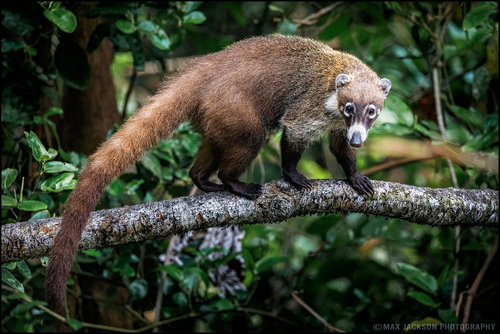
Reddish-brown to dark brown fur, paler underparts, a long pointed snout, small rounded ears, and a long banded tail usually held erect; facial markings include pale patches around the eyes and snout.
Size
Head-body length 41-67 cm, with tail nearly as long as the body, adding another 32-69 cm
Weight
Typically 2-7 kg, with males generally larger and heavier than females
Distinctive features
Distinguished from the White-nosed Coati by generally darker coloration and more southern/eastern range; elongated flexible snout and upright tail carriage are key identifying traits among procyonids.
Differences between males and females
Males are notably larger and heavier than females and become solitary as adults, while females remain smaller and highly social.
Behaviour and diet of the South American Coati
Females and juveniles live in bands of 5-30 individuals with a matriarchal social structure; adult males are largely solitary except during breeding season when they may join bands temporarily.
When it is active
Primarily diurnal, foraging on the ground during the day and retreating to trees to rest and sleep at night.
Diet
Omnivorous, feeding on invertebrates, small vertebrates, fruits, seeds, and occasionally eggs; diet shifts seasonally based on fruit and insect availability.
How it feeds and hunts
Uses its snout and forepaws to probe soil, leaf litter, and rotting logs for insects and larvae; opportunistically forages in groups, increasing chances of flushing prey.
Communication
Uses a range of vocalizations including chirps, grunts, and squeals, along with scent marking via anal glands and body postures to communicate within the band.
Interactions with other species
Predators include large felids such as jaguars and pumas, as well as large raptors preying on juveniles; coatis may compete with other omnivores for fruit and invertebrate resources.
Role in its ecosystem
Plays a role as both predator of invertebrates and small vertebrates and as a seed disperser through fruit consumption, contributing to forest regeneration.
Reproduction and lifecycle
Breeding is seasonal, often coinciding with fruit abundance; gestation lasts about 70-77 days, with litters of 2-6 young born in tree nests.
Raising the young
Females give birth and raise young mostly alone in the band, with communal care sometimes provided by other females; young are weaned around 4 months and become independent within a year.
Maturity and lifespan
Sexual maturity around 2 years; lifespan typically 7-8 years in the wild and up to 15-17 years in captivity.
Taxonomy and naming of the South American Coati
Classification
Mammalia > Carnivora > Procyonidae > Nasua > Nasua nasua
Subspecies
Several subspecies recognized including N. n. nasua (Brazil, Guianas), N. n. solitaria (southern Brazil, Argentina), N. n. candace, N. n. vittata, and others distributed across different regions of South America, though taxonomy remains debated.
Scientific synonyms
Viverra nasua (original Linnaean name), Nasua socialis
What research says
Recent studies
Recent studies have focused on coati social structure using GPS tracking, their role in seed dispersal in fragmented forests, and genetic diversity across subspecies boundaries.
Genome and DNA
Diploid chromosome number reported as 2n=38; limited but growing genomic studies related to procyonid phylogenetics.
Compared with similar species
Similar to the White-nosed Coati (Nasua narica) of Central America but generally smaller with a more restricted northern distribution overlap; distinguishable by range and subtle coloration differences.
The South American Coati and people
Coatis can rotate their ankles 180 degrees, allowing them to descend trees headfirst like squirrels; they are sometimes called 'Brazilian aardvark' due to their probing snout; groups of coatis are called bands.
Where and how to see it
Best observed in protected areas such as Brazil's Pantanal or Iguazu National Park during daytime hours when bands actively forage; early morning offers the highest activity levels.
Risks to humans
Generally low risk, though habituated individuals near tourist areas can bite or scratch if provoked while seeking food.
Human uses
Occasionally hunted for meat and fur in rural areas; also kept as exotic pets in some regions despite legal restrictions, and popular attractions in ecotourism settings.
Myths and legends
In some South American folk traditions, coatis are associated with mischief and cleverness due to their curious and bold behavior around human camps and settlements.
Countries where the South American Coati is recorded
The 7 countries named in the range description of its IUCN Red List assessment.
Questions about the South American Coati
Where does the South American Coati live?
The South American Coati is recorded in Argentina, Bolivia, Brazil, Colombia and Paraguay, among 7 countries in total across South America. These countries come from the range description of its IUCN Red List assessment, and they are what place the species on the interactive map.
Is the South American Coati endangered?
The IUCN Red List assesses the South American Coati as Least Concern. The species is widespread and abundant enough not to qualify for any threatened category. It does not mean the species is safe forever, only that nothing in the current data raises an alarm.
How many are left in the wild?
No precise global estimate exists; population considered stable overall, with some regional declines in heavily deforested areas. This figure comes from the species assessment on the IUCN Red List; population estimates for wild mammals are ranges, not counts, and are revised at each assessment.
What habitat does the South American Coati live in?
Found in tropical rainforest, dry forest, gallery forest, cerrado savanna, and secondary growth habitats; highly adaptable to disturbed and edge habitats near human settlements.
What is the scientific name of the South American Coati?
The South American Coati is Nasua nasua, in the family Procyonidae, order Carnivora.
Other species in the genus Nasua
Other species in the family Procyonidae
Species that share its range

Sources
Conservation status, range description and population estimate come from the IUCN Red List assessment for Nasua nasua. Countries are derived from that range description, not from a mapped country list. Last refreshed on .
The distribution map is drawn from the IUCN Red List spatial data compiled in 2008. IUCN (International Union for Conservation of Nature)