
Cacomistle
Bassariscus sumichrasti
Red List assessment
Least Concernon the IUCN Red List
- EXExtinct
- EWExtinct in the Wild
- CRCritically Endangered
- ENEndangered
- VUVulnerable
- NTNear Threatened
- LCLeast Concern
The Cacomistle is recorded in 8 countries across North America. The IUCN Red List assesses the Cacomistle as Least Concern. No precise global population estimate exists; the species is considered uncommon but not rare, with a likely declining trend due to ongoing habitat loss.
- Family
- Procyonidae
- Order
- Carnivora
- Genus
- Bassariscus
- Countries recorded
- 8
- Continents
- North America
- Red List category
- Least Concern
- Data updated
- August 9, 2026
What is the Cacomistle?
The cacomistle is a slender, nocturnal procyonid closely related to the ringtail, native to the humid forests of Mexico and Central America. It is an agile climber with a long banded tail nearly as long as its body, used for balance in the forest canopy. Though widespread, it is rarely seen due to its elusive, nocturnal, and highly arboreal habits. It plays an important ecological role as an omnivorous seed disperser and small predator.
Where does the Cacomistle live?
Southern Mexico, through Central America to western Panama
Ranges from southern Mexico (Veracruz, Oaxaca, Chiapas) through Guatemala, Belize, Honduras, El Salvador, Nicaragua, Costa Rica, to western Panama. Distribution is patchy, tied closely to remaining forest cover.
Altitude and depth
Found from sea level up to approximately 2,500-3,000 meters elevation, with highest densities in mid-elevation cloud forests.
Seasonal movements
No migration or hibernation; activity may shift slightly with rainy vs. dry season food availability, but the species remains active year-round.
Habitat of the Cacomistle
Primarily found in humid tropical and subtropical evergreen forests, cloud forests, and forest edges; also occupies secondary growth and areas near plantations. It prefers dense canopy cover for movement and shelter, often in association with rocky outcrops or tree hollows.
Adaptations to its environment
Its long tail, flexible spine, and semi-retractile claws allow exceptional agility for climbing and jumping between branches. Large eyes adapted for night vision aid nocturnal foraging in dense forest canopy. Its omnivorous diet allows flexibility in food availability across seasons.
Conservation status and numbers
Listed as Least Concern (LC) by the IUCN due to its relatively wide distribution and tolerance of some habitat disturbance, though populations are believed to be declining locally due to deforestation.
Estimated population
No precise global population estimate exists; the species is considered uncommon but not rare, with a likely declining trend due to ongoing habitat loss.
What threatens the Cacomistle?
Habitat loss from deforestation and agricultural expansion is the primary threat, along with fragmentation of forest corridors. Hunting and incidental trapping also pose localized threats.
Diseases and parasites
Specific studies are limited, but as with related procyonids, it likely can host parasites such as ticks, fleas, and intestinal worms, and may be susceptible to diseases affecting other procyonids like rabies or distemper.
What is being done to protect it?
Protected in several national parks and reserves across its range, including in Mexico and Costa Rica, where forest habitat is preserved. It is included in some Mexican wildlife protection regulations but lacks a dedicated species-specific conservation program.
Recommended actions
Priority actions include maintaining forest connectivity, protecting mid-elevation cloud forest habitat, and conducting more population studies to better assess actual density and trends.
What the Cacomistle looks like
The cacomistle has soft grayish-brown to olive-brown fur, a pale underside, and a long, bushy tail with 5-8 dark bands ending in a dark or black tip. Its face has a masked pattern with dark rings around large eyes, resembling a raccoon-lemur hybrid in appearance.
Size
Body length (head to base of tail) about 38-47 cm, with tail length nearly equal, at 40-53 cm, giving a total length up to nearly 1 meter.
Weight
Typically weighs between 0.8 and 1.2 kg, with limited difference between sexes.
Distinctive features
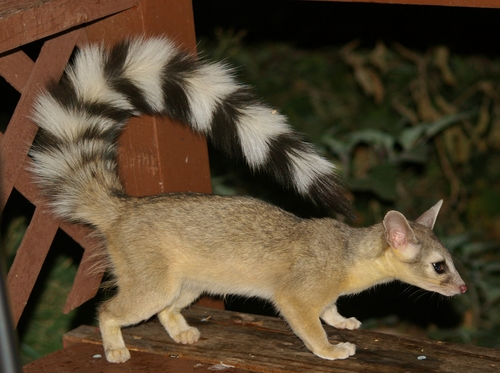
It can be distinguished from the closely related ringtail (Bassariscus astutus) by its darker, less contrasting tail bands, more elongated body, larger size, and preference for denser, wetter forest habitats.
Differences between males and females
Sexual dimorphism is minimal; males and females are similar in size and coloration.
Behaviour and diet of the Cacomistle
Mostly solitary, though occasionally seen in pairs or small family groups. Home ranges may overlap, especially between males and females during breeding season.
When it is active
Strictly nocturnal, spending daylight hours resting in tree hollows, dense vegetation, or rocky crevices, and becoming active after dusk to forage.
Diet
Omnivorous diet including fruits, insects, small vertebrates (rodents, birds, lizards), and occasionally nectar. Fruit can make up a significant portion of the diet, aiding in seed dispersal.
How it feeds and hunts
Hunts opportunistically by stalking and pouncing on small prey in trees or on the ground, using acute night vision and agility to catch insects and small vertebrates.
Communication
Communicates through a range of vocalizations including chirps, barks, and whistles, as well as scent marking using specialized anal glands to signal territory and reproductive status.
Interactions with other species
Natural predators may include large owls, ocelots, and other mid-sized carnivores; it also competes for food and habitat with other frugivorous/omnivorous mammals like kinkajous and opossums.
Role in its ecosystem
Functions as both predator of small animals and disperser of seeds through fruit consumption, playing a role in maintaining forest plant diversity and controlling insect and small vertebrate populations.
Reproduction and lifecycle
Breeding season generally occurs during the dry season (around March-May in parts of range); gestation lasts about 63-66 days, with litters of 1-3 young born typically once per year.
Raising the young
Females rear the young alone in a den (often a tree hollow), nursing and protecting them until weaning around 2 months, after which juveniles gradually become independent.
Maturity and lifespan
Sexual maturity is typically reached around 2-3 years of age; lifespan in the wild is estimated at 7-10 years, while captive individuals may live longer, up to 15 years.
Taxonomy and naming of the Cacomistle
Classification
Class Mammalia > Order Carnivora > Family Procyonidae > Genus Bassariscus > Species Bassariscus sumichrasti
Subspecies
Several subspecies have been proposed (e.g., B. s. sumichrasti, B. s. variabilis, B. s. willetti) based on regional variation, but taxonomy remains debated and not universally recognized.
Scientific synonyms
Bassaris sumichrasti (original combination), Jentinkia sumichrasti
What research says
Recent studies
Recent camera-trap and ecological studies have focused on clarifying its habitat use and density in fragmented Central American forests, highlighting its sensitivity to deforestation despite its LC status.
Genome and DNA
Specific chromosome counts and genomic studies are limited, though it shares general genetic similarities with other Procyonidae, particularly Bassariscus astutus.
Compared with similar species
Compared to the ringtail (Bassariscus astutus), the cacomistle is larger, has a less bushy and darker-banded tail, and inhabits wetter, denser forest rather than arid or rocky terrain.
The Cacomistle and people
The cacomistle's name comes from Nahuatl words meaning 'half mountain lion,' reflecting its cat-like agility. It can leap impressive distances between tree branches using its long tail for balance, and despite being related to raccoons, it is much more slender and agile.
Where and how to see it
Best observed at night in cloud forest reserves in Costa Rica or southern Mexico, using red-light flashlights or camera traps near fruiting trees; patience is required due to its elusive, nocturnal nature.
Risks to humans
No notable risk to humans; it is shy and avoids contact, though like other wild carnivores it could bite if cornered or handled.
Human uses
Historically, its fur has had minor local use, and some communities have hunted it for meat or as a perceived pest near plantations, but no major commercial trade exists today.
Myths and legends
In some indigenous Mesoamerican traditions, animals resembling the cacomistle were associated with nocturnal spirits or forest guardians, though specific documented myths about this species are scarce.
Countries where the Cacomistle is recorded
The 8 countries named in the range description of its IUCN Red List assessment.
Questions about the Cacomistle
Where does the Cacomistle live?
The Cacomistle is recorded in Belize, Costa Rica, El Salvador, Guatemala and Honduras, among 8 countries in total across North America. These countries come from the range description of its IUCN Red List assessment, and they are what place the species on the interactive map.
Is the Cacomistle endangered?
The IUCN Red List assesses the Cacomistle as Least Concern. The species is widespread and abundant enough not to qualify for any threatened category. It does not mean the species is safe forever, only that nothing in the current data raises an alarm.
How many are left in the wild?
No precise global population estimate exists; the species is considered uncommon but not rare, with a likely declining trend due to ongoing habitat loss. This figure comes from the species assessment on the IUCN Red List; population estimates for wild mammals are ranges, not counts, and are revised at each assessment.
What habitat does the Cacomistle live in?
Primarily found in humid tropical and subtropical evergreen forests, cloud forests, and forest edges; also occupies secondary growth and areas near plantations.
What is the scientific name of the Cacomistle?
The Cacomistle is Bassariscus sumichrasti, in the family Procyonidae, order Carnivora.
Other species in the genus Bassariscus
Other species in the family Procyonidae
Species that share its range
Sources
Conservation status, range description and population estimate come from the IUCN Red List assessment for Bassariscus sumichrasti. Countries are derived from that range description, not from a mapped country list. Last refreshed on .
The distribution map is drawn from the IUCN Red List spatial data compiled in 2008. IUCN (International Union for Conservation of Nature)