
Grey Dwarf Hamster
Nothocricetulus migratorius
Red List assessment
Least Concernon the IUCN Red List
- EXExtinct
- EWExtinct in the Wild
- CRCritically Endangered
- ENEndangered
- VUVulnerable
- NTNear Threatened
- LCLeast Concern
The Grey Dwarf Hamster is recorded in 9 countries across Asia and Europe. The IUCN Red List assesses the Grey Dwarf Hamster as Least Concern. No precise global population estimate exists, but the species is considered common to abundant throughout much of its range, with a presumed stable overall population trend.
- Family
- Cricetidae
- Order
- Rodentia
- Genus
- Nothocricetulus
- Countries recorded
- 9
- Continents
- Asia and Europe
- Red List category
- Least Concern
- Data updated
- August 9, 2026
What is the Grey Dwarf Hamster?
The Grey Dwarf Hamster is a small, widely distributed rodent found across a vast range from Eastern Europe to Mongolia and China. It inhabits steppe, semi-desert, and agricultural landscapes, often living close to human settlements. This species is notable for its extremely broad geographic range compared to most dwarf hamster species and its adaptability to diverse arid and semi-arid environments.
Where does the Grey Dwarf Hamster live?
Eastern Europe through the Balkans, Ukraine, southern Russia, the Caucasus, Central Asia, Middle East, Mongolia and northern China
Ranges from southeastern Europe (Balkans, Ukraine) through southern Russia, the Caucasus, Turkey, the Middle East (Iran, Iraq, Syria), Central Asian republics, Afghanistan, Pakistan, Mongolia, and into northwestern China.
Altitude and depth
Typically found from sea level up to around 3000 meters in mountainous regions of Central Asia and the Caucasus.
Seasonal movements
Does not undergo true hibernation but may reduce activity during severe winter cold, relying on stored food caches. Breeding activity peaks in warmer months from spring through autumn.
Habitat of the Grey Dwarf Hamster
Prefers steppe grasslands, semi-desert areas, agricultural fields, and dry rocky terrain. Also found in gardens, orchards, and human-modified landscapes including village outskirts and farmland edges.
Adaptations to its environment
Possesses cheek pouches for transporting and caching food, an adaptation crucial for surviving harsh winters and food scarcity. Its burrowing behavior provides protection from temperature extremes and predators in open steppe habitats.
Conservation status and numbers
Listed as Least Concern by the IUCN due to its extremely wide distribution, presumed large population, and tolerance of a variety of habitats including disturbed and agricultural land.
Estimated population
No precise global population estimate exists, but the species is considered common to abundant throughout much of its range, with a presumed stable overall population trend.
What threatens the Grey Dwarf Hamster?
Locally affected by agricultural intensification, rodenticide use as a perceived pest species, and habitat conversion, though these do not threaten the species at a global level.
Diseases and parasites
Known to host various ectoparasites including fleas and mites, and has been studied as a potential reservoir for certain zoonotic pathogens in some regions.
What is being done to protect it?
No specific conservation programs target this species due to its Least Concern status; it occurs in numerous protected steppe and desert reserves across its range incidentally.
Recommended actions
Continued monitoring of population trends in agricultural areas where it may be targeted as a pest, and taxonomic clarification of subspecies boundaries across its range.
What the Grey Dwarf Hamster looks like
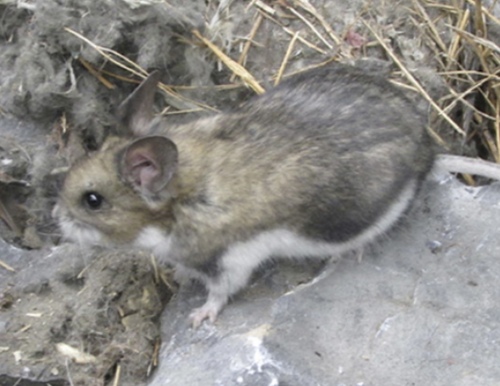
Fur is grey to greyish-brown on the back with a pale grey or white underside, giving it a distinctly bicolored appearance. The body is compact and rounded with small rounded ears and short legs typical of dwarf hamsters.
Size
Body length typically ranges from 8 to 13 cm, with a short tail of about 2-3 cm.
Weight
Adults typically weigh between 20 and 50 grams, with some regional variation.
Distinctive features
Distinguished from other Cricetulus and dwarf hamster species by its short tail, grey dorsal coloration lacking strong dark dorsal stripes, and larger average body size compared to some congeners.
Differences between males and females
Sexual dimorphism is minimal, with males and females similar in size and coloration, though females may be slightly heavier during breeding periods.
Behaviour and diet of the Grey Dwarf Hamster
Generally solitary and territorial outside of breeding encounters, with individuals maintaining separate burrow systems and showing aggression toward conspecifics.
When it is active
Primarily nocturnal, emerging after dusk to forage, though some crepuscular activity has been observed particularly in cooler seasons.
Diet
Omnivorous, feeding mainly on seeds, grains, and plant material, supplemented with insects and other small invertebrates when available.
How it feeds and hunts
Forages opportunistically on the ground, using cheek pouches to collect and transport food back to burrows for storage rather than active hunting.
Communication
Communicates through scent marking via specialized skin glands, along with ultrasonic vocalizations and body postures used in territorial and mating contexts.
Interactions with other species
Preyed upon by owls, foxes, small mustelids, and snakes; competes with other small rodents for food resources in steppe and agricultural habitats.
Role in its ecosystem
Plays a role in seed dispersal and soil aeration through burrowing activity, while also serving as an important prey base for numerous steppe predators.
Reproduction and lifecycle
Breeding occurs mainly from spring to autumn, with gestation lasting around 15-19 days and litters typically containing 4-9 pups, though larger litters have been recorded.
Raising the young
Females provide sole parental care, nursing and protecting pups in the burrow until weaning occurs at around 3 weeks of age, after which juveniles become independent.
Maturity and lifespan
Reaches sexual maturity at around 2-3 months of age; lifespan in the wild is typically 1-2 years, while captive individuals may live up to 2-3 years.
Taxonomy and naming of the Grey Dwarf Hamster
Classification
Class Mammalia > Order Rodentia > Family Cricetidae > Genus Nothocricetulus > Species Nothocricetulus migratorius
Subspecies
Several subspecies have been described across its vast range, including N. m. migratorius (western populations), N. m. caucasicus (Caucasus region), and N. m. fulvus (Central Asia), though taxonomy remains debated among some authorities.
Scientific synonyms
Cricetulus migratorius (widely used former genus placement); Cricetus migratorius
What research says
Recent studies
Recent phylogenetic studies have contributed to reclassifying this species from the genus Cricetulus into the monotypic genus Nothocricetulus based on genetic and morphological distinctiveness.
Genome and DNA
Has a diploid chromosome number of 2n=22, and has been used in some comparative genetic studies within the Cricetidae family.
Compared with similar species
Similar in general form to other dwarf hamsters like Cricetulus barabensis, but distinguished by larger size, grey coloration, and broader geographic tolerance spanning from Europe to East Asia.
The Grey Dwarf Hamster and people
Despite its common name 'migratory hamster,' it does not undertake long-distance migrations but was named for its unusually wide geographic distribution across Eurasia. It is also one of the ancestral species sometimes referenced in early hamster domestication research, though the golden hamster remains the primary domesticated species.
Where and how to see it
Best observed at dusk or during nighttime hours in steppe or agricultural areas across its range, using a flashlight near burrow entrances; patience is required due to its shy and nocturnal nature.
Risks to humans
No notable risk to humans; occasionally regarded as a minor agricultural pest due to seed and grain consumption.
Human uses
Not commonly used commercially, though it has occasionally been utilized in scientific research related to rodent physiology and genetics.
Countries where the Grey Dwarf Hamster is recorded
The 9 countries named in the range description of its IUCN Red List assessment.
Questions about the Grey Dwarf Hamster
Where does the Grey Dwarf Hamster live?
The Grey Dwarf Hamster is recorded in Afghanistan, China, Iran, Iraq and Mongolia, among 9 countries in total across Asia and Europe. These countries come from the range description of its IUCN Red List assessment, and they are what place the species on the interactive map.
Is the Grey Dwarf Hamster endangered?
The IUCN Red List assesses the Grey Dwarf Hamster as Least Concern. The species is widespread and abundant enough not to qualify for any threatened category. It does not mean the species is safe forever, only that nothing in the current data raises an alarm.
How many are left in the wild?
No precise global population estimate exists, but the species is considered common to abundant throughout much of its range, with a presumed stable overall population trend. This figure comes from the species assessment on the IUCN Red List; population estimates for wild mammals are ranges, not counts, and are revised at each assessment.
What habitat does the Grey Dwarf Hamster live in?
Prefers steppe grasslands, semi-desert areas, agricultural fields, and dry rocky terrain.
What is the scientific name of the Grey Dwarf Hamster?
The Grey Dwarf Hamster is Nothocricetulus migratorius, in the family Cricetidae, order Rodentia.
Other species in the family Cricetidae
Species that share its range
Sources
Conservation status, range description and population estimate come from the IUCN Red List assessment for Nothocricetulus migratorius. Countries are derived from that range description, not from a mapped country list. Last refreshed on .
The distribution map is drawn from the IUCN Red List spatial data compiled in 2008. IUCN (International Union for Conservation of Nature)