
Great Jerboa
Allactaga major
Red List assessment
Least Concernon the IUCN Red List
- EXExtinct
- EWExtinct in the Wild
- CRCritically Endangered
- ENEndangered
- VUVulnerable
- NTNear Threatened
- LCLeast Concern
The Great Jerboa is recorded in 9 countries across Asia and Europe. The IUCN Red List assesses the Great Jerboa as Least Concern. No precise global population estimate is available.
- Family
- Dipodidae
- Order
- Rodentia
- Genus
- Allactaga
- Countries recorded
- 9
- Continents
- Asia and Europe
- Red List category
- Least Concern
- Data updated
- August 9, 2026
What is the Great Jerboa?
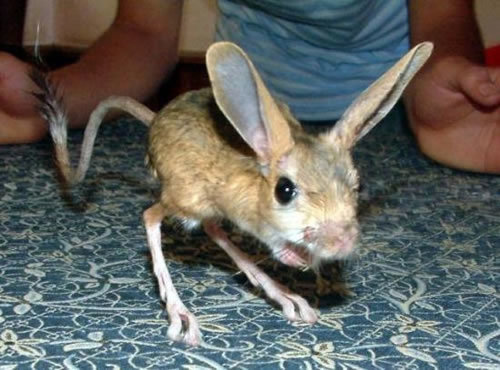
The Great Jerboa (Allactaga major) is the largest member of the five-toed jerboas (genus Allactaga) and one of the most iconic small mammals of the Eurasian steppes and semi-deserts. It is instantly recognizable by its extremely elongated hind limbs used for bipedal locomotion, its long balancing tail adorned with a distinctive black-and-white tufted tip, and its large eyes adapted for nocturnal life. It is remarkable for its extraordinary leaping ability — capable of covering up to 3 meters in a single bound — and its complete physiological independence from free water, deriving all moisture metabolically from its food. This species plays an important ecological role as a seed disperser and prey item for steppe predators.
Where does the Great Jerboa live?
Steppes and semi-deserts of Eastern Europe and Central Asia, from Ukraine and southern Russia eastward through Kazakhstan, Uzbekistan, Turkmenistan, and into northwestern China and Mongolia.
The species ranges from Ukraine and southern Russia (north of the Caucasus and across the lower Volga region) eastward through Kazakhstan, Uzbekistan, Turkmenistan, Kyrgyzstan, and Tajikistan, extending into the Xinjiang region of northwestern China and parts of Mongolia. It is one of the most widely distributed jerboas in the Palearctic.
Altitude and depth
Primarily a lowland species found from near sea level up to approximately 1,500–2,000 m in the foothills and elevated steppe plateaus of Central Asia.
Seasonal movements
The Great Jerboa is a true hibernator, entering deep torpor from approximately October or November through March or April, depending on latitude and local climate. After emergence, individuals are active through spring, summer, and early autumn. A period of hyperphagia occurs in late summer and autumn to accumulate fat reserves for hibernation.
Habitat of the Great Jerboa
The Great Jerboa primarily inhabits open steppes, semi-deserts, and desert margins with sparse grass and herbaceous cover. It shows a preference for flat or gently undulating terrain with sandy, loamy, or clay soils suitable for burrowing, and is also found in areas with wormwood (Artemisia) associations and degraded grasslands. It generally avoids dense vegetation and heavily cultivated lands.
Adaptations to its environment
Its massively enlarged hind limbs and reduced forelimbs are a classic adaptation for saltatorial (bipedal hopping) locomotion across open terrain, allowing rapid escape from predators. The long, tufted tail provides balance and steering during leaps. Large eyes are adapted for low-light nocturnal foraging, and relatively large pinnae enhance auditory detection of predators. Physiologically, it is capable of extracting all necessary water from its food, a critical adaptation for arid environments. It constructs complex burrow systems with separate chambers for sleeping, food storage, and hibernation, providing thermal refuge.
Conservation status and numbers
Least Concern (LC) on the IUCN Red List. The species has a wide distribution, a presumably large total population, and is present in numerous protected areas. Although some local populations may be declining due to agricultural intensification, there is no evidence of a range-wide decline meeting the threshold for a threatened category.
Estimated population
No precise global population estimate is available. The species is considered relatively common across most of its range, though local densities vary considerably. Population trend is considered stable overall, with possible local declines in heavily cultivated or overgrazed areas.
What threatens the Great Jerboa?
The main threats include conversion of natural steppe habitat to agricultural land, overgrazing by livestock (which degrades burrow habitats and reduces food plant cover), use of pesticides (which reduces insect prey availability), and desertification driven by climate change. Rodent poisoning campaigns conducted in some countries as pest control measures also pose a threat.
Diseases and parasites
The species is known to harbor fleas (particularly Xenopsylla and Nosopsyllus species) that can serve as vectors for plague (Yersinia pestis) and tularemia (Francisella tularensis) in natural foci across Central Asia. Ticks (Ixodes and Dermacentor spp.) are also common ectoparasites. Various internal helminth parasites have been recorded.
What is being done to protect it?
The Great Jerboa benefits from protection within numerous steppe nature reserves and national parks across its range, including reserves in Russia (e.g., Orenburgsky Reserve), Kazakhstan, and Uzbekistan. It is listed in national Red Data Books in some countries where local populations are threatened. No species-specific recovery programs are known to exist.
Recommended actions
Priority actions include maintaining and expanding steppe reserves, restricting indiscriminate rodenticide use, monitoring population trends through standardized surveys, and assessing the impact of agricultural expansion on local populations. Research into the genetic structure of populations across the range would also help clarify subspecific taxonomy and identify conservation units.
What the Great Jerboa looks like
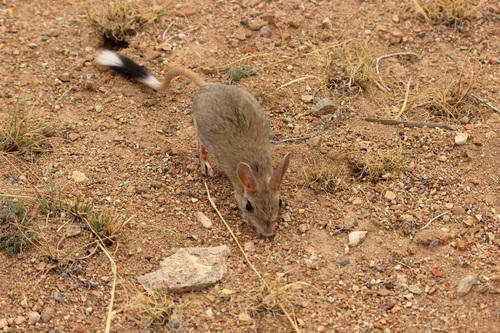
The dorsal fur is sandy-yellow to gray-brown, matching the steppe soil, while the underparts, including chin and belly, are pure white. The tail is long and slender with a characteristic bicolor terminal tuft — black proximally and white distally — used for balance and visual signaling. The hind limbs are extremely long and powerful with five toes (the first and fifth being small), while the forelimbs are short and used for digging and manipulating food. The ears are moderately large and the eyes are prominent and dark.
Size
Body length: 190–265 mm; tail length: 220–290 mm (approximately equal to or slightly longer than body); hind foot length: 70–85 mm; ear length: 40–55 mm.
Weight
Typically 250–480 g; individuals accumulate significant fat reserves before hibernation, reaching the upper end of this range in autumn. No strong sexual size dimorphism reported.
Distinctive features
The Great Jerboa is distinguished from other Allactaga species primarily by its large body size — it is noticeably larger than the small five-toed jerboa (A. elater) and other congeners. The five functional toes on the hind foot distinguish the entire genus Allactaga from the three-toed jerboas (Jaculus spp.). The distinctive black-and-white tufted tail tip is a consistent field mark.
Differences between males and females
Sexual dimorphism is minimal in this species. Males and females are similar in body size, coloration, and overall morphology, making field sexing difficult without handling.
Behaviour and diet of the Great Jerboa
The Great Jerboa is largely solitary outside of the breeding season. Each adult maintains and defends its own burrow system, and individuals generally avoid conspecifics. Some degree of social tolerance may occur in areas of high population density, particularly among juveniles before full establishment.
When it is active
Strictly nocturnal; individuals emerge from their burrows after sunset and return before dawn. Activity is concentrated in the early and late parts of the night. During extreme heat or during the pre-hibernation period, patterns may shift slightly.
Diet
The Great Jerboa is omnivorous, feeding primarily on seeds, bulbs, roots, and succulent plant parts, but supplementing its diet extensively with insects (beetles, grasshoppers, larvae) and other invertebrates, especially during the breeding season when protein demand is high. The proportion of animal matter in the diet varies seasonally and geographically.
How it feeds and hunts
Food is located by smell and hearing while moving bipedally across the ground surface. Insects are caught by rapid lunging with the forepaws. Seeds and plant materials are excavated from the soil or gathered from the surface. Food items may be carried back to the burrow in cheek pouches for caching.
Communication
Communication involves foot-drumming on the substrate, which may signal alarm or territorial presence. Ultrasonic vocalizations are likely used, particularly between mothers and offspring or during mating. Scent marking via urine and possibly specialized glands plays a role in territory delineation and mate attraction.
Interactions with other species
Major predators include owls (particularly barn and eagle owls), steppe foxes (Vulpes corsac), corsac foxes, ferrets (Mustela eversmanii), steppe eagles, and various snake species. It competes with other small herbivorous rodents for food resources. The species may act as a host for fleas capable of transmitting plague (Yersinia pestis) in endemic regions, making it epidemiologically significant.
Role in its ecosystem
The Great Jerboa plays a significant role in steppe ecosystems as a seed disperser (through caching behavior and abandoned food stores), a consumer of insects (contributing to invertebrate population regulation), and as an important prey species sustaining populations of steppe raptors and carnivores. Its burrowing activity also contributes to soil aeration and turnover.
Reproduction and lifecycle
The breeding season begins shortly after emergence from hibernation in spring (typically April–May). Gestation lasts approximately 25–30 days. Litter sizes range from 2 to 8, with an average of 3–5 young. One or two litters per year are produced, with the first litter born in May–June.
Raising the young
The female alone is responsible for raising the young, which are born altricial (naked, blind, and helpless) in a grass-lined nest chamber within the burrow. Weaning occurs at approximately 4–6 weeks of age, after which juveniles begin to disperse and establish their own burrows.
Maturity and lifespan
Sexual maturity is reached at approximately 10–12 months of age (i.e., in the first spring following birth). Lifespan in the wild is typically 2–3 years, rarely exceeding 4 years. In captivity, individuals have lived up to 5–6 years.
Taxonomy and naming of the Great Jerboa
Classification
Mammalia > Rodentia > Dipodidae > Allactaga > Allactaga major
Subspecies
Several subspecies have been described, including Allactaga major major (Pallas, 1778) covering the western range, A. m. annulata in parts of Central Asia, and A. m. mongolica in the eastern steppes; however, subspecific boundaries are debated and require further revision.
Scientific synonyms
Mus major Pallas, 1778; Dipus major (Pallas, 1778); Scirtetes major. The species was originally described by Pallas in 1778 under the genus Mus.
What research says
Recent studies
Recent phylogeographic studies across the Dipodidae family have explored the colonization history of steppe and desert ecosystems by jerboas, with A. major serving as a key taxon for understanding Palearctic biogeography. Studies on plague transmission in Central Asian rodent communities have examined its role as a secondary reservoir host. Climate change modeling studies have projected potential range shifts for steppe rodents including this species.
Genome and DNA
The diploid chromosome number for Allactaga major is reported as 2n = 48. Molecular phylogenetic studies of Dipodidae have confirmed the monophyly of the genus Allactaga and clarified its position within the family, though detailed genomic studies specific to this species remain limited.
Compared with similar species
Compared to the Small Five-Toed Jerboa (Allactaga elater), the Great Jerboa is substantially larger in all dimensions and has a broader ecological range. It is distinguished from the Mongolian Five-Toed Jerboa (Allactaga sibirica) by its range and slightly different proportions. Unlike the three-toed jerboas of the genus Jaculus, which are primarily desert specialists, Allactaga major is better adapted to true steppe environments. The Lesser Egyptian Jerboa (Jaculus jaculus) occupies a similar ecological niche in North Africa but belongs to a different genus with a reduced three-toed hind foot.
The Great Jerboa and people
1. The Great Jerboa can leap up to 3 meters in a single bound and travel several kilometers in a night, moving almost exclusively on two legs like a miniature kangaroo. 2. It never needs to drink water, obtaining all the moisture it needs metabolically from its food — a remarkable adaptation to arid steppe and desert life. 3. Before hibernation, it can nearly double its body weight by accumulating fat reserves, then loses this mass entirely over a 5–6 month hibernation without eating or drinking.
Where and how to see it
The best time to observe the Great Jerboa is on warm, windless nights in late spring through early autumn, using a red-filtered headlamp to minimize disturbance (animals are less sensitive to red light). Prime locations include open steppe reserves in Kazakhstan (e.g., Naurzum Nature Reserve), the Orenburg steppe region of Russia, and semi-desert areas of Uzbekistan. Approaching slowly by vehicle at night along dirt tracks through suitable habitat offers the best chances of sightings.
Risks to humans
No notable direct risk to humans. However, in plague-endemic areas of Central Asia, handling wild-caught individuals without protection is discouraged due to the potential presence of plague-carrying fleas. Like all wild rodents, it may bite if handled, carrying a small risk of bacterial infection.
Human uses
The Great Jerboa has limited direct human uses. It has historically been captured for the exotic pet trade in small numbers, though this is now regulated or prohibited in most range countries. It has been used as a model organism in some physiological studies of water balance and hibernation. In some regions, large aggregations have historically been considered minor agricultural pests due to seed consumption, leading to localized control measures.
Myths and legends
In Central Asian nomadic cultures, jerboas are sometimes regarded as auspicious or clever animals due to their seemingly magical ability to appear and disappear rapidly in the vast steppe. They feature in occasional folk tales as trickster figures. No major formal mythology is specifically associated with Allactaga major, though the broader group of jerboas has been noted in ancient Near Eastern and Central Asian oral traditions as symbols of desert survival and cunning.
Countries where the Great Jerboa is recorded
The 9 countries named in the range description of its IUCN Red List assessment.
Questions about the Great Jerboa
Where does the Great Jerboa live?
The Great Jerboa is recorded in China, Kazakhstan, Kyrgyzstan, Mongolia and Russia, among 9 countries in total across Asia and Europe. These countries come from the range description of its IUCN Red List assessment, and they are what place the species on the interactive map.
Is the Great Jerboa endangered?
The IUCN Red List assesses the Great Jerboa as Least Concern. The species is widespread and abundant enough not to qualify for any threatened category. It does not mean the species is safe forever, only that nothing in the current data raises an alarm.
How many are left in the wild?
No precise global population estimate is available. This figure comes from the species assessment on the IUCN Red List; population estimates for wild mammals are ranges, not counts, and are revised at each assessment.
What habitat does the Great Jerboa live in?
The Great Jerboa primarily inhabits open steppes, semi-deserts, and desert margins with sparse grass and herbaceous cover.
What is the scientific name of the Great Jerboa?
The Great Jerboa is Allactaga major, in the family Dipodidae, order Rodentia.
Other species in the genus Allactaga
Other species in the family Dipodidae
Species that share its range
Sources
Conservation status, range description and population estimate come from the IUCN Red List assessment for Allactaga major. Countries are derived from that range description, not from a mapped country list. Last refreshed on .
The distribution map is drawn from the IUCN Red List spatial data compiled in 2008. IUCN (International Union for Conservation of Nature)