
Hotson's Five-toed Jerboa
Allactaga hotsoni
Red List assessment
Least Concernon the IUCN Red List
- EXExtinct
- EWExtinct in the Wild
- CRCritically Endangered
- ENEndangered
- VUVulnerable
- NTNear Threatened
- LCLeast Concern
The Hotson's Five-toed Jerboa is recorded in 3 countries across Asia. The IUCN Red List assesses the Hotson's Five-toed Jerboa as Least Concern. No reliable global population estimate exists for this species.
- Family
- Dipodidae
- Order
- Rodentia
- Genus
- Allactaga
- Countries recorded
- 3
- Continents
- Asia
- Red List category
- Least Concern
- Data updated
- August 9, 2026
What is the Hotson's Five-toed Jerboa?
Hotson's Five-toed Jerboa is a small, bipedal rodent belonging to the family Dipodidae, first described by Oldfield Thomas in 1920 and named in honour of J.E.B. Hotson, a British officer active in the region at the time. Like all members of the genus Allactaga, it is characterized by greatly elongated hind limbs used for rapid bipedal locomotion across open desert terrain. It inhabits some of the most arid landscapes of the Iran-Pakistan borderlands, surviving in extreme heat with remarkable physiological efficiency. It is considered unremarkable in terms of conservation concern but remains one of the least-studied jerboas in its genus.
Where does the Hotson's Five-toed Jerboa live?
Southwestern Asia: primarily southeastern Iran (Sistan and Baluchestan Province) and western Pakistan (Balochistan Province), with possible occurrence in southern Afghanistan.
The species' range is centered on the arid lowlands of Balochistan Province in Pakistan and the adjacent Sistan and Baluchestan Province of southeastern Iran. Its western and northern range limits in Iran remain poorly defined, and there are unconfirmed records suggesting its presence in adjacent southern Afghanistan. Overall, the documented range is relatively restricted compared to other Allactaga species.
Altitude and depth
Typically found at low to moderate elevations, generally between 200 and 1200 meters above sea level, consistent with desert basin and plateau environments of the Iranian Plateau's southeastern margins.
Seasonal movements
Like many dipodids in continental arid zones, Hotson's Jerboa likely enters a period of winter torpor or reduced activity during the coldest months (December–February), retreating into sealed burrows. Activity peaks are expected in spring and early summer when plant productivity and insect availability are highest. Aestivation during the most extreme midsummer heat may also occur.
Habitat of the Hotson's Five-toed Jerboa
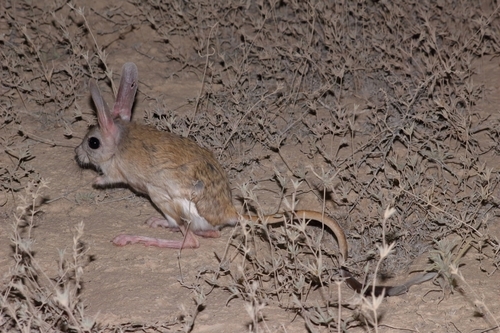
Primarily occupies hyper-arid desert and semi-desert landscapes, including sandy plains, stony gravel deserts (reg), and sparse scrubland with sparse vegetation. It is associated with loose soils suitable for burrowing and areas with patchy herbaceous or low shrub cover that provide foraging resources. It generally avoids mountain slopes and irrigated agricultural zones.
Adaptations to its environment
Its elongated hind limbs allow rapid bipedal hopping to escape predators and cover large distances while foraging in sparse habitat. Large eyes and ears enhance nocturnal vision and predator detection in open terrain. The kidneys are highly concentrated, minimizing water loss, and the animal can derive much of its water from food. Burrow-digging behavior provides thermal refuge from extreme diurnal temperatures that can exceed 45°C at ground surface.
Conservation status and numbers
Least Concern (LC) on the IUCN Red List. The species is assessed as LC because it has a reasonably broad range across arid southwestern Asia, no evidence of rapid population decline has been documented, and it is presumed to tolerate its harsh habitat well. However, data on actual population size and trend remain sparse.
Estimated population
No reliable global population estimate exists for this species. Population trend is assumed to be stable based on IUCN assessment, but this is largely inferred from habitat availability rather than field surveys.
What threatens the Hotson's Five-toed Jerboa?
The primary threats include habitat degradation from overgrazing by domestic livestock, which destabilizes sandy soils and reduces vegetative cover. Agricultural expansion and groundwater extraction alter desert ecosystems. Road construction and increased vehicular traffic across remote desert areas increase mortality. Climate change is a long-term concern, as intensifying drought and shifting precipitation patterns could reduce food availability.
Diseases and parasites
Like other small desert rodents, it likely hosts ectoparasites including fleas (Siphonaptera) and mites (Acari), which may act as vectors for pathogens including Leishmania species and various rickettsia. Specific parasite surveys for this species have not been published.
What is being done to protect it?
No species-specific conservation programme is known to exist for Hotson's Jerboa. It may benefit passively from protected areas within its range, such as the Hingol National Park in Pakistan. It is listed under Pakistan's Wildlife (Protection, Preservation, Conservation and Management) Act in various provincial ordinances.
Recommended actions
Targeted field surveys across the Iran-Pakistan-Afghanistan border region are urgently needed to clarify distribution and population status. Monitoring programs using camera traps and live-trapping should be established. Reducing overgrazing pressure in key habitat areas and incorporating the species into regional biodiversity assessments would improve conservation planning.
What the Hotson's Five-toed Jerboa looks like
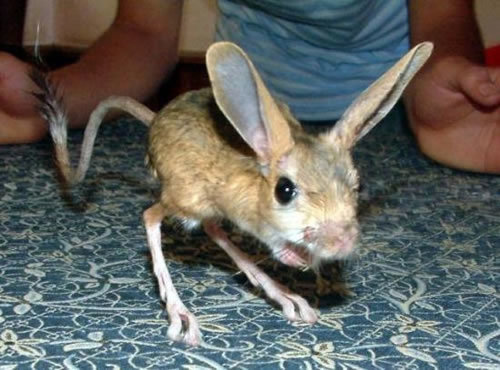
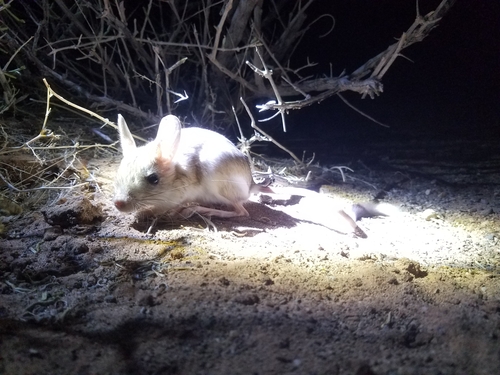
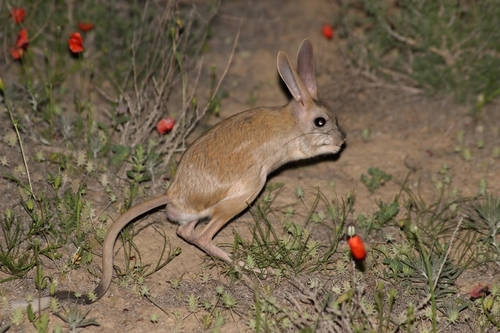
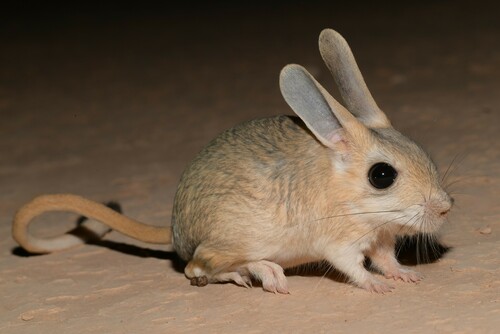
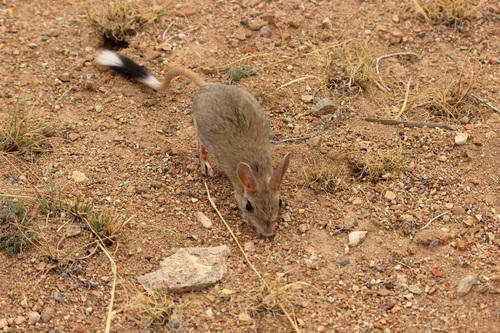
The dorsal pelage is sandy buff to pale brown, providing excellent camouflage against desert substrates. The ventral surface is white or pale cream. The tail is long and slender, ending in a conspicuous black-and-white terminal tuft ('flag'), which is used for balance during locomotion and possibly for intraspecific signaling. The hind feet are long and narrow, bearing five toes with stiff bristle-fringes aiding traction on loose sand.
Size
Body length approximately 95–135 mm; tail length approximately 155–205 mm (notably longer than the body); hind foot length approximately 60–75 mm. Ears are moderately long, around 30–40 mm.
Weight
Estimated body mass in the range of 45–90 grams, consistent with mid-sized Allactaga species; no sex-specific weight data are available.
Distinctive features
The presence of five functional hind toes (as opposed to three in Jaculus species) is the defining trait of genus Allactaga. Hotson's Jerboa is distinguished from sympatric or neighboring species such as Allactaga elater by its larger overall size, relatively longer ear length, and its restricted range in the southeastern part of the genus's distribution. The long tufted tail and the characteristic hopping gait are unmistakable field marks.
Differences between males and females
Sexual dimorphism is minimal in this species, as is typical for the genus. Males and females are similar in body size and coloration; males may be marginally heavier during the breeding season but this has not been formally quantified.
Behaviour and diet of the Hotson's Five-toed Jerboa
Hotson's Jerboa is presumed to be solitary outside the breeding season, consistent with most Allactaga species. Individuals maintain separate burrow systems and defend foraging territories. Transient overlap between individuals may occur at concentrated food patches.
When it is active
Strictly nocturnal; activity begins shortly after sunset and ceases before dawn. This pattern avoids the lethal daytime heat of the desert and reduces exposure to diurnal predators. During the day, the animal remains sealed inside its burrow.
Diet
Omnivorous, with a diet primarily composed of seeds, dry plant material, roots, and tubers, supplemented by insects and other invertebrates when available. Seeds of annual desert grasses and forbs form the staple diet. The ability to subsist almost entirely on dry seeds without free water is critical to survival in hyper-arid habitats.
How it feeds and hunts
Forages by moving bipedally across the desert surface, using its large ears to detect movement and its sensitive vibrissae to locate buried seeds and invertebrates. Seeds may be excavated from the soil surface or gleaned from plant structures. Insects are caught opportunistically with a quick lunge.
Communication
Communication likely involves high-pitched vocalizations including squeaks and ultrasonic calls used during social encounters. Scent marking via urine and specialized glands may demarcate territories or signal reproductive status. The tail tuft may serve as a visual signal during social interactions or as a distraction display toward predators.
Interactions with other species
Natural predators include nocturnal owls (particularly barn owls and eagle owls), sand cats, foxes, and various snake species adapted to desert environments. The jerboa is an important prey item in desert food webs. It competes with other granivorous rodents (such as gerbils and other jerboa species) for seeds. The animal's burrowing activities aerate soils and may facilitate seed burial.
Role in its ecosystem
Functions as a seed disperser and granivore in desert ecosystems, influencing plant community composition through selective seed predation and caching. Its burrows provide microhabitats for invertebrates and other small animals. As prey, it constitutes an important energy link between primary producers and higher-order predators in impoverished arid food webs.
Reproduction and lifecycle
Breeding season likely spans late spring to summer (approximately April–August), coinciding with increased food availability after winter rains. Gestation is estimated at around 25–30 days as in related species. Litter sizes are typically 2–5 young. Multiple litters per season may be possible under favourable conditions.
Raising the young
Young are born altricial (naked, blind, and helpless) in an underground burrow lined with soft plant material. The female provides all parental care; the young are weaned at approximately 4–6 weeks. Juveniles begin independent foraging soon after weaning.
Maturity and lifespan
Sexual maturity is likely reached at 2–3 months of age, consistent with other small Allactaga species. Lifespan in the wild is estimated at 2–3 years; captive individuals of related species may survive 5–6 years under optimal conditions.
Taxonomy and naming of the Hotson's Five-toed Jerboa
Classification
Mammalia > Rodentia > Dipodidae > Allactaginae > Allactaga > Allactaga hotsoni
What research says
Recent studies
No prominent dedicated recent studies on Allactaga hotsoni are known in the scientific literature. Phylogenetic studies of the family Dipodidae published in the 2010s have helped clarify relationships within the genus Allactaga but have not focused specifically on this species.
Genome and DNA
No published karyotype or genomic study specific to Allactaga hotsoni is known. Related Allactaga species typically have a diploid chromosome number around 2n = 48, but this has not been confirmed for this species.
Compared with similar species
Allactaga hotsoni is closely related to other mid-sized five-toed jerboas of the Middle East and Central Asia, particularly Allactaga elater (Small Five-toed Jerboa) and Allactaga williamsi. It differs from A. elater principally in its larger body size and more southeastern distribution. Unlike the larger Allactaga major of the Central Asian steppes, Hotson's Jerboa is adapted to hyper-arid rocky and sandy deserts rather than grassland steppe.
The Hotson's Five-toed Jerboa and people
Hotson's Jerboa can leap distances of up to 1.5–2 meters per bound using its spring-loaded hind legs, allowing it to sustain speeds comparable to a jogging human to escape predators across open desert. Its highly concentrated kidneys can produce urine up to five times more concentrated than human urine, allowing the animal to survive without ever drinking free water. The distinctive black-and-white tail tuft may act as a 'false target' for striking predators, distracting the attack away from the body.
Where and how to see it
The best chance of observing Hotson's Jerboa is during warm nights (April–October) in the sandy and gravelly plains of Balochistan (Pakistan) or Sistan-Baluchestan (Iran), using a red-filtered torch to minimize disturbance. Roads cutting through desert habitats at night can provide views of individuals crossing open ground. Patience and slow vehicle speeds are essential, as the animals are extremely fast and alert.
Risks to humans
No notable risk to humans. The species may carry ectoparasites that are potential vectors of zoonotic diseases (e.g., cutaneous leishmaniasis), but direct human contact is extremely rare and the animal does not bite aggressively.
Countries where the Hotson's Five-toed Jerboa is recorded
The 3 countries named in the range description of its IUCN Red List assessment.
Questions about the Hotson's Five-toed Jerboa
Where does the Hotson's Five-toed Jerboa live?
The Hotson's Five-toed Jerboa is recorded in Afghanistan, Iran and Pakistan across Asia. These countries come from the range description of its IUCN Red List assessment, and they are what place the species on the interactive map.
Is the Hotson's Five-toed Jerboa endangered?
The IUCN Red List assesses the Hotson's Five-toed Jerboa as Least Concern. The species is widespread and abundant enough not to qualify for any threatened category. It does not mean the species is safe forever, only that nothing in the current data raises an alarm.
How many are left in the wild?
No reliable global population estimate exists for this species. This figure comes from the species assessment on the IUCN Red List; population estimates for wild mammals are ranges, not counts, and are revised at each assessment.
What habitat does the Hotson's Five-toed Jerboa live in?
Primarily occupies hyper-arid desert and semi-desert landscapes, including sandy plains, stony gravel deserts (reg), and sparse scrubland with sparse vegetation.
What is the scientific name of the Hotson's Five-toed Jerboa?
The Hotson's Five-toed Jerboa is Allactaga hotsoni, in the family Dipodidae, order Rodentia.
Other species in the genus Allactaga
Other species in the family Dipodidae
Species that share its range
Sources
Conservation status, range description and population estimate come from the IUCN Red List assessment for Allactaga hotsoni. Countries are derived from that range description, not from a mapped country list. Last refreshed on .
The distribution map is drawn from the IUCN Red List spatial data compiled in 2008. IUCN (International Union for Conservation of Nature)