
Vinogradov's Jerboa
Scarturus vinogradovi
Red List assessment
Least Concernon the IUCN Red List
- EXExtinct
- EWExtinct in the Wild
- CRCritically Endangered
- ENEndangered
- VUVulnerable
- NTNear Threatened
- LCLeast Concern
The Vinogradov's Jerboa is recorded in 3 countries across Asia. The IUCN Red List assesses the Vinogradov's Jerboa as Least Concern. No precise global population estimate is available.
- Family
- Dipodidae
- Order
- Rodentia
- Genus
- Scarturus
- Countries recorded
- 3
- Continents
- Asia
- Red List category
- Least Concern
- Data updated
- August 9, 2026
What is the Vinogradov's Jerboa?
Vinogradov's Jerboa is a small, bipedal rodent belonging to the five-toed jerboa group, inhabiting the sandy and semi-sandy deserts of Central Asia. It is named in honor of the distinguished Soviet zoologist Boris Stepanovich Vinogradov, a pioneer in the study of dipodid rodents. Like all jerboas, it is remarkable for its elongated hind limbs, which allow it to travel rapidly across open desert terrain in leaping bounds. It is a little-studied species that occupies arid habitats with sparse vegetation.
Where does the Vinogradov's Jerboa live?
Central Asia, primarily in Kazakhstan, Uzbekistan, and possibly Turkmenistan; largely restricted to the Kyzylkum Desert region.
The species is known from southern Kazakhstan and northern and central Uzbekistan, centered on the Kyzylkum Desert. Its range may extend marginally into northern Turkmenistan. It is considered endemic to this Central Asian desert region.
Altitude and depth
Primarily lowland desert, typically between 50 and 400 meters above sea level, following the low-lying basin geography of the Kyzylkum Desert.
Seasonal movements
Like many desert jerboas, Vinogradov's Jerboa is believed to enter a period of winter torpor or hibernation from approximately November to March, retreating into sealed burrows to survive cold temperatures and food scarcity. Spring and summer represent peak activity periods.
Habitat of the Vinogradov's Jerboa
Sandy and semi-sandy deserts, including fixed and semi-fixed sand dunes with sparse saxaul (Haloxylon) and shrub cover. It also occupies clay-sandy transitional zones at the margins of the Kyzylkum Desert. The species shows a preference for areas with some vegetative cover that provides food and burrowing substrate.
Adaptations to its environment
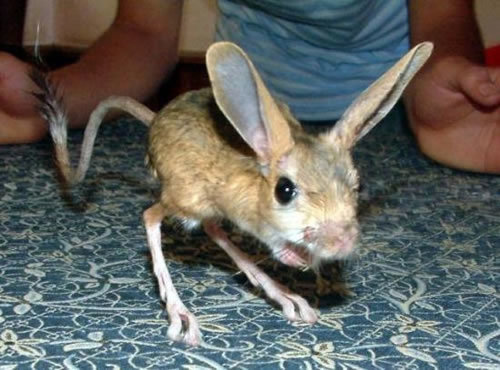
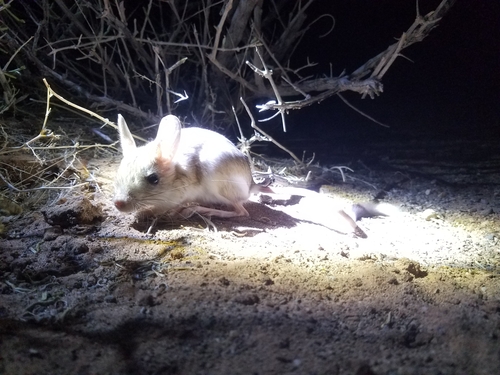
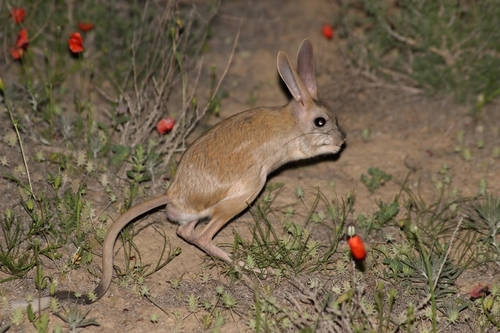
Powerful, elongated hind limbs enable rapid bipedal locomotion and escape from predators across open sandy terrain. Large eyes enhance night vision in low-light conditions. The sandy buff coloration provides excellent camouflage in desert substrate. It conserves water metabolically and obtains moisture primarily from its food, a critical adaptation for desert survival. Its long tufted tail provides balance during high-speed leaping.
Conservation status and numbers
Least Concern (LC) on the IUCN Red List. The species is assessed as not facing imminent threat of extinction, with an apparently stable population across its range, though detailed quantitative data are limited.
Estimated population
No precise global population estimate is available. The population is considered stable based on current IUCN assessments, though systematic surveys are lacking. Population trend is presumed stable.
What threatens the Vinogradov's Jerboa?
Habitat degradation from overgrazing by livestock, agricultural expansion, and water diversion projects in Central Asia (particularly irrigation schemes affecting desert margins). Desertification driven by climate change may alter habitat quality. Rodenticide use in adjacent agricultural zones poses a localized threat.
Diseases and parasites
Likely hosts ectoparasites including fleas (Siphonaptera) and ticks (Ixodidae), common among desert rodents in Central Asia. Central Asian jerboas have been implicated as potential reservoir hosts for plague (Yersinia pestis) and leishmaniasis in their broader region, though species-specific data for S. vinogradovi are lacking.
What is being done to protect it?
The species benefits incidentally from protected areas within its range, including nature reserves in Uzbekistan such as the Kyzylkum State Nature Reserve. No species-specific conservation programs are known to exist. It is listed under national wildlife protection legislation in Kazakhstan and Uzbekistan.
Recommended actions
Systematic field surveys to establish baseline population data and refine the range map. Monitoring of habitat quality in the Kyzylkum Desert. Assessment of the impact of agricultural expansion and rodenticide programs on local populations. Inclusion in Central Asian arid-land biodiversity monitoring frameworks.
What the Vinogradov's Jerboa looks like
The dorsal pelage is sandy buff to pale ochre, blending with desert substrate. The ventral surface is white or pale cream. A whitish hip stripe is typically present, a trait shared with other Scarturus species. The tail is long and slender, terminating in a distinctive black-and-white tufted tip used as a signal during locomotion.
Size
Body length approximately 95–130 mm; tail length 160–210 mm (including terminal tuft). Hind feet are elongated, typically 55–70 mm. Overall body plan is compact with disproportionately long hind limbs.
Weight
Estimated 60–130 grams, consistent with other medium-sized five-toed jerboas in the genus Scarturus. Seasonal weight fluctuations occur prior to and following hibernation.
Distinctive features
Vinogradov's Jerboa is distinguished from closely related species by a combination of its ear length, skull morphology (particularly the tympanic bullae proportions), and geographic range. It differs from Allactaga major and A. elater by subtle cranial and pelage characteristics. Five functional toes on the hind foot distinguish it from three-toed jerboas (Dipus, Jaculus).
Differences between males and females
Sexual dimorphism is minimal, as in most jerboas. Females may be slightly larger on average during reproductive periods due to pregnancy, but there are no marked differences in coloration or external morphology.
Behaviour and diet of the Vinogradov's Jerboa
Primarily solitary outside of the breeding season. Each individual maintains its own burrow system. Some loose aggregations of burrows may occur in optimal habitat patches, but there is no evidence of cooperative social organization.
When it is active
Strictly nocturnal. Emerges after sunset and returns to its burrow before dawn, avoiding heat and diurnal predators. During summer, activity is concentrated in the cooler hours shortly after dark.
Diet
Omnivorous with a strong herbivorous tendency. Diet consists primarily of seeds, succulent plant parts, roots, and tubers of desert plants (including Haloxylon, Calligonum, and annual ephemerals). Insects and other invertebrates are also consumed, providing important protein and moisture, especially during breeding season.
How it feeds and hunts
Forages by moving rapidly across open ground between sparse desert shrubs, using sensitive whiskers and large eyes to detect food items. Digs with small forelimbs to uncover buried seeds and roots. Does not actively hunt vertebrate prey.
Communication
Communication involves high-pitched vocalizations used during mating and alarm situations. Foot drumming on the substrate may function as a warning or territorial signal. Scent marking via specialized glands plays a role in territory delineation and mate recognition.
Interactions with other species
Predated upon by nocturnal raptors (owls such as Bubo bubo and Athene noctua), snakes (including Eryx and Psammophis species), and carnivorous mammals (foxes, stone martens). Competes for seeds with other desert rodents including gerbils (Meriones) and other jerboa species. No known symbiotic relationships.
Role in its ecosystem
Functions as a seed disperser and predator of invertebrates in desert ecosystems. As prey, it is an important energy source for desert predators. Its burrowing activity contributes to soil aeration and minor nutrient cycling in arid sandy soils.
Reproduction and lifecycle
Breeding season occurs primarily in spring (April–June) following emergence from hibernation, with possibly a second litter in summer. Gestation is approximately 25–30 days, consistent with other Allactaginae. Litter size is estimated at 2–6 young per litter.
Raising the young
The female alone raises the young in a natal burrow. Pups are born altricial (blind and hairless) and are nursed for approximately 4–5 weeks. Juveniles disperse to establish their own burrows after weaning.
Maturity and lifespan
Sexual maturity is reached at approximately 3–4 months of age, allowing for reproduction in the same year of birth if born early enough. Lifespan in the wild is estimated at 2–3 years; captive jerboas of related species have lived up to 5–6 years.
Taxonomy and naming of the Vinogradov's Jerboa
Classification
Mammalia > Rodentia > Dipodidae (Subfamily: Allactaginae) > Scarturus > Scarturus vinogradovi
Scientific synonyms
Allactaga vinogradovi Shenbrot, 1984. Previously placed in the genus Allactaga before molecular and morphological revisions elevated Scarturus to full genus status.
What research says
Recent studies
The main recent taxonomic development concerns the resurrection of the genus Scarturus to accommodate this and related species, supported by phylogenetic analyses of Dipodidae. Detailed ecological or behavioral studies specific to S. vinogradovi remain scarce in the published literature.
Genome and DNA
Chromosome number for the species has not been definitively published in accessible literature. Related Allactaginae species typically have diploid chromosome counts of 2n = 48. Molecular phylogenetic studies supporting the genus Scarturus have used mitochondrial and nuclear markers (cytochrome b, RAG1).
Compared with similar species
Most closely related to other Scarturus species such as S. elater (Small Five-toed Jerboa), from which it differs in body size, skull proportions, and geographic range. It is larger than S. elater and occupies a more restricted sandy desert habitat. It is distinguished from the broadly sympatric Allactaga major by its smaller size and more specialized sandy substrate preference.
The Vinogradov's Jerboa and people
Vinogradov's Jerboa can cover distances of up to a meter in a single leap using its powerful hind legs, making it one of the most agile small mammals relative to its body size. Its distinctive black-and-white tail tuft functions like a visual flag during rapid movement, possibly confusing predators. Named after Boris Vinogradov, whose 1925 monograph on jerboas remains a foundational reference in dipodid zoology over a century later.
Where and how to see it
Best observed in the Kyzylkum Desert of Uzbekistan and southern Kazakhstan during warm months (May–September), strictly at night using a red-filtered torch to avoid disturbing the animals. Scanning open sandy ground between shrubs after dark offers the best chance of spotting their reflective eyes. The Kyzylkum State Nature Reserve in Uzbekistan is a potential observation site.
Risks to humans
No notable risk to humans. May bite if handled, but poses no venom or significant injury risk. As a potential small rodent host in plague-endemic regions, standard precautions when handling wild rodents are advised.
Countries where the Vinogradov's Jerboa is recorded
The 3 countries named in the range description of its IUCN Red List assessment.
Questions about the Vinogradov's Jerboa
Where does the Vinogradov's Jerboa live?
The Vinogradov's Jerboa is recorded in Kazakhstan, Turkmenistan and Uzbekistan across Asia. These countries come from the range description of its IUCN Red List assessment, and they are what place the species on the interactive map.
Is the Vinogradov's Jerboa endangered?
The IUCN Red List assesses the Vinogradov's Jerboa as Least Concern. The species is widespread and abundant enough not to qualify for any threatened category. It does not mean the species is safe forever, only that nothing in the current data raises an alarm.
How many are left in the wild?
No precise global population estimate is available. This figure comes from the species assessment on the IUCN Red List; population estimates for wild mammals are ranges, not counts, and are revised at each assessment.
What habitat does the Vinogradov's Jerboa live in?
Sandy and semi-sandy deserts, including fixed and semi-fixed sand dunes with sparse saxaul (Haloxylon) and shrub cover.
What is the scientific name of the Vinogradov's Jerboa?
The Vinogradov's Jerboa is Scarturus vinogradovi, in the family Dipodidae, order Rodentia.
Other species in the genus Scarturus
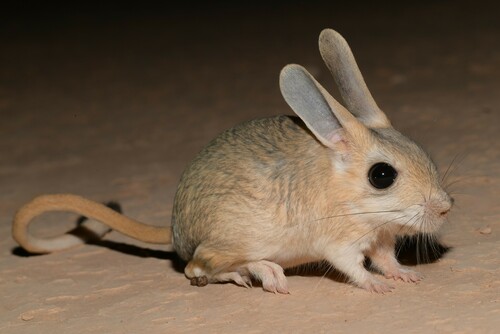
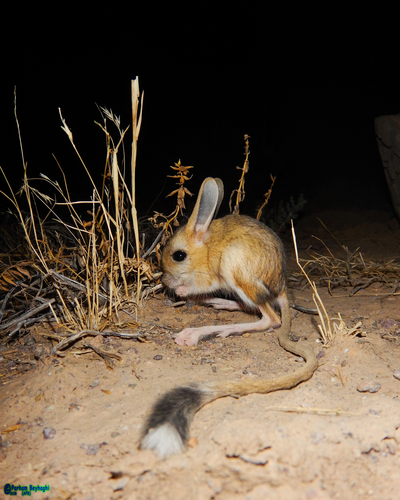
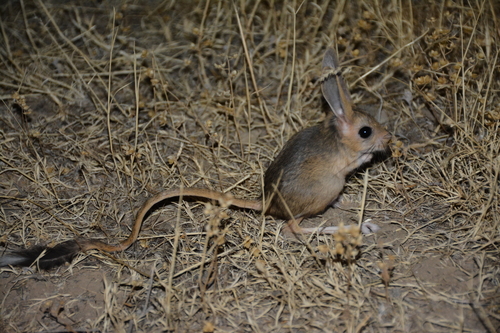
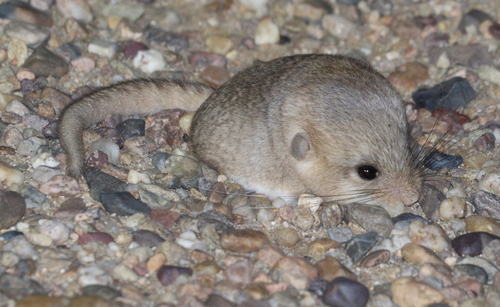
Other species in the family Dipodidae
Species that share its range
Sources
Conservation status, range description and population estimate come from the IUCN Red List assessment for Scarturus vinogradovi. Countries are derived from that range description, not from a mapped country list. Last refreshed on .
The distribution map is drawn from the IUCN Red List spatial data compiled in 2022. IUCN SSC Small Mammal Specialist Group