
Severtzov's Jerboa
Allactaga severtzovi
Red List assessment
Least Concernon the IUCN Red List
- EXExtinct
- EWExtinct in the Wild
- CRCritically Endangered
- ENEndangered
- VUVulnerable
- NTNear Threatened
- LCLeast Concern
The Severtzov's Jerboa is recorded in 3 countries across Asia. The IUCN Red List assesses the Severtzov's Jerboa as Least Concern. No precise global population estimate is available.
- Family
- Dipodidae
- Order
- Rodentia
- Genus
- Allactaga
- Countries recorded
- 3
- Continents
- Asia
- Red List category
- Least Concern
- Data updated
- August 9, 2026
What is the Severtzov's Jerboa?
Severtzov's Jerboa is a small, bipedal rodent belonging to the family Dipodidae, named after the Russian naturalist Nikolai Severtzov. It inhabits the arid and semi-arid desert and steppe zones of Central Asia, particularly in Kazakhstan and Uzbekistan. Like all members of the genus Allactaga, it is a five-toed jerboa, distinguishing it from three-toed relatives. It is remarkable for its highly specialized locomotion, covering ground in rapid bipedal hops using its elongated hind limbs.
Where does the Severtzov's Jerboa live?
Southern Kazakhstan, Uzbekistan, and adjacent parts of Turkmenistan; distributed across the arid lowlands of Central Asia.
Endemic to Central Asia, with the core range in southern and central Kazakhstan (Kyzylorda and surrounding regions), Uzbekistan (Kyzylkum Desert and surroundings), and possibly extending marginally into northern Turkmenistan. The given coordinates correspond to the Kazakhstan–Uzbekistan border region.
Altitude and depth
Primarily found at low to moderate altitudes, typically between 100 and 600 meters above sea level, across flat desert basins and plains.
Seasonal movements
Undergoes winter hibernation from approximately October or November through March or April, retreating into sealed burrows. Active periods are concentrated in spring, summer, and early autumn, with reduced surface activity during peak summer heat (aestivation possible during hottest months).
Habitat of the Severtzov's Jerboa
Primarily occupies sandy and clay deserts, semi-desert shrublands, and dry steppes with sparse vegetation cover. It favors areas with loose soils suitable for burrowing, including saxaul (Haloxylon) desert zones and takyrs (clay flats). Avoids dense vegetation and mountainous terrain.
Adaptations to its environment
Possesses greatly elongated hind limbs and feet for rapid bipedal locomotion and escape from predators. Large eyes are adapted for nocturnal vision in low light. Kidneys are highly efficient, minimizing water loss in arid environments. The long, tufted tail provides balance during jumping. Thick fur on the soles of the feet aids movement on loose sand.
Conservation status and numbers
Listed as Least Concern (LC) on the IUCN Red List, as it has a relatively wide distribution and is not considered to be facing immediate major threats leading to rapid population decline. However, local populations may face pressure from habitat degradation.
Estimated population
No precise global population estimate is available. The species is considered locally common within suitable habitat; population trend is presumed stable overall, though data are limited.
What threatens the Severtzov's Jerboa?
Habitat degradation due to overgrazing by livestock, agricultural expansion, and desertification exacerbated by climate change. Disturbance of burrow systems by vehicle traffic and land use change. Predation pressure from introduced or expanding predator populations may also be a factor locally.
Diseases and parasites
Like other Central Asian rodents, it may act as a reservoir or host for fleas (Siphonaptera) that can carry plague (Yersinia pestis), though it is considered a minor host compared to gerbils and ground squirrels. Endoparasites (helminths, coccidia) are likely present but poorly documented for this species specifically.
What is being done to protect it?
Parts of its range fall within protected areas in Kazakhstan and Uzbekistan, such as the Barsakelmes Nature Reserve and Kyzylkum Reserve. General national legislation protecting small mammals may apply. No species-specific conservation programs are known.
Recommended actions
Improve population monitoring through systematic surveys across its Central Asian range. Protect remaining intact desert and semi-desert habitats from overgrazing and agricultural conversion. Promote sustainable land management practices in the region and increase baseline ecological research on this poorly studied species.
What the Severtzov's Jerboa looks like
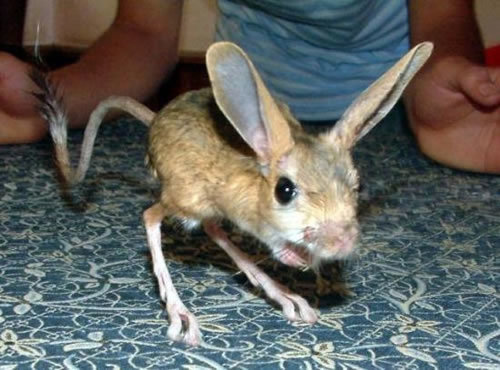
Dorsal fur is sandy-buff to pale ochre-yellow, blending with desert substrate. The belly and inner surfaces of limbs are white. The tail is long with a distinctive black-and-white tufted tip (the 'flag'). The large eyes are dark, the ears are moderately long and erect, and the muzzle is blunt with prominent whiskers.
Size
Body length approximately 105–155 mm; tail length approximately 155–210 mm (tail distinctly longer than body). Hind feet notably elongated, approximately 55–75 mm.
Weight
Typically 50–120 grams; no significant data on sexual dimorphism in weight is available for this species specifically.
Distinctive features
As a five-toed jerboa (genus Allactaga), it differs from three-toed jerboas (Dipus, Jaculus) by possessing five functional toes on the hind feet rather than three. Distinguished from the closely related A. elater by its larger overall size, and from A. major by smaller body dimensions. The characteristic bicolored tail tuft (black band followed by white tip) is a hallmark of the genus.
Differences between males and females
Sexual dimorphism is minimal in this species; males and females are similar in size and coloration. Females possess multiple pairs of mammary glands for nursing litters.
Behaviour and diet of the Severtzov's Jerboa
Primarily solitary outside of the breeding season. Individuals maintain separate burrow systems. No complex social hierarchy is reported. Brief male-female associations occur during mating season.
When it is active
Strictly nocturnal, emerging after dark to forage and retreating to burrows before dawn. During daytime, burrow entrances are plugged with soil to regulate temperature and humidity and avoid predators.
Diet
Omnivorous; diet includes seeds, roots, bulbs, green plant parts, and invertebrates (insects and their larvae). Diet composition shifts seasonally: more insects in spring and summer when protein is needed, more seeds and dry plant material in late summer and autumn for pre-hibernation fat accumulation.
How it feeds and hunts
Forages by searching the ground surface with its sensitive vibrissae and digging with its small forelimbs to uncover seeds and invertebrates. Insects are detected by movement and captured with the forepaws. No ambush or pursuit predation is employed.
Communication
Communication is poorly studied in this species. Likely uses ultrasonic vocalizations between mother and young. Foot-drumming on the ground may serve as alarm or territorial signaling. Scent glands may be used for marking territories and mate recognition.
Interactions with other species
Natural predators include owls (particularly Bubo bubo, Athene noctua), foxes (Vulpes vulpes, V. corsac), and snakes (e.g., Eryx species). Competes for seeds and invertebrates with other desert rodents such as gerbils (Meriones, Rhombomys) and other jerboa species. No known mutualistic or symbiotic relationships.
Role in its ecosystem
Functions as a secondary consumer and seed predator in desert ecosystems. Its burrowing activity aerates soil and may influence plant community structure. As prey, it supports populations of raptors, carnivores, and reptiles, forming an important link in the arid-zone food web.
Reproduction and lifecycle
Breeding season occurs in spring and possibly again in summer, typically April–July after emergence from hibernation. Gestation lasts approximately 25–30 days. Litter size ranges from 2 to 6 young. Females may produce 1–2 litters per year.
Raising the young
Young are born altricial (hairless, eyes closed) and are raised exclusively by the mother in the burrow. Nursing lasts approximately 4–5 weeks. The mother guards the burrow entrance and provides warmth. Juveniles become independent shortly after weaning.
Maturity and lifespan
Sexual maturity is likely reached at approximately 6–9 months of age, typical for small jerboas. Wild lifespan is estimated at 2–4 years; individuals in captivity may live slightly longer under optimal conditions.
Taxonomy and naming of the Severtzov's Jerboa
Classification
Mammalia > Rodentia > Dipodidae > Allactaga > Allactaga severtzovi
Scientific synonyms
Described by Ognev in 1922; no widely accepted synonyms, though it has historically been confused with closely related Allactaga species such as Allactaga elater in some older literature.
What research says
Recent studies
This species remains poorly studied and relatively few modern publications focus on it specifically. Broader phylogeographic studies of the genus Allactaga in Central Asia have touched on its taxonomic placement. Updated distribution models using occurrence data (such as the GBIF record near the provided coordinates) are contributing to better range mapping.
Genome and DNA
Chromosome number has not been definitively published for A. severtzovi specifically. Related Allactaga species typically have 2n = 48. No major genomic studies specific to this species are known.
Compared with similar species
Compared to Allactaga major (Great Jerboa), A. severtzovi is smaller in body size. Compared to Allactaga elater (Small Five-toed Jerboa), it is larger and occupies slightly different microhabitat preferences. All three species are five-toed jerboas and share the characteristic tuft-tipped tail, but differ in size, fur tone, and precise geographic range.
The Severtzov's Jerboa and people
Severtzov's Jerboa can cover ground at remarkable speed using bipedal bounding locomotion, with leaps that may exceed 1.5 meters in a single stride relative to its tiny body size. Its specialized kidneys are so efficient that it can survive entirely without drinking free water, obtaining all necessary moisture from food. Like a tiny kangaroo, it uses its long tail as a counterbalance and rudder during high-speed evasive maneuvers to escape predators.
Where and how to see it
Best observed in southern Kazakhstan and northern Uzbekistan (Kyzylkum Desert region) during warm months (May–September) after nightfall, using a red-light torch to minimize disturbance. Sandy plains with sparse saxaul shrubs near dusk are productive search areas. Look for plugged burrow entrances during daytime as an indicator of presence.
Risks to humans
No notable risk to humans. May theoretically carry flea-borne pathogens (e.g., plague) in endemic areas, but direct human contact is rare and risk is extremely low with normal precautions.
Countries where the Severtzov's Jerboa is recorded
The 3 countries named in the range description of its IUCN Red List assessment.
Questions about the Severtzov's Jerboa
Where does the Severtzov's Jerboa live?
The Severtzov's Jerboa is recorded in Kazakhstan, Turkmenistan and Uzbekistan across Asia. These countries come from the range description of its IUCN Red List assessment, and they are what place the species on the interactive map.
Is the Severtzov's Jerboa endangered?
The IUCN Red List assesses the Severtzov's Jerboa as Least Concern. The species is widespread and abundant enough not to qualify for any threatened category. It does not mean the species is safe forever, only that nothing in the current data raises an alarm.
How many are left in the wild?
No precise global population estimate is available. This figure comes from the species assessment on the IUCN Red List; population estimates for wild mammals are ranges, not counts, and are revised at each assessment.
What habitat does the Severtzov's Jerboa live in?
Primarily occupies sandy and clay deserts, semi-desert shrublands, and dry steppes with sparse vegetation cover.
What is the scientific name of the Severtzov's Jerboa?
The Severtzov's Jerboa is Allactaga severtzovi, in the family Dipodidae, order Rodentia.
Other species in the genus Allactaga
Other species in the family Dipodidae
Species that share its range
Sources
Conservation status, range description and population estimate come from the IUCN Red List assessment for Allactaga severtzovi. Countries are derived from that range description, not from a mapped country list. Last refreshed on .
The distribution map is drawn from the IUCN Red List spatial data compiled in 2008. IUCN (International Union for Conservation of Nature)