
Iranian Jerboa
Allactaga firouzi
Red List assessment
Data Deficienton the IUCN Red List
- EXExtinct
- EWExtinct in the Wild
- CRCritically Endangered
- ENEndangered
- VUVulnerable
- NTNear Threatened
- LCLeast Concern
Data Deficient has no position on the scale above — it records the absence of an assessment, not a degree of risk.
The Iranian Jerboa is recorded in one country, Iran across Asia. The IUCN Red List records the Iranian Jerboa as Data Deficient. Unknown; no reliable population estimate exists.
- Family
- Dipodidae
- Order
- Rodentia
- Genus
- Allactaga
- Countries recorded
- 1
- Continents
- Asia
- Red List category
- Data Deficient
- Data updated
- August 9, 2026
What is the Iranian Jerboa?
Allactaga firouzi is a small bipedal rodent belonging to the five-toed jerboa group, endemic to Iran. Like other members of the genus Allactaga, it is characterized by dramatically elongated hind limbs, a long tufted tail, and large eyes adapted to low-light conditions. It inhabits arid and semi-arid landscapes of the Iranian plateau. It is among the least-known jerboas in the world, with very few documented specimens, which is reflected in its IUCN Data Deficient status.
Where does the Iranian Jerboa live?
Endemic to Iran, likely restricted to arid and semi-arid interior regions of central and northern Iran.
Known only from Iran; the precise range is poorly defined due to limited specimen records. Likely distributed across parts of central and possibly northern Iran, potentially overlapping with the ranges of other Allactaga species such as A. elater and A. williamsi.
Altitude and depth
Likely occurs between 500 and 2000 m above sea level, consistent with the plateau and foothill habitats of central Iran.
Seasonal movements
Presumed to undergo winter torpor or hibernation during cold months, as is typical for jerboas in the region. Activity likely peaks in spring and summer when food resources are more abundant.
Habitat of the Iranian Jerboa
Arid steppe, semi-desert, and desert habitats on the Iranian plateau, typically featuring sparse vegetation, sandy or loamy soils, and scattered shrubs. It likely favors areas with loose substrate suitable for burrowing, a common trait across the Allactaga genus.
Adaptations to its environment
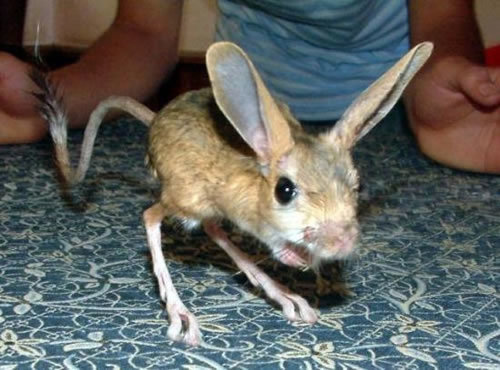
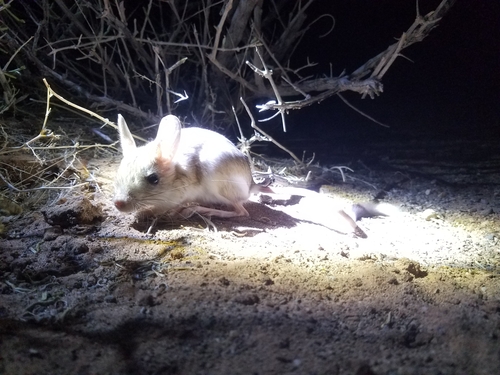
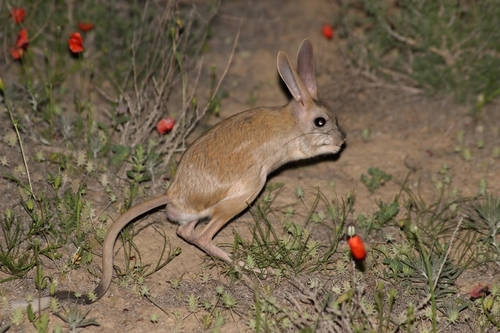
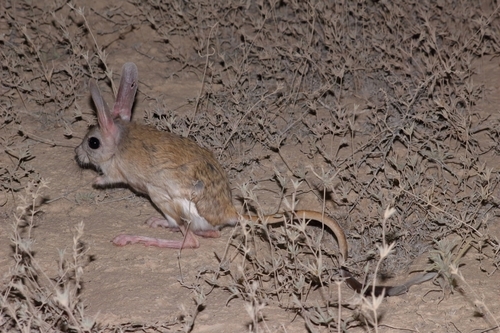
Enlarged hind legs allow rapid bipedal locomotion, enabling escape from predators in open terrain. Large eyes enhance night vision for its nocturnal lifestyle. Its pale sandy fur provides camouflage against desert substrates, and its kidneys are highly efficient at concentrating urine to minimize water loss in arid conditions.
Conservation status and numbers
Data Deficient (DD) on the IUCN Red List. This status reflects an absence of sufficient data to assess its distribution, population size, or trends rather than an indication that it is not threatened. Its apparent rarity and very limited geographic range may place it at genuine risk.
Estimated population
Unknown; no reliable population estimate exists. Given the extremely limited number of documented specimens and restricted range, the population is presumed to be small, with trend data entirely lacking.
What threatens the Iranian Jerboa?
Habitat degradation through overgrazing by livestock, agricultural expansion, and desertification driven by climate change are likely primary threats. Land conversion and human settlement in arid zones of Iran may further reduce available habitat. Pesticide use targeting agricultural pests could affect insect food sources.
Diseases and parasites
No specific studies exist. Jerboas in the region are known hosts for fleas (potential plague vectors), mites, and internal helminth parasites, which likely affect this species as well.
What is being done to protect it?
No species-specific conservation programs are known for Allactaga firouzi. It may receive incidental protection within designated protected areas of Iran managed by the Iranian Department of Environment. The species is named in honor of Eskandar Firouz, a pioneering Iranian conservationist.
Recommended actions
Urgent field surveys are needed to establish the species' actual range and population size. Genetic studies to confirm its distinct taxonomic status from related Allactaga species are a priority. Habitat protection in central Iranian arid zones and formal recognition in national biodiversity action plans are recommended.
What the Iranian Jerboa looks like
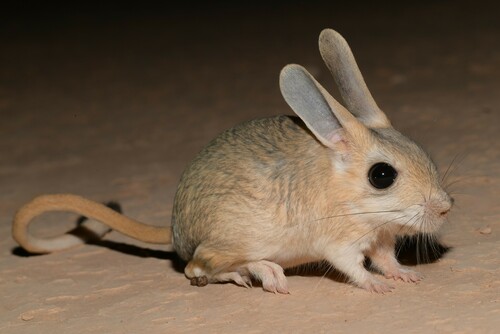
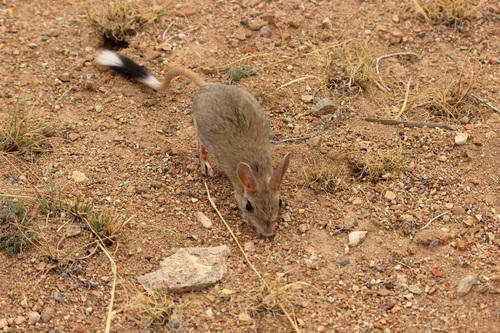
Like other Allactaga jerboas, it likely has sandy to pale ochre-brown dorsal fur blending into white or cream on the undersides. The tail is long and ends in a distinctive black-and-white tuft. The hind legs are greatly elongated, the forelimbs are short and delicate, and the ears are relatively large and upright.
Size
Estimated head-body length of approximately 100–150 mm, with a tail length of 160–220 mm; hind foot length approximately 60–75 mm. These estimates are based on closely related Allactaga species.
Weight
Estimated body weight of 50–120 g, consistent with medium-sized Allactaga species. No sex-specific weight data are available.
Distinctive features
Distinguished from co-occurring Allactaga species by specific morphometric characters of the skull, dental features, and pelage coloration details documented at the time of its original description. It has five functional hind toes, which separates the Allactaga genus from three-toed jerboas (Dipus, Jaculus).
Differences between males and females
No documented sexual dimorphism; likely minimal as in most jerboa species, with females potentially slightly larger during gestation.
Behaviour and diet of the Iranian Jerboa
Presumed to be largely solitary outside of the breeding season, as is typical for jerboas. Individuals likely maintain individual burrow systems and home ranges in arid terrain.
When it is active
Strongly nocturnal, emerging after dark to forage and retreating to burrows before dawn to avoid diurnal predators and daytime heat. May be crepuscular during cooler seasons.
Diet
Likely omnivorous, feeding on seeds, dry plant material, roots, bulbs, and insects or other invertebrates, consistent with the dietary habits of other Allactaga species. Seeds of grasses and desert shrubs probably form the bulk of the diet.
How it feeds and hunts
Forages by hopping across open ground on its elongated hind legs, using its sensitive vibrissae and large eyes to locate food items. May use its small forepaws to manipulate seeds and dig for buried food resources.
Communication
Likely uses drumming of hind feet on the ground as an alarm signal, as documented in related jerboas. Scent marking via glands may be used to delineate territories or communicate reproductive status. Vocalizations are probably limited to soft squeaks or ultrasonic calls.
Interactions with other species
Natural predators likely include owls (Bubo bubo, Asio species), snakes (particularly Colubrids and Viperids common to the Iranian plateau), and small carnivorous mammals such as foxes and weasels. It may compete with other small rodents and jerboas for seeds and burrow sites.
Role in its ecosystem
Functions as a seed disperser and soil aerator through its burrowing activity. As a prey species, it contributes to the food web of arid ecosystems, supporting populations of raptors and carnivores on the Iranian plateau.
Reproduction and lifecycle
Reproductive details are unknown for this species specifically. By analogy with related species, breeding likely occurs in spring and possibly again in early summer, with a gestation period of approximately 25–30 days and litters of 2–5 young.
Raising the young
Young are likely born altricial (blind and hairless) and are nursed in the burrow for several weeks. Maternal care is presumed to be the sole form of parental investment, as in other jerboas.
Maturity and lifespan
Sexual maturity is estimated at 3–6 months, consistent with related species. Lifespan in the wild is probably 2–3 years; captive jerboas can live up to 5–6 years.
Taxonomy and naming of the Iranian Jerboa
Classification
Mammalia > Rodentia > Dipodidae > Allactaga > Allactaga firouzi
Scientific synonyms
No widely accepted synonyms; originally described as Allactaga firouzi by Womochel, 1978.
What research says
Recent studies
The species has received very little scientific attention since its original description in 1978. It has been included in molecular phylogenetic studies of Dipodidae that helped clarify genus-level relationships, but targeted research on this species remains essentially absent.
Genome and DNA
No karyological or genomic studies specific to Allactaga firouzi are available. Related Allactaga species typically have diploid chromosome numbers of 2n = 48 or similar; this has not been confirmed for A. firouzi.
Compared with similar species
Most closely related to other members of the Allactaga genus such as A. elater (Small Five-toed Jerboa) and A. williamsi (Williams' Jerboa), which also occur in Iran. A. firouzi is distinguished by specific skull morphology and dental proportions. It shares its bipedal locomotion and nocturnal lifestyle with all Allactaga species but is considerably less studied than its congeners.
The Iranian Jerboa and people
Allactaga firouzi is named in honor of Eskandar Firouz, the Iranian statesman and naturalist who was instrumental in establishing Iran's network of national parks and protected areas in the 1960s–70s. Despite being capable of remarkable bipedal leaps — some Allactaga species can jump over 3 meters in a single bound — this jerboa remains almost invisible to science. It can survive in extreme desert conditions partly because it can obtain all the water it needs from its food alone, never needing to drink free-standing water.
Where and how to see it
Observation in the wild would require nocturnal fieldwork with red-filtered flashlights in central Iranian arid zones, particularly in areas of sparse shrub-steppe habitat. The provinces of Isfahan, Yazd, and Semnan in central Iran represent probable search areas. Given the extreme rarity of documented sightings, professional collaboration with Iranian wildlife authorities is strongly advised.
Risks to humans
No notable risk to humans. Jerboas are generally docile; as with all wild rodents, there is a theoretical risk of transmission of zoonotic diseases (e.g., via fleas) but direct human contact is exceedingly rare.
Myths and legends
No specific myths or legends are documented for this species. Jerboas in general are sometimes referred to in Persian folklore as 'desert mice' (موش صحرایی) and are regarded as curious desert inhabitants, but no specific cultural significance is attributed to A. firouzi.
Countries where the Iranian Jerboa is recorded
The 1 countries named in the range description of its IUCN Red List assessment.
Questions about the Iranian Jerboa
Where does the Iranian Jerboa live?
The Iranian Jerboa is recorded in Iran across Asia. These countries come from the range description of its IUCN Red List assessment, and they are what place the species on the interactive map.
Is the Iranian Jerboa endangered?
The IUCN Red List assesses the Iranian Jerboa as Data Deficient. There is not enough information to judge the risk of extinction, usually because the species is rarely seen or has never been surveyed. It is not a reassuring category: several species were Data Deficient right up to the point they were found to be Critically Endangered.
How many are left in the wild?
Unknown; no reliable population estimate exists. This figure comes from the species assessment on the IUCN Red List; population estimates for wild mammals are ranges, not counts, and are revised at each assessment.
What habitat does the Iranian Jerboa live in?
Arid steppe, semi-desert, and desert habitats on the Iranian plateau, typically featuring sparse vegetation, sandy or loamy soils, and scattered shrubs.
What is the scientific name of the Iranian Jerboa?
The Iranian Jerboa is Allactaga firouzi, in the family Dipodidae, order Rodentia.
Other species in the genus Allactaga
Other species in the family Dipodidae
Species that share its range
Sources
Conservation status, range description and population estimate come from the IUCN Red List assessment for Allactaga firouzi. Countries are derived from that range description, not from a mapped country list. Last refreshed on .
The distribution map is drawn from the IUCN Red List spatial data compiled in 2016. IUCN SSC Small Mammal Specialist Group