
Euphrates Jerboa
Scarturus euphratica
Red List assessment
Least Concernon the IUCN Red List
- EXExtinct
- EWExtinct in the Wild
- CRCritically Endangered
- ENEndangered
- VUVulnerable
- NTNear Threatened
- LCLeast Concern
The Euphrates Jerboa is recorded in 6 countries across Asia. The IUCN Red List assesses the Euphrates Jerboa as Least Concern. No reliable global population estimate exists.
- Family
- Dipodidae
- Order
- Rodentia
- Genus
- Scarturus
- Countries recorded
- 6
- Continents
- Asia
- Red List category
- Least Concern
- Data updated
- August 9, 2026
What is the Euphrates Jerboa?
The Euphrates Jerboa (Scarturus euphratica) is a small to medium-sized bipedal rodent in the family Dipodidae, native to the arid and semi-arid lowlands of the Middle East, particularly around the Euphrates and Tigris river systems. It is characterized by greatly elongated hind limbs adapted for rapid bipedal hopping, large dark eyes for nocturnal vision, prominent ears, and a long tail bearing a distinctive black-and-white terminal tuft. The species is remarkable for its extreme physiological adaptations to desert life, including the ability to survive without ever drinking free water. It plays an important ecological role as a seed consumer and prey species in desert food webs.
Where does the Euphrates Jerboa live?
Middle East: primarily Iraq (Euphrates-Tigris basin), Syria, southeastern Turkey, western Iran, Jordan, northern and central Saudi Arabia, and Kuwait
Distributed across the broader Fertile Crescent and surrounding arid zones: Iraq (core range along the Euphrates and Tigris valleys), Syria, southeastern Turkey, western Iran, Jordan, northern and central Saudi Arabia, and Kuwait. Its range broadly corresponds to lowland Mesopotamian and Arabian desert environments.
Altitude and depth
Primarily inhabits lowland plains and plateaus from near sea level up to approximately 1,500 m elevation, though the vast majority of records come from below 800 m in flat desert terrain.
Seasonal movements
In colder winter months the species enters a period of reduced activity or shallow torpor, sealing itself inside its burrow. Activity peaks in spring and early summer when seeds and invertebrate food are most abundant. No long-distance seasonal migration is known.
Habitat of the Euphrates Jerboa
Arid and semi-arid deserts, sandy and gravelly plains, dry riverbeds and wadis, and desert scrublands with sparse vegetation. It strongly favors areas with sandy or loamy soils suitable for burrow construction, avoiding rocky substrates.
Adaptations to its environment
Elongated hind limbs (up to four times the length of the forelimbs) allow fast bipedal locomotion and explosive escape from predators. Highly efficient kidneys concentrate urine to minimize water loss, and the animal can extract all required moisture metabolically from dry food. Pale sandy fur provides camouflage on desert substrates, while the large eyes maximize light-gathering capacity for nocturnal foraging.
Conservation status and numbers
Least Concern (LC) on the IUCN Red List. The species has a broad distribution across the Middle East and no significant quantified population decline has been detected. It remains locally common in suitable desert habitat, though formal population assessments are lacking.
Estimated population
No reliable global population estimate exists. The species is considered relatively widespread and locally common in suitable habitats; population trend is presumed stable in the absence of data indicating otherwise.
What threatens the Euphrates Jerboa?
Habitat degradation through agricultural expansion, overgrazing, and accelerating desertification. Urbanization and infrastructure development in the Euphrates-Tigris corridor, along with altered irrigation regimes affecting riparian habitats, pose localized threats. Occasional capture for the exotic pet trade is documented.
Diseases and parasites
Susceptible to ectoparasites common among desert rodents including fleas, mites, and ticks. Related jerboas across the region have been identified as reservoir hosts for Leishmania spp. (cutaneous leishmaniasis) and other zoonotic pathogens, and similar reservoir roles may apply to this species.
What is being done to protect it?
Benefits indirectly from protected desert reserves in Iraq, Saudi Arabia, Jordan, and Syria. No species-specific conservation or monitoring program is known to target the Euphrates Jerboa directly. General rodent biodiversity surveys in the region occasionally document the species.
Recommended actions
Systematic distributional and population surveys to establish baseline data across the range. Monitoring of habitat integrity in the Euphrates-Tigris corridor, and inclusion of the species in national biodiversity monitoring frameworks. Assessment of potential zoonotic disease reservoir roles to guide public health policy.
What the Euphrates Jerboa looks like
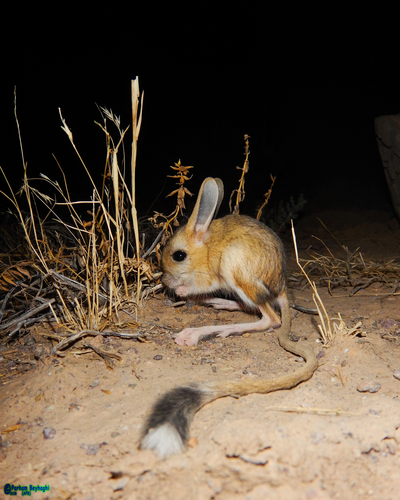
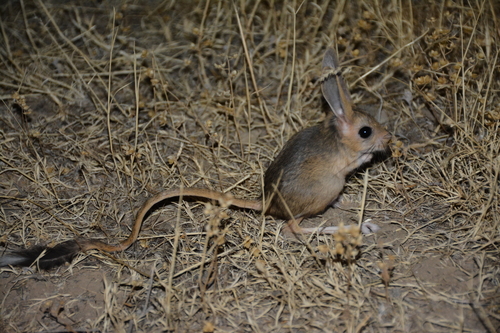
Dorsal fur is sandy to pale yellowish-brown or ochre, closely matching desert substrate for camouflage. The ventral surface and inner leg surfaces are white. The tail is long and slender with a distinctive black subterminal band followed by a white terminal tuft. Eyes are large and dark; ears are long, narrow, and erect.
Size
Head-body length approximately 90–130 mm; tail length 150–215 mm (significantly longer than the body); hind foot length 55–72 mm; ear length 30–45 mm.
Weight
Typically 40–85 g; slight individual variation exists but the species is not strongly sexually dimorphic in mass.
Distinctive features
Distinguished from the larger Greater Five-toed Jerboa (Allactaga major) by its smaller overall size and relatively shorter ears. The specific combination of a five-toed hind foot (with two vestigial lateral metatarsals), intermediate body size, and the characteristic black-and-white tail tuft sets it apart from sympatric dipodid species.
Differences between males and females
Sexual dimorphism is minimal; males and females are similar in body size and coloration. Females possess multiple pairs of mammae for nursing litters, the only consistent external distinction.
Behaviour and diet of the Euphrates Jerboa
Solitary and territorial outside the mating season. Each individual maintains a private burrow system and defends a home range against conspecifics. Social interactions between adults are generally rare and brief.
When it is active
Strictly nocturnal. Spends daylight hours sealed inside its burrow to avoid heat, desiccation, and diurnal predators. Foraging activity begins shortly after full darkness and may continue through most of the night.
Diet
Omnivorous. The diet consists primarily of seeds, dry plant matter, succulent roots, and tubers. Insects and other invertebrates are consumed opportunistically, providing essential protein and supplementary moisture. Diet composition varies seasonally with resource availability.
How it feeds and hunts
Forages on the ground using sensitive vibrissae and large eyes to locate food in darkness. Uses small, dexterous forelimbs to manipulate and hold food items. May dig shallowly with the forepaws to uncover buried seeds or roots. No active predatory pursuit behavior is recorded.
Communication
Likely uses rhythmic foot-drumming to signal alarm or territorial status, a behavior widespread among dipodid rodents. Scent marking via specialized skin glands is presumed to play a role in territorial delineation and reproductive signaling. Vocalizations between mother and young have been inferred but are poorly documented.
Interactions with other species
Predated upon by nocturnal raptors (Barn Owl, Eagle Owl), vipers and other desert snakes, Red Fox, and small felids. As a granivore it competes with other small rodents and seed-eating birds for food resources. Its burrowing activity locally modifies soil aeration and structure.
Role in its ecosystem
Contributes to seed dispersal and granivore seed regulation in desert ecosystems. As a prey species it forms a critical link in the desert food web, supporting populations of owls, snakes, and small carnivores. Burrow construction provides secondary habitat for invertebrates.
Reproduction and lifecycle
Breeding occurs primarily in spring and early summer. Gestation period is estimated at approximately 25–35 days, consistent with related dipodids. Litter size ranges from 2 to 6 young, and females may produce up to 2 litters per year under favorable conditions.
Raising the young
Young are born altricial — hairless, eyes and ears closed — and are nursed and protected exclusively by the mother within the burrow. Weaning occurs at approximately 4–6 weeks of age, after which juveniles progressively become independent and disperse to establish their own territories.
Maturity and lifespan
Sexual maturity is reached at approximately 2–3 months of age. Lifespan in the wild is estimated at 1–3 years, primarily limited by predation. Captive individuals of closely related species have lived up to 5–6 years.
Taxonomy and naming of the Euphrates Jerboa
Classification
Mammalia > Rodentia > Dipodidae > Scarturus > Scarturus euphratica
Scientific synonyms
Allactaga euphratica (Thomas, 1881); formerly placed in the genus Allactaga before molecular phylogenetic revision elevated Scarturus to full genus status.
What research says
Recent studies
The most significant recent development is the molecular phylogenetic reclassification of this species from Allactaga to Scarturus, supported by multi-locus DNA studies published in the 2010s that redefined subfamily relationships within Dipodidae. Ongoing dipodid systematics research continues to refine genus boundaries across the family.
Compared with similar species
Most closely related to other Scarturus and Allactaga species such as Allactaga major (Greater Five-toed Jerboa), which is distinctly larger with proportionally longer ears. Compared to the Three-toed Jerboas (Dipus and Jaculus), S. euphratica retains five functional toes on the hind foot, placing it in the Allactaginae subfamily rather than Dipodinae. It shares key desert adaptations with distantly related jerboas on other continents, representing convergent evolution.
The Euphrates Jerboa and people
The Euphrates Jerboa can leap distances many times its own body length in a single bound, using its long tail as a dynamic counterbalance mid-air. Like a miniature camel, it never needs to drink liquid water, producing all necessary moisture through the metabolic breakdown of dry seeds. Despite its tiny size, it has been clocked moving at speeds that, relative to body length, rival those of much larger cursorial mammals.
Where and how to see it
Best observed on warm, moonless desert nights in the Euphrates-Tigris lowlands of Iraq or in the sandy plains of northern Saudi Arabia and Jordan. Spotlighting slowly along sandy desert tracks after nightfall with a red-filtered torch (to minimize disturbance) offers the best chance of encounters. Protected desert areas and biosphere reserves in Jordan and Saudi Arabia are recommended sites.
Risks to humans
No notable risk to humans under normal circumstances. As with all wild rodents in the region, handling should be avoided due to the potential for ectoparasite transfer and possible zoonotic pathogen carriage, including Leishmania vectors.
Human uses
Occasionally captured for the exotic pet trade in small numbers. Of scientific interest for research into desert physiology, particularly water conservation mechanisms. No significant use in traditional medicine, agriculture, or commerce is recorded.
Countries where the Euphrates Jerboa is recorded
The 6 countries named in the range description of its IUCN Red List assessment.
Questions about the Euphrates Jerboa
Where does the Euphrates Jerboa live?
The Euphrates Jerboa is recorded in Iran, Iraq, Jordan, Kuwait and Saudi Arabia, among 6 countries in total across Asia. These countries come from the range description of its IUCN Red List assessment, and they are what place the species on the interactive map.
Is the Euphrates Jerboa endangered?
The IUCN Red List assesses the Euphrates Jerboa as Least Concern. The species is widespread and abundant enough not to qualify for any threatened category. It does not mean the species is safe forever, only that nothing in the current data raises an alarm.
How many are left in the wild?
No reliable global population estimate exists. This figure comes from the species assessment on the IUCN Red List; population estimates for wild mammals are ranges, not counts, and are revised at each assessment.
What habitat does the Euphrates Jerboa live in?
Arid and semi-arid deserts, sandy and gravelly plains, dry riverbeds and wadis, and desert scrublands with sparse vegetation.
What is the scientific name of the Euphrates Jerboa?
The Euphrates Jerboa is Scarturus euphratica, in the family Dipodidae, order Rodentia.
Other species in the genus Scarturus
Other species in the family Dipodidae
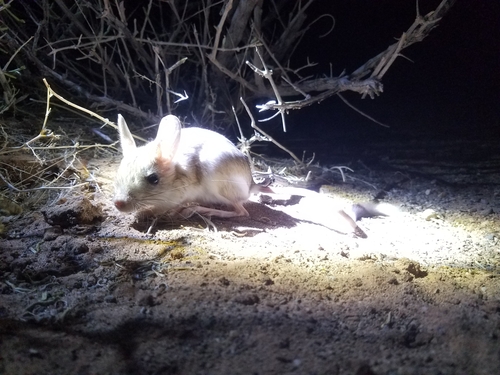
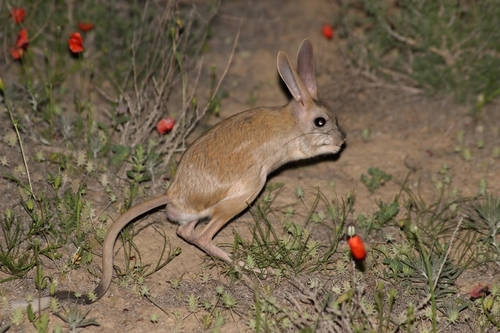
Species that share its range
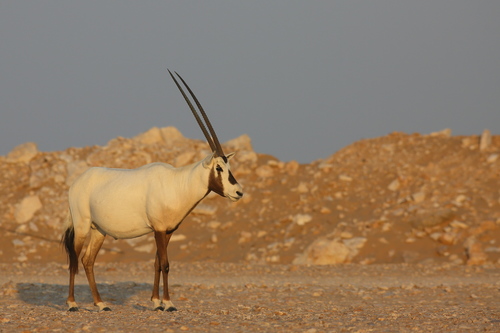
Sources
Conservation status, range description and population estimate come from the IUCN Red List assessment for Scarturus euphratica. Countries are derived from that range description, not from a mapped country list. Last refreshed on .
The distribution map is drawn from the IUCN Red List spatial data compiled in 2019. IUCN SSC Small Mammal Specialist Group