
Siberian Jerboa
Allactaga sibirica
Red List assessment
Least Concernon the IUCN Red List
- EXExtinct
- EWExtinct in the Wild
- CRCritically Endangered
- ENEndangered
- VUVulnerable
- NTNear Threatened
- LCLeast Concern
The Siberian Jerboa is recorded in 4 countries across Asia and Europe. The IUCN Red List assesses the Siberian Jerboa as Least Concern. No precise global population estimate is available; the species is considered locally common throughout most of its range, and the IUCN assesses the population trend as stable.
- Family
- Dipodidae
- Order
- Rodentia
- Genus
- Allactaga
- Countries recorded
- 4
- Continents
- Asia and Europe
- Red List category
- Least Concern
- Data updated
- August 9, 2026
What is the Siberian Jerboa?
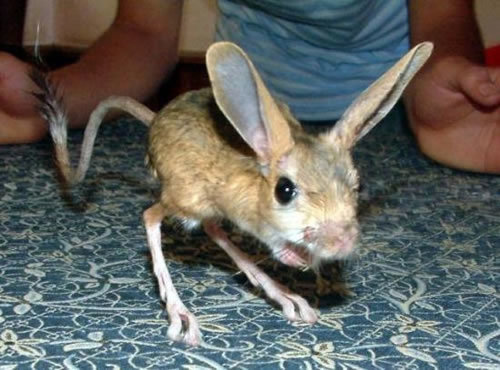
The Siberian Jerboa (Allactaga sibirica) is a small, highly specialized bipedal rodent of the family Dipodidae, native to the steppes, semi-deserts, and deserts of Central Asia and southern Siberia. It is instantly recognizable by its disproportionately long hind limbs, large dark eyes, and long pencil-tufted tail — adaptations that make it an extraordinarily agile leaper capable of covering several body lengths in a single bound. Inhabiting some of the harshest continental environments on Earth, it survives bitterly cold winters through deep hibernation and copes with summer heat through strictly nocturnal activity. It serves as a model organism for research into bipedal locomotion, hibernation physiology, and arid-zone adaptation.
Where does the Siberian Jerboa live?
Central Asia: Russia (southern Siberia, Altai, Transbaikalia), Kazakhstan, Mongolia, and northern China (Xinjiang, Inner Mongolia, Gansu, Qinghai, Ningxia)
Distributed across a broad east-west band of Central Asia: from the Russian steppes of southern Siberia (Altai Republic, Tuva, Buryatia, Transbaikalia) westward through northern Kazakhstan, across the entirety of Mongolia, and into northwestern and northern China (Xinjiang, Inner Mongolia, Gansu, Qinghai, Ningxia, and western Hebei provinces).
Altitude and depth
Typically found from lowland plains (~500 m) up to approximately 2,500 m in mountain foothills and plateau edges; most densely distributed between 800–1,600 m in the Mongolian steppe and Gobi transition belt.
Seasonal movements
Undergoes true deep hibernation from approximately October–November until March–April, retreating into sealed burrows with plugged entrances where body temperature drops dramatically. Activity peaks in summer; during extreme heat waves individuals may enter short-term summer torpor. Spring emergence timing is sensitive to ambient temperature.
Habitat of the Siberian Jerboa
Primarily occupies dry steppes, semi-desert grasslands, sandy and clay deserts, and loess plains with sparse, low-growing vegetation. It prefers open terrain with sandy or loose soils suitable for burrowing and avoids dense forest, wetlands, and high alpine zones. It is highly tolerant of degraded or overgrazed steppe landscapes.
Adaptations to its environment
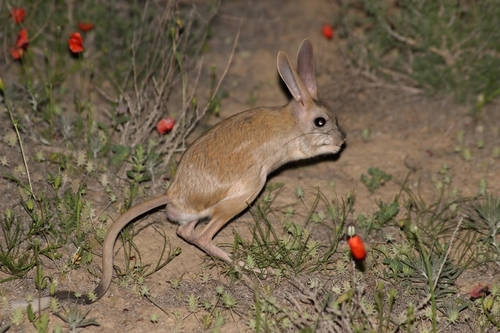
Greatly elongated hind legs (metatarsals fused into a single cannon bone) enable leaps of up to 3 m for rapid predator escape. Large, forward-facing eyes provide acute nocturnal vision, while pale sandy fur offers camouflage on open desert ground. The long tufted tail acts as a dynamic counterbalance during bipedal locomotion. Efficient kidneys concentrate urine to minimize water loss, and pre-hibernation fat deposition allows survival through six months of fasting.
Conservation status and numbers
Least Concern (LC) on the IUCN Red List (last assessed 2016); the species has an extensive distribution, is tolerant of moderate habitat disturbance, and shows no evidence of rapid or sustained population decline sufficient to qualify for a threatened category.
Estimated population
No precise global population estimate is available; the species is considered locally common throughout most of its range, and the IUCN assesses the population trend as stable.
What threatens the Siberian Jerboa?
Principal threats include overgrazing by livestock degrading steppe and semi-desert habitat, agricultural conversion of native grasslands, road and vehicle mortality, and progressive desertification linked to climate change. Indiscriminate rodenticide campaigns targeting agricultural pest rodents in China and Kazakhstan pose a significant secondary poisoning risk.
Diseases and parasites
Hosts ectoparasites including fleas (Ceratophyllus, Nosopsyllus), ticks (Ixodes, Dermacentor), and mites that can serve as vectors for plague (Yersinia pestis) and tularemia (Francisella tularensis) in enzootic areas of Central Asia. Internal helminths and protozoan gut parasites have also been documented.
What is being done to protect it?
Indirectly protected within multiple protected areas including Gobi Gurvansaikhan National Park (Mongolia), the Kalamaili Nature Reserve (Xinjiang, China), and Altai Tavan Bogd National Park. Listed under national wildlife protection regulations in China and Russia, though no species-specific targeted conservation program exists.
Recommended actions
Priority actions include establishing long-term population monitoring transects across the range, restricting indiscriminate rodenticide use in agricultural and pastoral landscapes, protecting intact steppe and semi-desert corridors from conversion, and investigating the phenological effects of climate change on hibernation timing and breeding success.
What the Siberian Jerboa looks like
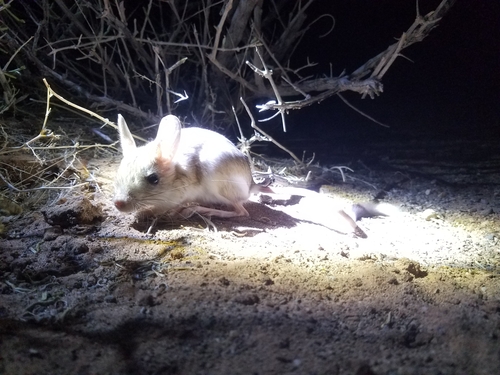
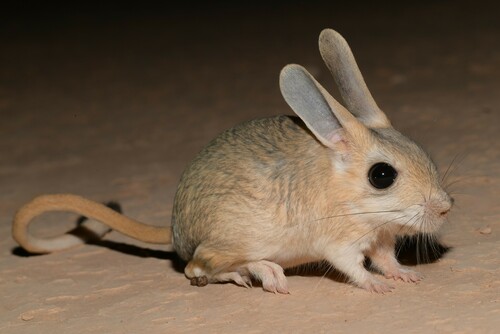
Dorsal fur is sandy-yellow to buff-brown with a subtle darker mid-dorsal stripe, providing excellent camouflage in arid terrain. The underparts are pure white. The long tail terminates in a distinctive black band followed by a conspicuous white or pale tuft. The ears are large and erect, the eyes large and glossy black, and the minute forelimbs contrast sharply with the powerful elongated hind legs.
Size
Head-body length: 120–200 mm; tail length: 160–255 mm (distinctly longer than the body); hind foot length: 60–80 mm; ear length: 30–45 mm.
Weight
Typically 70–130 g in summer; individuals accumulate substantial fat reserves before hibernation and may reach up to 150 g in late autumn.
Distinctive features
Distinguished from the Great Jerboa (A. major) by its smaller body size and more easterly, arid distribution. Separated from three-toed jerboas (Dipus, Jaculus) by the possession of five hind toes, with the three central metatarsals fused into a cannon bone. The black-and-white tail tuft pattern and overall body proportions are characteristic of the genus Allactaga.
Differences between males and females
Sexual dimorphism is minimal; males and females are very similar in size and coloration. Females may appear noticeably larger during late pregnancy or lactation. Scrotal testes are visible in reproductively active males.
Behaviour and diet of the Siberian Jerboa
Primarily solitary outside of the brief breeding season; individuals maintain and defend separate burrow systems used for shelter, sleeping, and hibernation. Population densities fluctuate seasonally and inter-annually, but can reach locally high levels in prime sandy steppe habitat.
When it is active
Strictly nocturnal, emerging shortly after full darkness to forage and returning to burrows before dawn. Moonlight intensity strongly modulates activity, with markedly reduced foraging on bright nights to minimize predation risk.
Diet
Omnivorous with a diet dominated by seeds, bulbs, tubers, green plant material, and succulent roots; also actively consumes insects, beetle larvae, and other invertebrates, particularly during summer when invertebrate biomass is high. Invertebrate prey is critical for protein and water intake during dry periods.
How it feeds and hunts
Forages by moving bipedally or quadrupedally across open ground, using sensitive vibrissae, acute olfaction, and large eyes to locate food. Seeds are detected by smell and excavated from shallow soil with the forepaws; invertebrates are captured by rapid lunges. Small quantities of food may be cached near burrow entrances.
Communication
Relatively quiet species; produces soft squeaks and ultrasonic vocalizations during agonistic encounters and mother-offspring interactions. Hind-foot drumming on the substrate likely serves as an alarm and territorial signal. Scent marking via perianal glands and cheek rubbing communicates reproductive status and burrow ownership.
Interactions with other species
Natural predators include corsac fox (Vulpes corsac), red fox (V. vulpes), steppe eagle (Aquila nipalensis), barn owl (Tyto alba), long-eared owl (Asio otus), various snakes (Elaphe, Psammophis), and domestic cats near settlements. Competes for seeds and burrow sites with gerbils (Meriones) and ground squirrels (Spermophilus). Abandoned burrows are frequently colonized by invertebrates and small reptiles.
Role in its ecosystem
Functions as an important prey species for a broad guild of steppe predators, contributing to mid-trophic energy transfer. As a granivore and seed cacher, it influences plant community composition in arid zones. Burrowing activity aerates compacted soils and facilitates water infiltration, contributing to steppe soil health.
Reproduction and lifecycle
Breeding occurs from spring through early summer (April–July), with up to two or three litters possible per season. Gestation lasts approximately 25–35 days. Litter size ranges from 2 to 8 pups, with an average of 3–5.
Raising the young
Females provide all parental care; pups are born altricial — naked, blind, and helpless — in a grass-lined nest chamber within the burrow. Weaning occurs at approximately 3–4 weeks of age, after which juveniles disperse and become fully independent. Males play no role in pup rearing.
Maturity and lifespan
Sexual maturity is reached at approximately 3–4 months; individuals born early in the spring may reproduce within their first summer. Wild lifespan is typically 2–3 years due to predation and winter mortality; captive individuals can survive up to 5–6 years.
Taxonomy and naming of the Siberian Jerboa
Classification
Mammalia > Rodentia > Dipodidae > Allactaga > Allactaga sibirica (Forster, 1778)
Subspecies
Up to eight subspecies have been described: A. s. sibirica (type form, southern Siberia/Mongolia), A. s. annulata (Satunin, 1903), A. s. australis (Bobrinskii, 1925), A. s. conditor (Heptner, 1933), A. s. jacksoni (Heptner, 1933), A. s. mongolica (Hilzheimer, 1910), A. s. saltator (Heptner, 1933), and A. s. tungusensis (Heptner, 1933); taxonomic boundaries remain under active revision.
Scientific synonyms
Originally described as Mus sibirica by Forster (1778); historical synonyms include Dipus sibiricus, Scirtetes sibiricus, and Alactaga sibirica (variant spelling).
What research says
Recent studies
Recent phylogeographic analyses have revealed significant cryptic genetic divergence between Mongolian, Chinese, and Russian populations, suggesting possible hidden species boundaries. Biomechanical studies of its bipedal locomotion have informed robotics engineering, particularly in the design of jumping micro-robots and prosthetic limbs.
Genome and DNA
The diploid chromosome number (2n) reported for Allactaga sibirica is approximately 48; molecular phylogenetic studies using mitochondrial and nuclear markers place it within a well-supported Central Asian clade of Allactaga, clearly distinct from western Palearctic congeners such as A. major.
Compared with similar species
Relative to the Great Jerboa (A. major), the Siberian Jerboa is considerably smaller and occupies more arid, eastern habitats. Compared to the Lesser Five-toed Jerboa (A. elater), it is larger with a proportionally longer tail. Unlike the three-toed jerboas (Dipus sagitta), it retains five functional hind toes with the lateral digits reduced but present. It superficially resembles the North American kangaroo rat (Dipodomys spp.), a classic case of convergent evolution driven by shared arid-habitat selective pressures.
The Siberian Jerboa and people
The Siberian Jerboa can leap up to 3 meters in a single bound — roughly 20 times its own body length — making it one of the most impressive jumpers among small mammals. Despite its tiny size, it can sustain running speeds exceeding 25 km/h in bipedal mode. During hibernation it remains sealed inside a plugged burrow for up to six months, surviving entirely on fat reserves accumulated during the summer feeding season.
Where and how to see it
Best observed in the Mongolian steppe and Gobi desert-steppe transition zone between May and September, in the first two hours after full darkness using a dim red-light torch to minimize behavioral disturbance. The Great Gobi Protected Area (Mongolia), Kalamaili Nature Reserve (Xinjiang, China), and the semi-desert zones of southern Buryatia (Russia) are recommended sites. Staking out known burrow entrances just after sunset offers the highest probability of sighting.
Risks to humans
No notable direct risk to humans; the species is shy and will not approach people. In plague-enzootic regions of Central Asia, fleas carried by this and other small rodents can theoretically transmit Yersinia pestis, so direct handling of wild individuals without protective equipment should be avoided.
Human uses
Occasionally captured for the exotic pet trade in China and Russia, though this is not widespread or commercially significant. In parts of Central Asia, jerboas have historically featured in traditional folk medicine preparations. The species is increasingly used as a study subject in biomechanics, locomotion research, and hibernation physiology.
Myths and legends
In Mongolian nomadic tradition, jerboas are sometimes regarded as nimble spirits of the steppe endowed with supernatural agility, appearing and vanishing at dusk like ghosts. They feature in regional folk tales as clever tricksters who consistently outwit foxes and eagles through speed and cunning. Their sudden emergence from underground reinforces associations with subterranean spirits in some Siberian shamanistic traditions.
Countries where the Siberian Jerboa is recorded
The 4 countries named in the range description of its IUCN Red List assessment.
Questions about the Siberian Jerboa
Where does the Siberian Jerboa live?
The Siberian Jerboa is recorded in China, Kazakhstan, Mongolia and Russia across Asia and Europe. These countries come from the range description of its IUCN Red List assessment, and they are what place the species on the interactive map.
Is the Siberian Jerboa endangered?
The IUCN Red List assesses the Siberian Jerboa as Least Concern. The species is widespread and abundant enough not to qualify for any threatened category. It does not mean the species is safe forever, only that nothing in the current data raises an alarm.
How many are left in the wild?
No precise global population estimate is available; the species is considered locally common throughout most of its range, and the IUCN assesses the population trend as stable. This figure comes from the species assessment on the IUCN Red List; population estimates for wild mammals are ranges, not counts, and are revised at each assessment.
What habitat does the Siberian Jerboa live in?
Primarily occupies dry steppes, semi-desert grasslands, sandy and clay deserts, and loess plains with sparse, low-growing vegetation.
What is the scientific name of the Siberian Jerboa?
The Siberian Jerboa is Allactaga sibirica, in the family Dipodidae, order Rodentia.
Other species in the genus Allactaga
Other species in the family Dipodidae
Species that share its range
Sources
Conservation status, range description and population estimate come from the IUCN Red List assessment for Allactaga sibirica. Countries are derived from that range description, not from a mapped country list. Last refreshed on .
The distribution map is drawn from the IUCN Red List spatial data compiled in 2008. IUCN (International Union for Conservation of Nature)