
Five-toed Pygmy Jerboa
Cardiocranius paradoxus
Red List assessment
Data Deficienton the IUCN Red List
- EXExtinct
- EWExtinct in the Wild
- CRCritically Endangered
- ENEndangered
- VUVulnerable
- NTNear Threatened
- LCLeast Concern
Data Deficient has no position on the scale above — it records the absence of an assessment, not a degree of risk.
The Five-toed Pygmy Jerboa is recorded in 3 countries across Asia. The IUCN Red List records the Five-toed Pygmy Jerboa as Data Deficient. No reliable population estimates exist; the species is considered rare or uncommonly recorded, with population trend unknown due to lack of systematic surveys.
- Family
- Dipodidae
- Order
- Rodentia
- Genus
- Cardiocranius
- Countries recorded
- 3
- Continents
- Asia
- Red List category
- Data Deficient
- Data updated
- August 9, 2026
What is the Five-toed Pygmy Jerboa?
The Five-toed Pygmy Jerboa is one of the smallest jerboa species, inhabiting the arid deserts and semi-deserts of Central Asia. It is remarkable for its tiny size, disproportionately large head, and unique five-toed hind feet (unlike most jerboas which have reduced toe numbers). This nocturnal rodent is highly specialized for life in sandy and gravelly desert habitats, using bipedal hopping locomotion to move efficiently across open terrain.
Where does the Five-toed Pygmy Jerboa live?
Central Asia, primarily Mongolia and northern China (Xinjiang, Gansu, Inner Mongolia), extending into parts of Kazakhstan
Found across the Gobi Desert region spanning Mongolia and northern China, with populations extending into adjacent areas of Inner Mongolia, Gansu, and Xinjiang provinces, and possibly into southeastern Kazakhstan.
Altitude and depth
Typically found at elevations ranging from 500 to 1500 meters above sea level in desert basins and plains
Seasonal movements
Likely undergoes a period of reduced activity or torpor during the cold winter months typical of Central Asian desert climates, though specific hibernation patterns are not well documented
Habitat of the Five-toed Pygmy Jerboa
Inhabits arid and semi-arid desert regions, including sandy deserts, gravel plains, and desert steppes with sparse vegetation. Prefers areas with loose, sandy soil suitable for burrowing.
Adaptations to its environment
Possesses elongated hind limbs and a bipedal hopping gait for rapid movement across sand and evading predators. Large auditory bullae enhance hearing for detecting predators in open terrain, while nocturnal habits help avoid extreme daytime desert heat.
Conservation status and numbers
Listed as Data Deficient (DD) by IUCN due to insufficient population data, limited research, and uncertainty about distribution and population trends across its range.
Estimated population
No reliable population estimates exist; the species is considered rare or uncommonly recorded, with population trend unknown due to lack of systematic surveys.
What threatens the Five-toed Pygmy Jerboa?
Potential threats include habitat degradation from overgrazing by livestock, desertification processes, and possible impacts from mining or agricultural expansion in Central Asian steppes, though specific threats remain poorly documented.
What is being done to protect it?
No specific conservation programs are known to target this species directly; it may receive incidental protection within existing protected areas of the Gobi Desert region in Mongolia and China.
Recommended actions
Priority actions include conducting systematic population surveys, studying habitat requirements and distribution limits, and assessing potential threats to establish an accurate conservation status.
What the Five-toed Pygmy Jerboa looks like
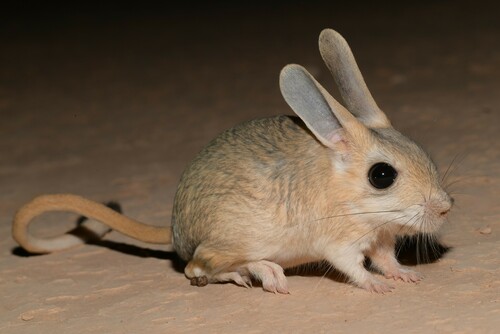
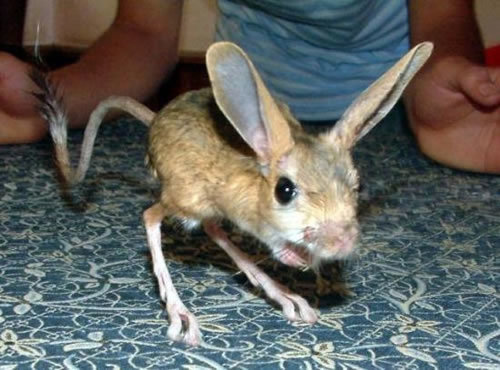
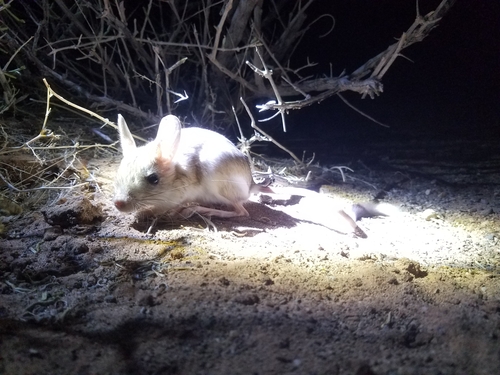
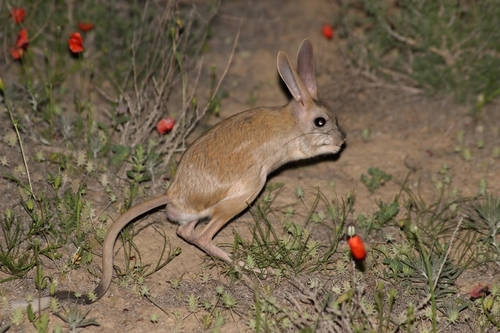
Has soft, sandy-brown to grayish fur on the back with lighter, whitish underparts, providing camouflage in desert environments. The head is large relative to body size, with prominent eyes and ears, and hind legs are elongated for jumping.
Size
Body length ranges from 4 to 5.5 cm, with a tail length of approximately 6 to 8 cm, making it one of the smallest jerboa species
Weight
Adults typically weigh between 7 and 10 grams
Distinctive features
Distinguished from other jerboas by having five toes on each hind foot rather than the reduced three-toed condition common in most jerboa species, along with its notably compact, rounded body shape and short tail relative to body length.
Differences between males and females
Minimal sexual dimorphism reported; males and females are similar in size and coloration
Behaviour and diet of the Five-toed Pygmy Jerboa
Generally solitary, coming together only briefly during breeding season; individuals maintain separate burrow systems
When it is active
Strictly nocturnal, emerging after dark to forage and avoid extreme daytime temperatures and visual predators
Diet
Primarily herbivorous, feeding on seeds, plant shoots, and possibly some insects; diet is adapted to sparse desert vegetation
How it feeds and hunts
Forages by searching along the ground for seeds and plant material; not a predatory hunter but may opportunistically consume small invertebrates
Communication
Communication methods are not well documented but likely include vocalizations, scent marking of burrows, and tactile interactions during brief mating encounters
Interactions with other species
Preyed upon by desert-adapted carnivores and raptors including foxes, owls, and small mustelids; competes with other small desert rodents for limited food resources
Role in its ecosystem
Plays a role in desert ecosystems as a seed disperser and as prey for various predators, contributing to nutrient cycling through burrowing activity that aerates soil
Reproduction and lifecycle
Breeding season likely occurs in spring and summer; gestation period is estimated at around 25-30 days based on related jerboa species, with litter sizes typically small, around 2-4 young
Raising the young
Females likely provide sole parental care, nursing and protecting young in burrows until weaning, though specific behavioral details remain poorly studied
Maturity and lifespan
Sexual maturity is likely reached within the first year of life; lifespan in the wild is estimated at 2-3 years, with potentially longer survival in captivity, though specific data is limited
Taxonomy and naming of the Five-toed Pygmy Jerboa
Classification
Class Mammalia > Order Rodentia > Family Dipodidae > Genus Cardiocranius > Species Cardiocranius paradoxus
Subspecies
No widely recognized subspecies; the genus Cardiocranius is monotypic with C. paradoxus being the sole species
What research says
Recent studies
Limited recent research exists on this species due to its remote habitat and elusive nature; most studies focus on broader jerboa taxonomy and desert rodent ecology in Central Asia
Compared with similar species
Compared to the more common Three-toed Pygmy Jerboa (Salpingotus species), Cardiocranius paradoxus is distinguished by its five-toed hind feet and slightly more robust body shape, though both share similar tiny size and desert adaptations.
The Five-toed Pygmy Jerboa and people
Despite being called a 'jerboa,' this species retains five toes on its hind feet, a rare trait among jerboas that have evolved reduced toe numbers for efficient bipedal locomotion. It is among the smallest rodents in the world capable of true bipedal hopping.
Where and how to see it
Best observed during nighttime excursions in the Gobi Desert regions of Mongolia, particularly in sandy areas with sparse vegetation; specialized nocturnal wildlife tours with local guides increase chances of sighting this elusive species.
Risks to humans
No notable risk to humans
Countries where the Five-toed Pygmy Jerboa is recorded
The 3 countries named in the range description of its IUCN Red List assessment.
Questions about the Five-toed Pygmy Jerboa
Where does the Five-toed Pygmy Jerboa live?
The Five-toed Pygmy Jerboa is recorded in China, Kazakhstan and Mongolia across Asia. These countries come from the range description of its IUCN Red List assessment, and they are what place the species on the interactive map.
Is the Five-toed Pygmy Jerboa endangered?
The IUCN Red List assesses the Five-toed Pygmy Jerboa as Data Deficient. There is not enough information to judge the risk of extinction, usually because the species is rarely seen or has never been surveyed. It is not a reassuring category: several species were Data Deficient right up to the point they were found to be Critically Endangered.
How many are left in the wild?
No reliable population estimates exist; the species is considered rare or uncommonly recorded, with population trend unknown due to lack of systematic surveys. This figure comes from the species assessment on the IUCN Red List; population estimates for wild mammals are ranges, not counts, and are revised at each assessment.
What habitat does the Five-toed Pygmy Jerboa live in?
Inhabits arid and semi-arid desert regions, including sandy deserts, gravel plains, and desert steppes with sparse vegetation.
What is the scientific name of the Five-toed Pygmy Jerboa?
The Five-toed Pygmy Jerboa is Cardiocranius paradoxus, in the family Dipodidae, order Rodentia.
Other species in the family Dipodidae
Species that share its range

Sources
Conservation status, range description and population estimate come from the IUCN Red List assessment for Cardiocranius paradoxus. Countries are derived from that range description, not from a mapped country list. Last refreshed on .
The distribution map is drawn from the IUCN Red List spatial data compiled in 2008. IUCN (International Union for Conservation of Nature)