
Balikun Jerboa
Allactaga balikunica
Red List assessment
Least Concernon the IUCN Red List
- EXExtinct
- EWExtinct in the Wild
- CRCritically Endangered
- ENEndangered
- VUVulnerable
- NTNear Threatened
- LCLeast Concern
The Balikun Jerboa is recorded in one country, China across Asia. The IUCN Red List assesses the Balikun Jerboa as Least Concern. No precise global population estimate is available.
- Family
- Dipodidae
- Order
- Rodentia
- Genus
- Allactaga
- Countries recorded
- 1
- Continents
- Asia
- Red List category
- Least Concern
- Data updated
- August 9, 2026
What is the Balikun Jerboa?
The Balikun Jerboa is a small bipedal rodent endemic to the Balikun (Barkol) Basin of eastern Xinjiang, China. Like other members of the genus Allactaga, it is characterized by greatly elongated hind limbs adapted for saltatorial (jumping) locomotion, a long tufted tail used for balance, and large eyes suited to nocturnal activity. It inhabits arid and semi-arid steppe and desert-steppe landscapes at relatively high elevation. Its narrow geographic range and specialized desert adaptations make it a notable example of endemism among Central Asian small mammals.
Where does the Balikun Jerboa live?
Northwestern China, specifically the Balikun (Barkol) Basin and surrounding semi-arid regions of the Xinjiang Uyghur Autonomous Region.
Endemic to China; range centered on the Balikun (Barkol) Basin in the Hami Prefecture of the Xinjiang Uyghur Autonomous Region, eastern Xinjiang. The full extent of its range beyond the type locality is poorly documented, but it is considered a geographically restricted species.
Altitude and depth
Occurs primarily at elevations between approximately 1,500 and 2,000 m above sea level, consistent with the high-basin steppe terrain of the Balikun area.
Seasonal movements
Like most jerboas in continental Central Asia, the Balikun Jerboa likely undergoes winter torpor or hibernation during the coldest months (approximately November to March), retreating to sealed burrows to survive harsh winters with sub-zero temperatures. Active season peaks in spring through autumn.
Habitat of the Balikun Jerboa
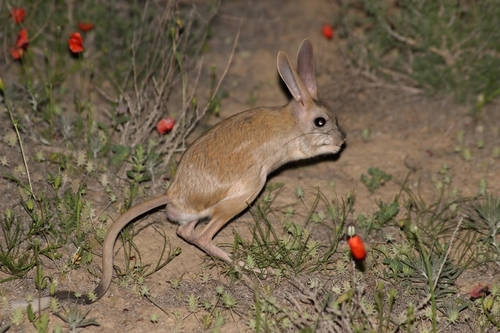
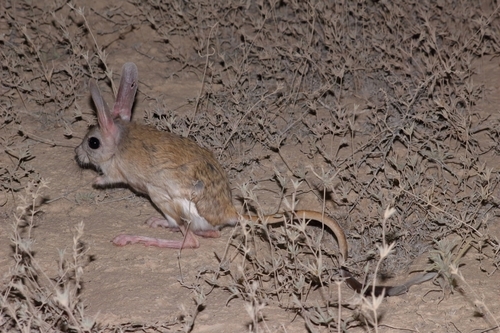
The Balikun Jerboa occupies arid and semi-arid steppe, desert-steppe, and gravelly or sandy desert plains typical of the Balikun Basin in eastern Xinjiang. It favors open, sparsely vegetated terrain with loose or compacted soils suitable for burrowing. Shrub-steppe communities dominated by Artemisia and low grasses appear to be key microhabitats.
Adaptations to its environment
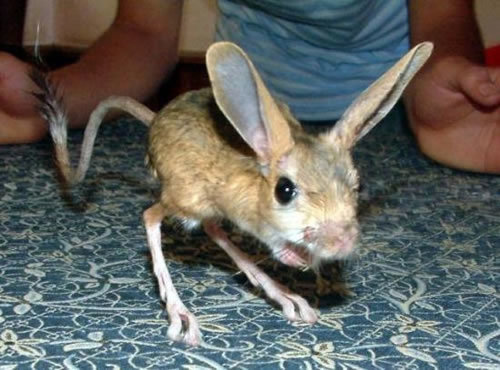
Possesses highly elongated hind limbs enabling rapid bipedal leaping to escape predators and cover large distances in sparse desert habitat. Large external ears enhance auditory detection of predators in open terrain. Efficient kidneys minimize water loss, allowing survival with little free water by metabolizing moisture from food. Pale sandy-buff dorsal fur provides effective camouflage against arid substrates.
Conservation status and numbers
Least Concern (LC) on the IUCN Red List. The species is assessed as LC due to the absence of evidence of rapid population decline, and while its range is geographically restricted, no immediate major threats have been identified that would warrant a higher threat category.
Estimated population
No precise global population estimate is available. Population trend is assumed to be stable based on current IUCN assessment, but detailed surveys are lacking.
What threatens the Balikun Jerboa?
Potential threats include habitat degradation through overgrazing by livestock, agricultural expansion into the Balikun Basin, and desertification driven by climate change. The restricted endemic range makes the species inherently vulnerable to localized disturbances. Collection for the pet or specimen trade may be a minor pressure.
Diseases and parasites
No species-specific disease or parasite data are available. Like other steppe rodents in Central Asia, it may harbor fleas (Siphonaptera) that can vector plague (Yersinia pestis), though this has not been confirmed for this species specifically.
What is being done to protect it?
No dedicated conservation programs specifically targeting Allactaga balikunica are known. The species may receive incidental protection within any nature reserves or protected areas established in Xinjiang, but specific reserve coverage of its range is unclear.
Recommended actions
Priority actions include conducting systematic field surveys to accurately delineate the species' range and estimate population size. Monitoring grazing pressure and agricultural encroachment in the Balikun Basin is advisable. Formal inclusion of key habitat within protected area networks in Xinjiang would provide a conservation safety net for this endemic species.
What the Balikun Jerboa looks like
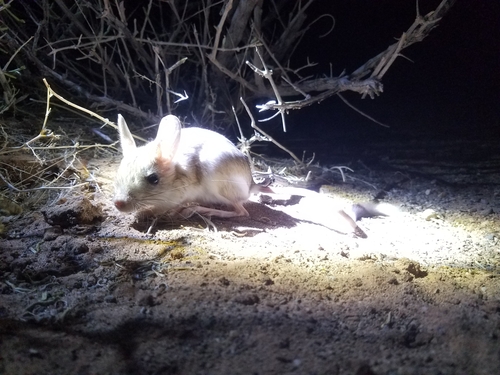
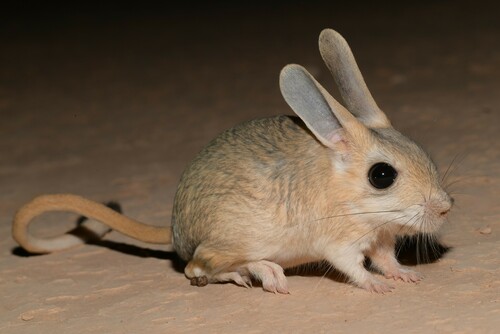
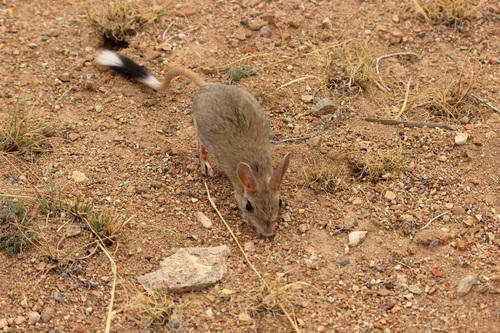
Dorsal fur is sandy-buff to pale ochre-brown, providing camouflage on desert soils. The ventral surface is white. The tail is long, slender, and ends in a distinctive black-and-white tufted pennant. The hind legs are extremely elongated relative to the compact body. The ears are large and upright; the eyes are prominent and dark.
Size
Body length approximately 100–140 mm; tail length 150–190 mm (including terminal tuft). Hind foot length typically 55–70 mm. Overall size is medium for the genus Allactaga.
Weight
Estimated body mass 50–120 g, consistent with similarly sized Allactaga species; significant seasonal variation expected, with individuals fattening before hibernation.
Distinctive features
As a member of the five-toed Allactaga genus, it possesses five functional toes on the hind foot (including two small lateral toes), distinguishing it from three-toed jerboas (Dipus, Jaculus). It can be distinguished from the closely related Allactaga sibirica by its more restricted range, potentially subtle cranial and dental morphology differences, and specific pelage tones, though definitive field identification requires expert examination.
Differences between males and females
Sexual dimorphism is considered minimal in most Allactaga species; males and females are similar in size and coloration. Females possess multiple pairs of mammary glands associated with potentially multi-pup litters.
Behaviour and diet of the Balikun Jerboa
Likely solitary outside the breeding season, as is typical for most jerboa species. Individuals maintain separate burrow systems. No evidence of colonial or highly social behavior.
When it is active
Primarily nocturnal, emerging after dusk to forage and retreating to burrows before dawn. This pattern minimizes exposure to daytime heat and diurnal predators. During peak summer heat, activity may be more pronounced in the cooler hours just after dark.
Diet
Omnivorous with a strong herbivorous tendency; diet likely consists of seeds, roots, bulbs, green plant material, and opportunistically insects and other invertebrates. Seeds and storage organs are particularly important for building fat reserves before hibernation.
How it feeds and hunts
Forages by moving bipedally across open ground, using sensitive vibrissae and hearing to locate food items. Seeds and plant matter are gathered directly from the ground or dug from shallow soil. Insects may be pursued and caught opportunistically.
Communication
Communication likely involves high-frequency vocalizations (possibly ultrasonic), foot-thumping on the ground as an alarm signal, and olfactory scent marking via urine and glandular secretions to delineate territories and signal reproductive status.
Interactions with other species
Natural predators likely include small carnivores such as corsac fox (Vulpes corsac), weasels (Mustela spp.), and raptors including eagle owls (Bubo bubo) and falcons active over open steppe. The species competes with other small rodents (voles, gerbils) for seeds and plant resources in its habitat.
Role in its ecosystem
Functions as a seed disperser and granivore within the desert-steppe ecosystem, influencing plant community structure. As prey, it forms part of the food web supporting mid-level carnivores and raptors in the Balikun Basin.
Reproduction and lifecycle
Breeding biology is not well documented for this specific species. Based on related Allactaga species, breeding likely occurs in spring and early summer (April–July), with a gestation period of approximately 25–30 days and litter sizes of 2–6 young. Two litters per year may be possible during the short active season.
Raising the young
Young are born altricial (naked, blind, helpless) in a grass-lined burrow chamber. The female provides all parental care; she nurses and protects the young until they are weaned at approximately 4–5 weeks of age, after which they become independent.
Maturity and lifespan
Sexual maturity likely reached at 2–3 months of age, consistent with other Allactaga species. Lifespan in the wild is estimated at 2–3 years; captive individuals of related species have lived up to 4–6 years.
Taxonomy and naming of the Balikun Jerboa
Classification
Mammalia > Rodentia > Dipodidae > Allactaga > Allactaga balikunica
What research says
Recent studies
The species remains poorly studied; no major recent publications specifically focused on Allactaga balikunica ecology, genetics, or population biology are known as of 2024. It is occasionally referenced in broader taxonomic revisions of the Dipodidae.
Genome and DNA
No published chromosome count or genomic study specific to Allactaga balikunica is available. Related Allactaga species typically have diploid chromosome numbers in the range of 2n = 48. Molecular phylogenetic studies of Dipodidae place Allactaga in subfamily Allactaginae.
Compared with similar species
Most closely related to other Central Asian Allactaga species such as Allactaga sibirica (Mongolian Five-toed Jerboa) and Allactaga bullata (Gobi Jerboa). Compared to A. sibirica, A. balikunica is geographically more restricted and may show morphological adaptations to the specific altitude and climate of the Balikun Basin. All share the pentadactyl hind foot and tufted tail characteristic of the genus.
The Balikun Jerboa and people
The Balikun Jerboa can leap distances of up to 1.5–2 meters in a single bound using its powerful hind legs — proportionally equivalent to a human jumping roughly 10 meters. Its distinctive black-and-white tail tuft is thought to act as a 'false target,' confusing predators during erratic escape jumps. Despite surviving frigid Central Asian winters, it does so not by migrating but by entering a deep torpor in sealed underground burrows, surviving entirely on stored body fat.
Where and how to see it
Best observed in the Balikun Basin of eastern Xinjiang during the active season (May–September) after nightfall, using a red-filtered flashlight to avoid startling individuals. Open gravelly steppe areas near Balikun Lake and surrounding semi-desert plains are the recommended search sites. Local naturalist guides or researchers from Xinjiang universities may assist in locating active burrow systems.
Risks to humans
No notable risk to humans. The Balikun Jerboa is a small, timid rodent that will attempt to flee rather than bite when encountered. Standard precautions regarding rodent-associated ectoparasites (fleas) are advisable when handling any wild individual.
Countries where the Balikun Jerboa is recorded
The 1 countries named in the range description of its IUCN Red List assessment.
Questions about the Balikun Jerboa
Where does the Balikun Jerboa live?
The Balikun Jerboa is recorded in China across Asia. These countries come from the range description of its IUCN Red List assessment, and they are what place the species on the interactive map.
Is the Balikun Jerboa endangered?
The IUCN Red List assesses the Balikun Jerboa as Least Concern. The species is widespread and abundant enough not to qualify for any threatened category. It does not mean the species is safe forever, only that nothing in the current data raises an alarm.
How many are left in the wild?
No precise global population estimate is available. This figure comes from the species assessment on the IUCN Red List; population estimates for wild mammals are ranges, not counts, and are revised at each assessment.
What habitat does the Balikun Jerboa live in?
The Balikun Jerboa occupies arid and semi-arid steppe, desert-steppe, and gravelly or sandy desert plains typical of the Balikun Basin in eastern Xinjiang.
What is the scientific name of the Balikun Jerboa?
The Balikun Jerboa is Allactaga balikunica, in the family Dipodidae, order Rodentia.
Other species in the genus Allactaga
Other species in the family Dipodidae
Species that share its range
Sources
Conservation status, range description and population estimate come from the IUCN Red List assessment for Allactaga balikunica. Countries are derived from that range description, not from a mapped country list. Last refreshed on .
The distribution map is drawn from the IUCN Red List spatial data compiled in 2008. IUCN (International Union for Conservation of Nature)