
Bobrinski's Jerboa
Allactodipus bobrinskii
Red List assessment
Least Concernon the IUCN Red List
- EXExtinct
- EWExtinct in the Wild
- CRCritically Endangered
- ENEndangered
- VUVulnerable
- NTNear Threatened
- LCLeast Concern
The Bobrinski's Jerboa is recorded in 3 countries across Asia. The IUCN Red List assesses the Bobrinski's Jerboa as Least Concern. No precise global population estimate is available.
- Family
- Dipodidae
- Order
- Rodentia
- Genus
- Allactodipus
- Countries recorded
- 3
- Continents
- Asia
- Red List category
- Least Concern
- Data updated
- August 9, 2026
What is the Bobrinski's Jerboa?
Bobrinski's Jerboa is a small, bipedal rodent and the sole member of the monotypic genus Allactodipus within the family Dipodidae. Named in honor of the Russian zoologist Count Nikolai Bobrinski (1890–1964), it inhabits the harsh sandy deserts of Central Asia. It is remarkable for being a relict lineage, morphologically intermediate between several other jerboa genera, making it taxonomically unique. Like all jerboas, it is adapted for rapid bipedal locomotion across open desert terrain.
Where does the Bobrinski's Jerboa live?
Sandy deserts of Central Asia, primarily Uzbekistan (Kyzylkum Desert) and Turkmenistan (Karakum Desert), with possible presence in adjacent Kazakhstan.
Restricted to Central Asia, with the core range centered in the Karakum Desert of Turkmenistan and the Kyzylkum Desert of Uzbekistan. Marginal records exist from southern Kazakhstan. The overall range is relatively narrow and fragmented.
Altitude and depth
Primarily lowland desert, typically between 50 and 500 meters above sea level, consistent with the flat topography of Central Asian desert basins.
Seasonal movements
Undergoes winter hibernation, typically from October or November through March or April, retreating into deep burrows to survive cold temperatures and food scarcity. Activity peaks during the warmer months of spring and summer. Breeding activity is concentrated in the post-hibernation spring period.
Habitat of the Bobrinski's Jerboa
Predominantly fixed and semi-fixed sand dunes with sparse xerophytic vegetation such as saxaul (Haloxylon ammodendron), sedges, and low desert shrubs. It avoids barren, shifting dunes and areas with compacted soils, preferring loose sandy substrates with some vegetative cover for foraging and burrowing.
Adaptations to its environment
Possesses greatly elongated hind limbs for rapid bipedal hopping, allowing it to escape predators and cover large distances foraging in sparse desert habitat. Large external ears likely enhance predator detection in open terrain. Pale sandy-buff dorsal fur provides cryptic camouflage against desert substrates. Highly efficient kidneys minimize water loss, enabling survival without free water by extracting metabolic water from food.
Conservation status and numbers
Listed as Least Concern (LC) on the IUCN Red List, primarily because the species is not known to be declining rapidly enough to qualify for a threatened category, and it persists across a range that, while geographically restricted, remains relatively intact. However, reliable population data are scarce and monitoring is limited.
Estimated population
No precise global population estimate is available. The population is presumed to be relatively small given the species' restricted range, but is considered stable under current IUCN assessments. Long-term trend data are lacking.
What threatens the Bobrinski's Jerboa?
Habitat degradation caused by overgrazing by livestock, which destabilizes sandy soils and alters desert vegetation structure. Agricultural expansion and irrigation development in Central Asian deserts reduce available habitat. Climate change may intensify desertification or alter vegetation dynamics. Pesticide use in surrounding agricultural areas may indirectly affect food availability.
Diseases and parasites
As with other Central Asian rodents, it is potentially susceptible to fleas (Siphonaptera), ticks, and internal helminths. Central Asian rodents are known reservoirs of plague (Yersinia pestis) and leishmania, though specific records for Allactodipus bobrinskii are lacking. No species-specific disease studies have been published.
What is being done to protect it?
Parts of its range fall within protected areas in Turkmenistan and Uzbekistan, including nature reserves in the Karakum and Kyzylkum regions. National legislation in both countries provides some general protection for wildlife. No species-specific conservation program is known to exist.
Recommended actions
Systematic field surveys are needed to establish baseline population data and refine range maps. Monitoring of habitat quality within protected areas should be strengthened. Research into population genetics and connectivity would clarify conservation priorities. Awareness among local communities about the ecological importance of desert fauna should be promoted.
What the Bobrinski's Jerboa looks like
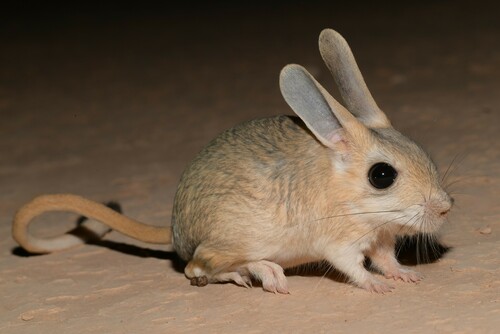
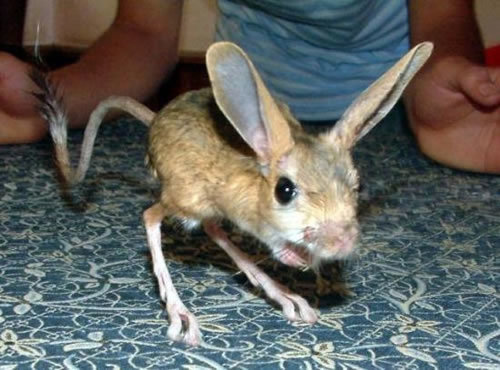
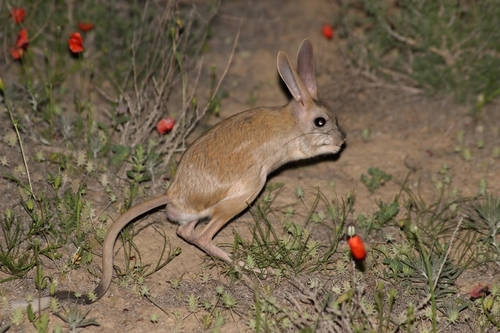
Dorsal fur is pale sandy-buff to ochre-yellow, providing excellent camouflage against desert sand. The underparts are white or cream. The long tail ends in a distinctive black-and-white tufted tip. The hind legs are greatly elongated relative to the body, and the ears are moderately large and rounded. The eyes are large and dark, typical of nocturnal small mammals.
Size
Body length approximately 90–115 mm; tail length 145–175 mm (tail distinctly longer than body); hind foot length approximately 55–65 mm. A relatively small jerboa within Dipodidae.
Weight
Estimated body mass of approximately 40–70 grams; no significant sexual size dimorphism has been documented, though data are limited.
Distinctive features
Distinguished from the closely related five-toed jerboas of genus Allactaga by subtle differences in skull morphology, dental structure, and proportions of the metatarsal bones. The tufted tail with a dark subterminal band followed by a white tip is characteristic. Its status as the sole member of Allactodipus reflects its morphological distinctiveness from all other dipodid genera.
Differences between males and females
Sexual dimorphism is minimal or absent in external morphology, as in most Dipodidae. Males and females are of similar size and coloration. Females possess mammary glands visible during lactation.
Behaviour and diet of the Bobrinski's Jerboa
Predominantly solitary, as typical of most jerboa species. Individuals maintain separate burrows and home ranges. Social interactions are likely limited to the breeding season. No cooperative behavior or complex social hierarchy has been documented.
When it is active
Strictly nocturnal, emerging from burrows only after dark to forage. Activity is concentrated in the first half of the night. During daylight hours and during winter, the animal retreats to sealed burrows dug in sandy soil.
Diet
Primarily granivorous, feeding on seeds of desert grasses and forbs. Also consumes green plant material, roots, and bulbs when available. May opportunistically consume insects and other invertebrates, which provide protein and moisture. Foraging occurs over relatively large areas given the sparsity of food resources.
How it feeds and hunts
Forages by moving bipedally across the desert surface, pausing to detect and dig out buried seeds or locate arthropods. Uses its forepaws to manipulate and handle food items. May use its sensitive vibrissae (whiskers) and large eyes to locate food in low-light conditions.
Communication
Communication likely involves ultrasonic vocalizations for short-range interactions, particularly during mating. Scent marking via specialized glands may define individual territories or attract mates. Foot-drumming on the substrate, observed in some dipodids, may occur but has not been specifically documented in this species.
Interactions with other species
Natural predators likely include owls (particularly Barn Owl Tyto alba and Eagle Owl Bubo bubo), snakes (e.g., sand boas), and small carnivorous mammals such as foxes and weasels. Competes with other small rodents (gerbils, other jerboas) for seeds and burrow sites. No known mutualistic or symbiotic relationships have been documented.
Role in its ecosystem
Functions as a seed predator and disperser within desert ecosystems, contributing to plant community dynamics. As prey for multiple carnivore species, it forms part of the desert food web. Its burrowing activity may contribute to soil aeration and texture modification in sandy habitats.
Reproduction and lifecycle
Breeding occurs in spring and possibly again in early summer following emergence from hibernation. Gestation period is estimated at approximately 25–35 days, consistent with related dipodid species. Litter size is likely 2–5 young. Females may produce one or two litters per active season.
Raising the young
Young are altricial at birth (naked, blind, helpless) and are raised exclusively by the mother within a lined burrow nest. Weaning occurs at approximately 4–6 weeks of age. Juveniles become independent relatively quickly and must establish their own burrows before winter.
Maturity and lifespan
Sexual maturity is likely reached at 2–3 months of age, after the first winter hibernation, as typical of similar jerboas. Lifespan in the wild is estimated at 2–3 years; captive longevity data are not available for this species.
Taxonomy and naming of the Bobrinski's Jerboa
Classification
Mammalia > Rodentia > Dipodidae > Allactodipus > Allactodipus bobrinskii
Scientific synonyms
No widely recognized synonyms; described by Vinogradov in 1930. The genus Allactodipus is monotypic.
What research says
Recent studies
The species has been included in molecular systematic analyses of the family Dipodidae conducted in the 2000s–2010s, which helped clarify its phylogenetic position. It remains one of the least-studied jerboas, and no substantial recent field studies have been published specifically on its ecology or behavior.
Genome and DNA
No published chromosome count or detailed genomic data specific to Allactodipus bobrinskii are available. Molecular phylogenetic studies of Dipodidae have confirmed the monotypic genus as a distinct lineage, likely sister to or nested near Allactaga, but precise relationships remain debated.
Compared with similar species
Most closely related to the five-toed jerboas of genus Allactaga, which share a similar body plan and Central Asian distribution but occur across a much wider range and include numerous species. Allactodipus bobrinskii differs in specific cranial and dental morphology and in its more restricted, specialist sandy-desert habitat preference. It is considerably smaller and more range-restricted than the Great Jerboa (Allactaga major).
The Bobrinski's Jerboa and people
Bobrinski's Jerboa is the sole representative of its entire genus, making it a truly unique evolutionary lineage with no close living relatives. Despite its small size, it can leap distances many times its own body length to evade predators, using its long tufted tail as a balancing rudder in mid-air. The species remained virtually unknown to Western science for decades after its original description in 1930, largely due to its remote desert habitat and strictly nocturnal habits.
Where and how to see it
Best observed during warm, calm nights in spring or early summer in the Karakum or Kyzylkum deserts by spotlighting from a vehicle along sandy desert tracks. The eyeshine of jerboas is visible at low angles of headlamp or torch light. Access to the core range requires travel to remote areas of Uzbekistan and Turkmenistan, ideally with a local naturalist guide. Patience and slow movement are essential as the animal is extremely alert.
Risks to humans
No notable risk to humans. The species is small, timid, and avoids human contact. As with all wild rodents in Central Asia, there is a theoretical risk of ectoparasite transmission, but direct human health incidents involving this species are not documented.
Countries where the Bobrinski's Jerboa is recorded
The 3 countries named in the range description of its IUCN Red List assessment.
Questions about the Bobrinski's Jerboa
Where does the Bobrinski's Jerboa live?
The Bobrinski's Jerboa is recorded in Kazakhstan, Turkmenistan and Uzbekistan across Asia. These countries come from the range description of its IUCN Red List assessment, and they are what place the species on the interactive map.
Is the Bobrinski's Jerboa endangered?
The IUCN Red List assesses the Bobrinski's Jerboa as Least Concern. The species is widespread and abundant enough not to qualify for any threatened category. It does not mean the species is safe forever, only that nothing in the current data raises an alarm.
How many are left in the wild?
No precise global population estimate is available. This figure comes from the species assessment on the IUCN Red List; population estimates for wild mammals are ranges, not counts, and are revised at each assessment.
What habitat does the Bobrinski's Jerboa live in?
Predominantly fixed and semi-fixed sand dunes with sparse xerophytic vegetation such as saxaul (Haloxylon ammodendron), sedges, and low desert shrubs.
What is the scientific name of the Bobrinski's Jerboa?
The Bobrinski's Jerboa is Allactodipus bobrinskii, in the family Dipodidae, order Rodentia.
Other species in the family Dipodidae
Species that share its range
Sources
Conservation status, range description and population estimate come from the IUCN Red List assessment for Allactodipus bobrinskii. Countries are derived from that range description, not from a mapped country list. Last refreshed on .
The distribution map is drawn from the IUCN Red List spatial data compiled in 2008. IUCN (International Union for Conservation of Nature)