
Goeldi's Monkey
Callimico goeldii
Red List assessment
Vulnerableon the IUCN Red List
- EXExtinct
- EWExtinct in the Wild
- CRCritically Endangered
- ENEndangered
- VUVulnerable
- NTNear Threatened
- LCLeast Concern
The Goeldi's Monkey is recorded in 5 countries across South America. The IUCN Red List assesses the Goeldi's Monkey as Vulnerable. Exact population numbers are unknown, but the species is considered to have a declining population trend due to continued habitat destruction across its range.
- Family
- Callitrichidae
- Order
- Primates
- Genus
- Callimico
- Countries recorded
- 5
- Continents
- South America
- Red List category
- Vulnerable
- Data updated
- August 9, 2026
What is the Goeldi's Monkey?
Goeldi's Monkey is a small, dark-furred New World primate found in the understory of the western Amazon basin. It is notable for its unusual mix of traits shared with both marmosets/tamarins and larger monkeys, including a single offspring per birth rather than twins typical of other callitrichids. It lives in small family groups in dense bamboo and understory vegetation, making it one of the more elusive and poorly studied Amazonian primates. Its taxonomic position has long puzzled scientists, leading to its own subfamily classification within Callitrichidae.
Where does the Goeldi's Monkey live?
Upper Amazon Basin: western Brazil, eastern Peru, northern Bolivia, and southern Colombia/Ecuador border regions
Found in the upper Amazon Basin spanning western Brazil (Acre, Amazonas), eastern Peru, northern Bolivia, and marginal areas of southeastern Colombia and Ecuador. Distribution is patchy and tied to specific understory habitat conditions.
Altitude and depth
Typically found at low elevations, generally below 500m, within lowland tropical rainforest.
Seasonal movements
No migration or hibernation; however, breeding activity may show slight seasonal peaks correlated with fruit and insect availability during wetter months.
Habitat of the Goeldi's Monkey
Prefers dense, humid tropical rainforest understory, particularly areas with bamboo thickets, tangled vine growth, and secondary forest regrowth. Often found near seasonally flooded forest margins and areas with dense low vegetation providing cover from predators.
Adaptations to its environment
Possesses sharp claws for vertical clinging and climbing in dense understory vegetation, and a diet flexible enough to exploit fungi, insects, and fruit depending on availability. Its small size and secretive behavior help it avoid predation in the thick undergrowth it inhabits.
Conservation status and numbers
Classified as Vulnerable (VU) by IUCN due to ongoing habitat loss from deforestation and fragmentation across its range, combined with a naturally patchy distribution and low population densities.
Estimated population
Exact population numbers are unknown, but the species is considered to have a declining population trend due to continued habitat destruction across its range.
What threatens the Goeldi's Monkey?
Primary threats include deforestation for agriculture and cattle ranching, logging, infrastructure development, and habitat fragmentation, which isolates populations and reduces genetic connectivity.
Diseases and parasites
Susceptible to various intestinal parasites and some viral infections common among New World primates, though specific studies on wild populations remain limited.
What is being done to protect it?
Occurs within several protected areas including national parks and reserves in Peru, Brazil, and Bolivia; also present in international zoo breeding programs that contribute to genetic and behavioral research.
Recommended actions
Priority actions include expanding protected habitat corridors, monitoring population trends through field surveys, reducing deforestation rates in key range areas, and supporting community-based conservation initiatives.
What the Goeldi's Monkey looks like
Covered in dark blackish-brown, almost uniformly colored fur, giving it a sleek and shadowy appearance ideal for understory camouflage. It has a small body, long non-prehensile tail, and a rounded head with large expressive eyes adapted for low-light foraging.
Size
Body length ranges from about 20-24 cm, with a tail of similar or slightly greater length, adding roughly 25-30 cm.
Weight
Adults typically weigh between 350-500 grams, with no major difference between males and females.
Distinctive features
Unlike most callitrichids, Goeldi's Monkey has a full set of molars (not reduced), and typically gives birth to a single offspring instead of twins, distinguishing it clearly from marmosets and tamarins.
Behaviour and diet of the Goeldi's Monkey
Lives in small family groups of about 2-8 individuals, usually consisting of a breeding pair and their offspring. Groups show cooperative behavior, especially in offspring care and vigilance against predators.
When it is active
Primarily diurnal, being most active during daylight hours while foraging and moving through dense understory vegetation.
Diet
Omnivorous diet consisting of fruit, fungi, insects, small vertebrates, and occasionally nectar; fungi consumption is notably higher than in most other primates.
How it feeds and hunts
Forages opportunistically by searching through leaf litter, decaying wood, and low vegetation for insects and fungi, using quick, agile movements to catch small prey.
Communication
Uses a range of vocalizations including chirps, trills, and long calls for group coordination and territory signaling, along with scent marking to communicate reproductive status and territory boundaries.
Interactions with other species
Natural predators include birds of prey, small forest cats, and snakes; it may also compete with sympatric tamarin species for food resources in overlapping habitats.
Role in its ecosystem
Plays a role in seed dispersal for various fruiting plants and contributes to fungal spore dispersal, making it ecologically significant within its forest understory niche.
Reproduction and lifecycle
Breeding can occur nearly year-round with some seasonal peaks; gestation lasts about 150-160 days, and typically a single infant is born, unlike the twin births common in related species.
Raising the young
Both parents and other group members participate in carrying and caring for the infant, with the father often playing a particularly active caregiving role, similar to other callitrichids.
Maturity and lifespan
Reaches sexual maturity around 1-2 years of age; lifespan in the wild is estimated at around 10 years, while captive individuals can live up to 15-20 years.
Taxonomy and naming of the Goeldi's Monkey
Classification
Class Mammalia > Order Primates > Family Callitrichidae > Genus Callimico > Species Callimico goeldii
Scientific synonyms
Callimico goeldii is monotypic; formerly sometimes placed in its own family Callimiconidae due to unique dental and reproductive traits
What research says
Recent studies
Recent research has focused on its unique reproductive biology, single-offspring births, and its evolutionary position bridging marmosets/tamarins and larger New World monkeys.
Genome and DNA
Diploid chromosome number is 2n=47, an unusual odd number among primates that has drawn scientific interest in comparative genomic studies.
Compared with similar species
Compared to marmosets and tamarins, Goeldi's Monkey has fuller dentition, larger body size relative to some tamarins, and produces single offspring rather than twins, making it ecologically and reproductively distinct within Callitrichidae.
The Goeldi's Monkey and people
Goeldi's Monkey is one of the few primates known to regularly eat fungi as a significant dietary component. It was historically so taxonomically puzzling that it was once placed in its own family. Despite being small, it can leap impressively far between branches in dense understory vegetation.
Where and how to see it
Best observed in protected reserves within the Peruvian and Bolivian Amazon during early morning hours when groups are actively foraging in dense understory vegetation. Patience and knowledge of bamboo thicket habitats greatly increase chances of sighting due to the species' secretive nature.
Risks to humans
No notable risk to humans; it is a small, shy primate that avoids human contact.
Human uses
Occasionally kept in zoos for conservation breeding and research purposes; historically some individuals were captured for the exotic pet trade, though this is now largely restricted by conservation laws.
Countries where the Goeldi's Monkey is recorded
The 5 countries named in the range description of its IUCN Red List assessment.
Questions about the Goeldi's Monkey
Where does the Goeldi's Monkey live?
The Goeldi's Monkey is recorded in Bolivia, Brazil, Colombia, Ecuador and Peru across South America. These countries come from the range description of its IUCN Red List assessment, and they are what place the species on the interactive map.
Is the Goeldi's Monkey endangered?
Yes. The IUCN Red List assesses the Goeldi's Monkey as Vulnerable, one of the three threatened categories. The species faces a high risk of extinction in the wild. It is the first of the three threatened categories: numbers are falling, the range is shrinking, or the population is small enough that a single bad event could do lasting damage.
How many are left in the wild?
Exact population numbers are unknown, but the species is considered to have a declining population trend due to continued habitat destruction across its range. This figure comes from the species assessment on the IUCN Red List; population estimates for wild mammals are ranges, not counts, and are revised at each assessment.
What habitat does the Goeldi's Monkey live in?
Prefers dense, humid tropical rainforest understory, particularly areas with bamboo thickets, tangled vine growth, and secondary forest regrowth.
What is the scientific name of the Goeldi's Monkey?
The Goeldi's Monkey is Callimico goeldii, in the family Callitrichidae, order Primates.
Other species in the family Callitrichidae
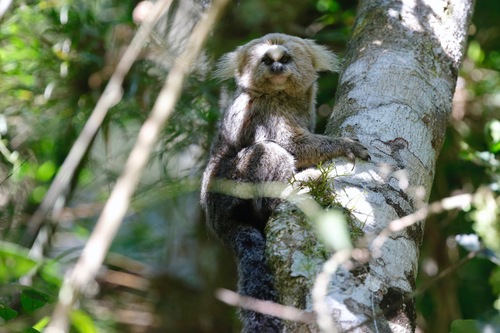
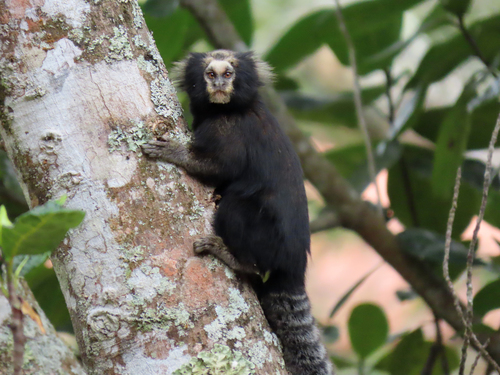
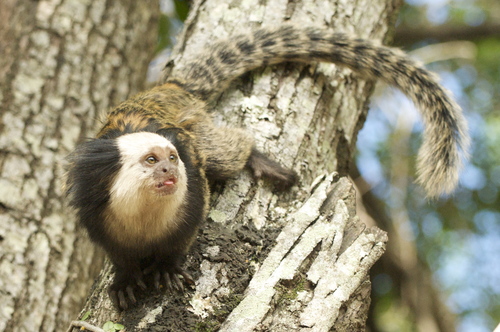
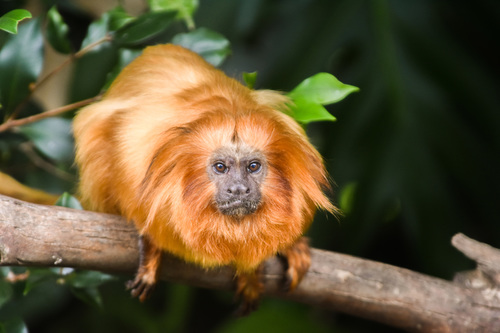
Species that share its range
Sources
Conservation status, range description and population estimate come from the IUCN Red List assessment for Callimico goeldii. Countries are derived from that range description, not from a mapped country list. Last refreshed on .
The distribution map is drawn from the IUCN Red List spatial data compiled in 2008. IUCN (International Union for Conservation of Nature)