
Golden Lion Tamarin
Leontopithecus rosalia
Red List assessment
Endangeredon the IUCN Red List
- EXExtinct
- EWExtinct in the Wild
- CRCritically Endangered
- ENEndangered
- VUVulnerable
- NTNear Threatened
- LCLeast Concern
The Golden Lion Tamarin is recorded in one country, Brazil across South America. The IUCN Red List assesses the Golden Lion Tamarin as Endangered. Approximately 2,500-3,700 individuals in the wild, with a trend showing gradual increase due to conservation programs, though still highly fragmented.
- Family
- Callitrichidae
- Order
- Primates
- Genus
- Leontopithecus
- Countries recorded
- 1
- Continents
- South America
- Red List category
- Endangered
- Data updated
- August 9, 2026
What is the Golden Lion Tamarin?
The Golden Lion Tamarin is a small, strikingly colored New World monkey endemic to the Atlantic Forest of southeastern Brazil, known for its brilliant golden-orange fur and lion-like mane. It is one of the most iconic and heavily studied conservation success stories among primates, having been brought back from the brink of extinction through captive breeding and habitat restoration. It lives in fragmented lowland forest patches, relying on tree cavities and dense vegetation for shelter. Its charismatic appearance and endangered status have made it a flagship species for tropical forest conservation.
Where does the Golden Lion Tamarin live?
Brazil (Rio de Janeiro state, Atlantic Forest)
Restricted to a small region of Rio de Janeiro state in southeastern Brazil, primarily within fragmented remnants of the Atlantic Forest such as Poço das Antas Biological Reserve and surrounding private lands and reserves.
Altitude and depth
Sea level to approximately 300-400 meters
Seasonal movements
No migration or hibernation; however, foraging behavior and diet shift seasonally with fruit availability, with more insect consumption during dry season fruit scarcity.
Habitat of the Golden Lion Tamarin
Lowland and submontane tropical Atlantic Forest, including primary and secondary forest with dense canopy cover, lianas, and abundant tree holes used for sleeping sites. It prefers forest with a mix of large trees for foraging and vine tangles for locomotion and refuge from predators.
Adaptations to its environment
Long fingers and claw-like nails (tegulae) allow it to extract prey from bark crevices and bromeliads. Its small body size and agile climbing ability enable movement through dense vine tangles and thin branches inaccessible to larger predators. Use of multiple tree-hole sleeping sites helps avoid predation and parasite buildup.
Conservation status and numbers
Endangered (EN) according to IUCN, primarily due to historic habitat loss reducing its range to less than 2% of original Atlantic Forest cover; populations have stabilized and slightly increased due to intensive conservation efforts but remain vulnerable to fragmentation.
Estimated population
Approximately 2,500-3,700 individuals in the wild, with a trend showing gradual increase due to conservation programs, though still highly fragmented.
What threatens the Golden Lion Tamarin?
Habitat loss and fragmentation from agriculture, urbanization, and cattle ranching; genetic isolation in small forest fragments; illegal pet trade in the past; and diseases transmitted from domestic animals.
Diseases and parasites
Susceptible to yellow fever outbreaks, intestinal parasites, and diseases transmissible from domestic animals such as canine distemper.
What is being done to protect it?
Extensive reintroduction and translocation programs, protected areas such as Poço das Antas and União Biological Reserves, corridor creation projects connecting forest fragments, and a globally coordinated captive breeding program (Golden Lion Tamarin Association) have been central to its recovery.
Recommended actions
Continued reforestation and corridor creation to reconnect isolated populations, stricter enforcement of habitat protection laws, genetic management of small populations, and community engagement to reduce forest encroachment.
What the Golden Lion Tamarin looks like
Vivid golden-orange silky fur covers the body, with a distinctive mane-like ruff framing the face, resembling a lion's mane. The face is dark and hairless, contrasting with the bright fur, and the tail is long and non-prehensile.
Size
Head-body length of 20-34 cm, with a tail of 32-40 cm, roughly equal to or longer than body length.
Weight
Approximately 360-710 grams, with males and females similar in size.
Distinctive features
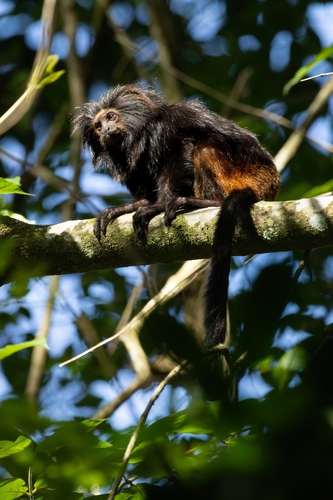
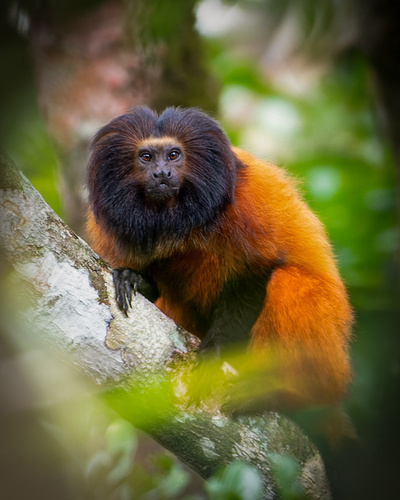
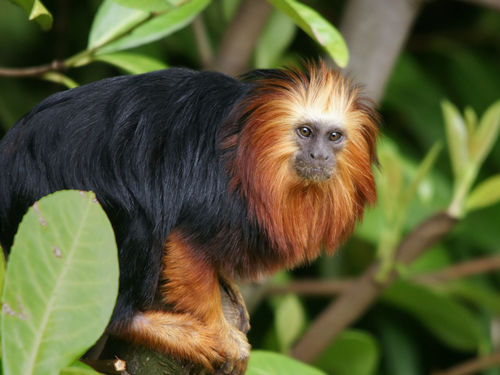
Distinguished from other Leontopithecus species by its uniformly golden coat, whereas relatives like the golden-headed or black lion tamarin have contrasting black or dark body fur with golden extremities.
Differences between males and females
Minimal sexual dimorphism; males and females are similar in size and coloration, though females are often slightly heavier.
Behaviour and diet of the Golden Lion Tamarin
Lives in small family groups of 2-8 individuals, typically composed of a monogamous or polyandrous breeding pair and their offspring, exhibiting cooperative behavior and shared vigilance against predators.
When it is active
Diurnal, active during daylight hours, foraging and moving through the forest canopy before retreating to tree hollows at night.
Diet
Omnivorous diet consisting of ripe fruits, flowers, nectar, insects, small vertebrates, and invertebrates found in bark crevices and bromeliads.
How it feeds and hunts
Uses precise manual dexterity and long fingers to probe bark, bromeliads, and leaf litter for hidden insects and small prey rather than active pursuit hunting.
Communication
Communicates through a range of vocalizations including long calls, trills, and alarm clicks, as well as scent marking with scent glands and visual displays such as piloerection of the mane.
Interactions with other species
Preyed upon by raptors, snakes, and wild cats such as ocelots; competes with other small mammals for fruit and insect resources, and occasionally associates with other primate species in mixed foraging groups.
Role in its ecosystem
Plays an important ecological role as a seed disperser for various fruiting trees within the Atlantic Forest, thereby contributing to forest regeneration and plant diversity.
Reproduction and lifecycle
Breeding season generally occurs from September to March, coinciding with the wet season; gestation lasts about 125-130 days, typically producing twins.
Raising the young
Both parents and older siblings participate in carrying and caring for infants, with the father often carrying the young most of the time and transferring them to the mother mainly for nursing.
Maturity and lifespan
Reaches sexual maturity around 2 years of age; lifespan is approximately 8 years in the wild and up to 20 years in captivity.
Taxonomy and naming of the Golden Lion Tamarin
Classification
Mammalia > Primates > Callitrichidae > Leontopithecus > L. rosalia
Scientific synonyms
Midas rosalia, Simia rosalia (historical synonyms used prior to modern taxonomic revisions)
What research says
Recent studies
Recent research has focused on genetic diversity management in fragmented populations and the effectiveness of forest corridors in maintaining gene flow between isolated groups.
Genome and DNA
Diploid chromosome number of 2n=44; genetic studies have been used extensively to manage inbreeding in captive and reintroduced populations.
Compared with similar species
Similar to other lion tamarins (golden-headed, black, and black-faced lion tamarins) but distinguished by its fully golden coat; generally smaller and more brightly colored than most other callitrichid species like marmosets.
The Golden Lion Tamarin and people
The Golden Lion Tamarin's mane inspired its common name due to its resemblance to a lion. It was once considered nearly extinct with fewer than 200 individuals in the 1970s but has since become a global conservation icon. It can rotate its head almost 180 degrees to watch for predators while foraging.
Where and how to see it
Best observed in early morning hours within protected reserves such as Poço das Antas Biological Reserve or REGUA in Rio de Janeiro state, ideally with a local guide familiar with tamarin group locations.
Risks to humans
No notable risk to humans; the species is shy and avoids human contact.
Human uses
Historically captured for the exotic pet trade, but now primarily valued for ecotourism and as a symbol for conservation education and fundraising.
Myths and legends
While not tied to major indigenous myths, the species has become a modern symbol of Brazilian biodiversity conservation and is featured on Brazilian currency and postage stamps.
Countries where the Golden Lion Tamarin is recorded
The 1 countries named in the range description of its IUCN Red List assessment.
Questions about the Golden Lion Tamarin
Where does the Golden Lion Tamarin live?
The Golden Lion Tamarin is recorded in Brazil across South America. These countries come from the range description of its IUCN Red List assessment, and they are what place the species on the interactive map.
Is the Golden Lion Tamarin endangered?
Yes. The IUCN Red List assesses the Golden Lion Tamarin as Endangered, one of the three threatened categories. The species faces a very high risk of extinction in the wild — a step below Critically Endangered, but still on a trajectory that ends badly without intervention.
How many are left in the wild?
Approximately 2,500-3,700 individuals in the wild, with a trend showing gradual increase due to conservation programs, though still highly fragmented. This figure comes from the species assessment on the IUCN Red List; population estimates for wild mammals are ranges, not counts, and are revised at each assessment.
What habitat does the Golden Lion Tamarin live in?
Lowland and submontane tropical Atlantic Forest, including primary and secondary forest with dense canopy cover, lianas, and abundant tree holes used for sleeping sites.
What is the scientific name of the Golden Lion Tamarin?
The Golden Lion Tamarin is Leontopithecus rosalia, in the family Callitrichidae, order Primates.
Other species in the genus Leontopithecus
Other species in the family Callitrichidae
Species that share its range
Sources
Conservation status, range description and population estimate come from the IUCN Red List assessment for Leontopithecus rosalia. Countries are derived from that range description, not from a mapped country list. Last refreshed on .
The distribution map is drawn from the IUCN Red List spatial data compiled in 2008. IUCN (International Union for Conservation of Nature)