
Buffy-tufted-ear Marmoset
Callithrix aurita
Red List assessment
Endangeredon the IUCN Red List
- EXExtinct
- EWExtinct in the Wild
- CRCritically Endangered
- ENEndangered
- VUVulnerable
- NTNear Threatened
- LCLeast Concern
The Buffy-tufted-ear Marmoset is recorded in one country, Brazil across South America. The IUCN Red List assesses the Buffy-tufted-ear Marmoset as Endangered. Population size is not precisely known but is estimated to be declining, with fragmented subpopulations likely numbering in the low thousands; overall trend is decreasing
- Family
- Callitrichidae
- Order
- Primates
- Genus
- Callithrix
- Countries recorded
- 1
- Continents
- South America
- Red List category
- Endangered
- Data updated
- August 9, 2026
What is the Buffy-tufted-ear Marmoset?
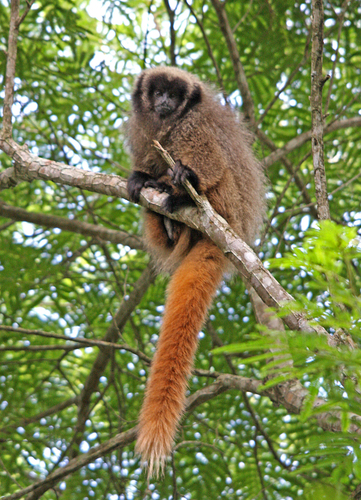
The buffy-tufted-ear marmoset is a small New World monkey endemic to the highly fragmented Atlantic Forest of southeastern Brazil. It is distinguished by its dark coloration and characteristic whitish ear tufts. This species is remarkable for being one of the most threatened marmosets due to severe habitat loss and hybridization with introduced congeners. It plays an important ecological role as a seed disperser and insectivore in its forest habitat.
Where does the Buffy-tufted-ear Marmoset live?
Southeastern Brazil, primarily in the Atlantic Forest of São Paulo, Rio de Janeiro, and Minas Gerais states
Endemic to Brazil, found in a restricted range within the Atlantic Forest biome spanning parts of São Paulo, Rio de Janeiro, and Minas Gerais states, particularly in the Serra do Mar and Serra da Mantiqueira mountain ranges.
Altitude and depth
400-1500 meters above sea level, with populations concentrated in mid-to-high elevation forest remnants
Seasonal movements
No true migration or hibernation; however, activity levels and ranging behavior may shift seasonally with fruit and insect availability during wet and dry seasons
Habitat of the Buffy-tufted-ear Marmoset
Primary and secondary Atlantic Forest, including montane and submontane rainforest, as well as forest edges and fragments. It prefers dense, humid forest with abundant gum-producing trees and insect prey.
Adaptations to its environment
Specialized incisors adapted for gouging tree bark to access gum and sap, an important dietary resource. Sharp claws (tegulae) allow vertical clinging and leaping between tree trunks. Small body size facilitates movement through dense forest understory and access to insect prey in narrow crevices.
Conservation status and numbers
Endangered (EN) according to IUCN, with a suspected population decline exceeding 50% over the past three generations due to habitat destruction, fragmentation, and genetic swamping from hybridization with invasive marmoset species.
Estimated population
Population size is not precisely known but is estimated to be declining, with fragmented subpopulations likely numbering in the low thousands; overall trend is decreasing
What threatens the Buffy-tufted-ear Marmoset?
Habitat loss and fragmentation from urban expansion and agriculture, hybridization with introduced Callithrix species (especially C. penicillata and C. jacchus), illegal pet trade, and roadkill in fragmented landscapes.
Diseases and parasites
Susceptible to various endoparasites including nematodes and protozoans, as well as potential exposure to yellow fever virus, which has caused mortality events in New World primates in Brazil.
What is being done to protect it?
Protected under Brazilian federal law; occurs in several protected areas including Serra da Cantareira State Park and Serra do Mar State Park. Conservation breeding programs and genetic studies are underway to address hybridization concerns.
Recommended actions
Expand and connect protected forest fragments through corridors, control the spread of invasive congeneric marmosets, enforce anti-poaching and anti-trafficking laws, and conduct genetic monitoring to identify and manage hybrid populations.
What the Buffy-tufted-ear Marmoset looks like
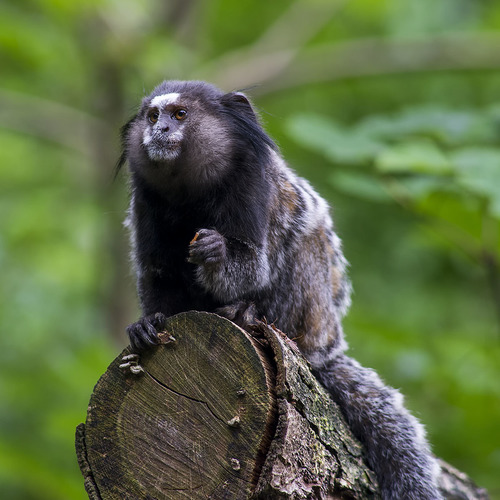
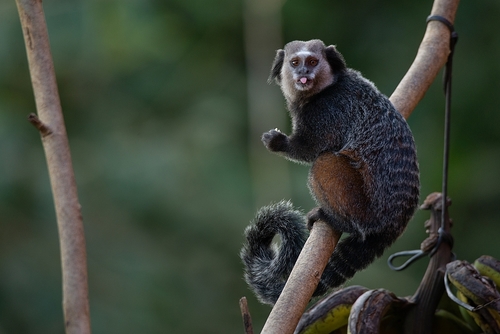
Dark brown to blackish body fur with grizzled agouti patterning, a distinctive black face, and prominent white or buffy ear tufts that give the species its common name. The tail is long, non-prehensile, and ringed with darker bands.
Size
Head-body length approximately 20-30 cm, with a tail length of 30-40 cm
Weight
Approximately 300-450 grams, with males and females similar in size
Distinctive features
Distinguished from other Callithrix species by its darker overall coloration and buffy-white (rather than black or dark) ear tufts, along with a less contrasting facial pattern compared to relatives like the black-tufted marmoset.
Behaviour and diet of the Buffy-tufted-ear Marmoset
Lives in small cooperative family groups typically of 2-8 individuals, usually consisting of a dominant breeding pair and their offspring, with helpers assisting in infant care.
When it is active
Diurnal, most active during daylight hours, foraging and socializing from early morning until dusk with rest periods at midday.
Diet
Omnivorous diet consisting of plant exudates (gum, sap, resin), fruits, flowers, nectar, and a significant proportion of arthropods such as insects and spiders, as well as occasional small vertebrates.
How it feeds and hunts
Forages actively by gouging tree bark with specialized incisors to stimulate gum flow, and uses stealth and quick manual capture to catch insects and small prey in foliage and bark crevices.
Communication
Uses a range of vocalizations including trills, chirps, and alarm calls, along with scent marking via specialized glands to communicate territorial boundaries and reproductive status, and visual displays like piloerection.
Interactions with other species
Preyed upon by raptors, small wild cats, and snakes; competes with other marmoset species for food resources; hybridizes problematically with introduced Callithrix species, threatening genetic integrity.
Role in its ecosystem
Functions as an important seed disperser for various Atlantic Forest plants and helps control insect populations, while also serving as prey for mid-sized forest predators, contributing to overall forest ecosystem balance.
Reproduction and lifecycle
Breeding can occur year-round but often peaks in the wet season; gestation lasts approximately 140-150 days, typically resulting in twins, which is common among callitrichids.
Raising the young
Cooperative breeding system where the mother, father, and older siblings all participate in carrying, feeding, and protecting infants; fathers often carry infants for extended periods to reduce maternal energetic costs.
Maturity and lifespan
Sexual maturity is reached at approximately 18-24 months; lifespan in the wild is estimated at 10-12 years, while captive individuals can live up to 16 years.
Taxonomy and naming of the Buffy-tufted-ear Marmoset
Classification
Class Mammalia > Order Primates > Family Callitrichidae > Genus Callithrix > Species Callithrix aurita
Scientific synonyms
Hapale aurita, Callithrix jacchus aurita (formerly considered a subspecies of the common marmoset)
What research says
Recent studies
Recent research has emphasized the urgent conservation genetics needed to identify hybrid zones with invasive marmosets and has used genomic tools to better delineate species boundaries and inform conservation management strategies.
Genome and DNA
Diploid chromosome number of 2n=44, similar to other Callithrix species; genetic studies have focused on identifying hybridization markers to distinguish pure C. aurita from hybrids with introduced congeners.
Compared with similar species
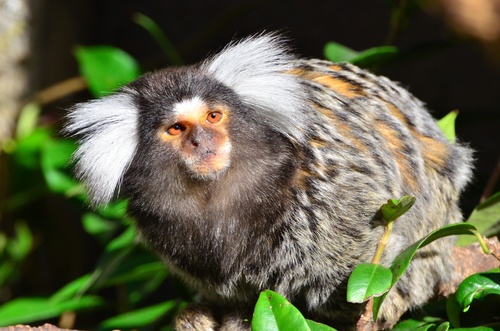
Similar in size and ecology to the black-tufted marmoset (Callithrix penicillata) and common marmoset (Callithrix jacchus), but distinguished by darker body coloration and lighter, buffy ear tufts; C. aurita has a more restricted and threatened range than these more widespread relatives.
The Buffy-tufted-ear Marmoset and people
This species is one of the few marmosets facing extinction primarily due to genetic pollution from hybridization rather than direct habitat loss alone. Its ear tufts can vary in shade from cream to golden, giving rise to its common name. It is one of the rarest marmosets in the wild, with some populations existing only in small forest islands.
Where and how to see it
Best observed in well-protected forest fragments such as Serra da Cantareira State Park or Serra do Mar State Park in São Paulo state during early morning hours when family groups are most active and vocal.
Risks to humans
No notable risk; this species poses no danger to humans and is not known to be a disease vector of concern to people.
Human uses
Historically captured for the illegal pet trade due to its small size and appealing appearance, though this practice is now illegal and discouraged due to its endangered status.
Countries where the Buffy-tufted-ear Marmoset is recorded
The 1 countries named in the range description of its IUCN Red List assessment.
Questions about the Buffy-tufted-ear Marmoset
Where does the Buffy-tufted-ear Marmoset live?
The Buffy-tufted-ear Marmoset is recorded in Brazil across South America. These countries come from the range description of its IUCN Red List assessment, and they are what place the species on the interactive map.
Is the Buffy-tufted-ear Marmoset endangered?
Yes. The IUCN Red List assesses the Buffy-tufted-ear Marmoset as Endangered, one of the three threatened categories. The species faces a very high risk of extinction in the wild — a step below Critically Endangered, but still on a trajectory that ends badly without intervention.
How many are left in the wild?
Population size is not precisely known but is estimated to be declining, with fragmented subpopulations likely numbering in the low thousands; overall trend is decreasing This figure comes from the species assessment on the IUCN Red List; population estimates for wild mammals are ranges, not counts, and are revised at each assessment.
What habitat does the Buffy-tufted-ear Marmoset live in?
Primary and secondary Atlantic Forest, including montane and submontane rainforest, as well as forest edges and fragments.
What is the scientific name of the Buffy-tufted-ear Marmoset?
The Buffy-tufted-ear Marmoset is Callithrix aurita, in the family Callitrichidae, order Primates.
Other species in the genus Callithrix
Other species in the family Callitrichidae
Species that share its range


Sources
Conservation status, range description and population estimate come from the IUCN Red List assessment for Callithrix aurita. Countries are derived from that range description, not from a mapped country list. Last refreshed on .
The distribution map is drawn from the IUCN Red List spatial data compiled in 2008. Biodiversitas Brazil