
Geoffroy's Tufted-ear Marmoset
Callithrix geoffroyi
Red List assessment
Least Concernon the IUCN Red List
- EXExtinct
- EWExtinct in the Wild
- CRCritically Endangered
- ENEndangered
- VUVulnerable
- NTNear Threatened
- LCLeast Concern
The Geoffroy's Tufted-ear Marmoset is recorded in one country, Brazil across South America. The IUCN Red List assesses the Geoffroy's Tufted-ear Marmoset as Least Concern. No precise global population estimate exists, but the population is considered to be declining due to continued habitat loss; classified as locally common in remaining forest fragments.
- Family
- Callitrichidae
- Order
- Primates
- Genus
- Callithrix
- Countries recorded
- 1
- Continents
- South America
- Red List category
- Least Concern
- Data updated
- August 9, 2026
What is the Geoffroy's Tufted-ear Marmoset?
Geoffroy's tufted-ear marmoset is a small New World monkey native to the Atlantic Forest of eastern Brazil, notable for its distinctive white face and head contrasting with a dark body. It lives in small family groups in forest canopies and is remarkable for its cooperative breeding system and gum-feeding adaptations. This species is one of several Callithrix marmosets endemic to Brazil's biodiversity hotspot, the Atlantic Forest.
Where does the Geoffroy's Tufted-ear Marmoset live?
Eastern Brazil, primarily in the states of Espírito Santo, Minas Gerais, and Bahia
Endemic to eastern Brazil, ranging through the states of Espírito Santo, southern Bahia, and eastern Minas Gerais, largely confined to the highly fragmented Atlantic Forest biome.
Altitude and depth
Sea level up to approximately 1000m
Seasonal movements
No true migration or hibernation; some seasonal variation in feeding behavior with increased gum-feeding during dry seasons when fruit availability decreases.
Habitat of the Geoffroy's Tufted-ear Marmoset
Primarily found in Atlantic coastal rainforest, including primary and secondary forest, forest edges, and fragmented woodlands; also tolerates disturbed habitats and can survive in small forest patches near human settlements.
Adaptations to its environment
Possesses specialized lower incisors for gouging tree bark to access gum and sap, an important adaptation for exploiting a stable food resource during lean periods. Sharp claws (tegulae) instead of nails aid in vertical clinging and climbing on tree trunks.
Conservation status and numbers
Listed as Least Concern by IUCN, though populations are experiencing decline due to ongoing habitat loss in the Atlantic Forest, one of the most threatened biomes in the world. The species benefits from a relatively wide range and adaptability to fragmented habitats.
Estimated population
No precise global population estimate exists, but the population is considered to be declining due to continued habitat loss; classified as locally common in remaining forest fragments.
What threatens the Geoffroy's Tufted-ear Marmoset?
Habitat destruction and fragmentation due to agriculture, urbanization, and logging; hybridization with introduced Callithrix species (like C. jacchus) in areas of range overlap; illegal pet trade.
Diseases and parasites
Susceptible to various endoparasites (nematodes, protozoa) and can be affected by yellow fever outbreaks, similar to other Brazilian primates.
What is being done to protect it?
Protected under Brazilian wildlife law; found within several protected areas including Reserva Biológica de Duas Bocas and other Atlantic Forest reserves; part of broader Atlantic Forest conservation and reforestation initiatives.
Recommended actions
Expand and connect protected forest fragments, control the introduction and spread of non-native marmoset species, enforce anti-poaching and anti-pet-trade laws, and support habitat corridors between fragmented populations.
What the Geoffroy's Tufted-ear Marmoset looks like
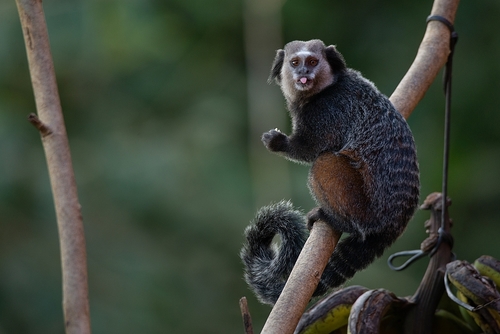
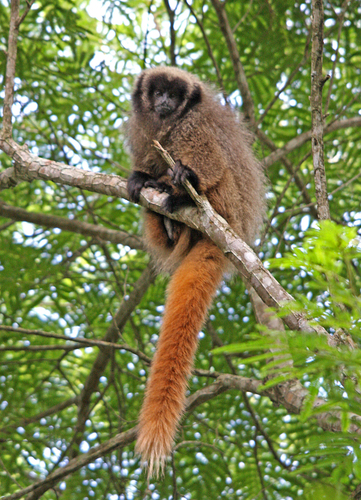
Distinctive white face and forehead contrasting with a dark brown to black body; ears are tufted with white or pale hair tufts; the tail is long, non-prehensile, and ringed with dark bands.
Size
Head-body length approximately 19-23 cm, with a tail length of 30-34 cm
Weight
Approximately 320-450 grams, with minimal difference between males and females
Distinctive features
Distinguished from other Callithrix species primarily by its striking white face and head combined with a dark body and prominent ear tufts, unlike the more uniformly colored common marmoset.
Differences between males and females
Minimal sexual dimorphism; males and females are similar in size and coloration, though females are typically the dominant sex in social groups.
Behaviour and diet of the Geoffroy's Tufted-ear Marmoset
Lives in small cooperative family groups of 2-15 individuals, typically dominated by a single breeding female; group members, including older offspring, help care for infants.
When it is active
Diurnal, active during daylight hours with peak activity in early morning and late afternoon.
Diet
Omnivorous, feeding on tree gum and sap, fruits, flowers, nectar, insects, and small vertebrates such as frogs and lizards.
How it feeds and hunts
Forages opportunistically for insects and small prey by searching bark crevices and foliage; gouges tree bark with specialized teeth to stimulate and extract gum flow.
Communication
Uses a range of vocalizations including high-pitched calls for group coordination and alarm, along with scent marking via specialized skin glands for territory and social signaling; also uses facial expressions and body postures.
Interactions with other species
Preyed upon by birds of prey, snakes, and small wild cats; competes with other primates and animals for fruit and gum resources; may hybridize with introduced Callithrix jacchus where ranges overlap.
Role in its ecosystem
Plays a role as a seed disperser for various fruiting trees and contributes to insect population control; gum-feeding behavior also influences tree bark ecology.
Reproduction and lifecycle
Breeding can occur year-round with peaks tied to food availability; gestation lasts approximately 140-150 days, typically resulting in twins; infants are weaned around 3 months of age.
Raising the young
Cooperative breeding system where the father and other group members, including older siblings, carry and help care for infants; mother nurses but shares carrying duties extensively with the group.
Maturity and lifespan
Sexual maturity reached around 18 months to 2 years; lifespan averages 10-12 years in the wild and up to 16 years in captivity.
Taxonomy and naming of the Geoffroy's Tufted-ear Marmoset
Classification
Mammalia > Primates > Callitrichidae > Callithrix > Callithrix geoffroyi
Scientific synonyms
Callithrix jacchus geoffroyi (formerly classified as a subspecies of the common marmoset)
What research says
Recent studies
Recent research has focused on hybridization dynamics between C. geoffroyi and introduced marmoset species, as well as the impact of Atlantic Forest fragmentation on genetic diversity and population viability.
Genome and DNA
Diploid chromosome number of 2n=46; genetic studies have been used to assess hybridization risk with other Callithrix species in overlapping ranges.
Compared with similar species
Similar to other Callithrix species like the common marmoset (C. jacchus) and buffy-tufted marmoset (C. aurita), but distinguished by its distinctive white face and head; less arboreal specialization than tamarins but shares the small body size and clawed digits typical of callitrichids.
The Geoffroy's Tufted-ear Marmoset and people
Geoffroy's marmosets can leap several meters between trees despite their small size; their gouging behavior can create long-lasting scars on tree trunks that are still visible years later; twins are the norm rather than the exception in this species.
Where and how to see it
Best observed in protected Atlantic Forest reserves in Espírito Santo, such as Reserva Biológica de Duas Bocas, during early morning hours when groups are most active and vocal.
Risks to humans
No notable risk; bites are possible if handled but the species poses no significant threat to humans.
Human uses
Occasionally kept illegally as exotic pets due to their small size and appealing appearance; also studied extensively in biomedical and behavioral research due to their cooperative breeding system.
Countries where the Geoffroy's Tufted-ear Marmoset is recorded
The 1 countries named in the range description of its IUCN Red List assessment.
Questions about the Geoffroy's Tufted-ear Marmoset
Where does the Geoffroy's Tufted-ear Marmoset live?
The Geoffroy's Tufted-ear Marmoset is recorded in Brazil across South America. These countries come from the range description of its IUCN Red List assessment, and they are what place the species on the interactive map.
Is the Geoffroy's Tufted-ear Marmoset endangered?
The IUCN Red List assesses the Geoffroy's Tufted-ear Marmoset as Least Concern. The species is widespread and abundant enough not to qualify for any threatened category. It does not mean the species is safe forever, only that nothing in the current data raises an alarm.
How many are left in the wild?
No precise global population estimate exists, but the population is considered to be declining due to continued habitat loss; classified as locally common in remaining forest fragments. This figure comes from the species assessment on the IUCN Red List; population estimates for wild mammals are ranges, not counts, and are revised at each assessment.
What habitat does the Geoffroy's Tufted-ear Marmoset live in?
Primarily found in Atlantic coastal rainforest, including primary and secondary forest, forest edges, and fragmented woodlands; also tolerates disturbed habitats and can survive in small forest patches near human settlements.
What is the scientific name of the Geoffroy's Tufted-ear Marmoset?
The Geoffroy's Tufted-ear Marmoset is Callithrix geoffroyi, in the family Callitrichidae, order Primates.
Other species in the genus Callithrix
Other species in the family Callitrichidae
Species that share its range


Sources
Conservation status, range description and population estimate come from the IUCN Red List assessment for Callithrix geoffroyi. Countries are derived from that range description, not from a mapped country list. Last refreshed on .
The distribution map is drawn from the IUCN Red List spatial data compiled in 2008. IUCN (International Union for Conservation of Nature)