
Fringed Fruit-eating Bat
Artibeus fimbriatus
Red List assessment
Least Concernon the IUCN Red List
- EXExtinct
- EWExtinct in the Wild
- CRCritically Endangered
- ENEndangered
- VUVulnerable
- NTNear Threatened
- LCLeast Concern
The Fringed Fruit-eating Bat is recorded in 3 countries across South America. The IUCN Red List assesses the Fringed Fruit-eating Bat as Least Concern. No precise global population estimate exists.
- Family
- Phyllostomidae
- Order
- Chiroptera
- Genus
- Artibeus
- Countries recorded
- 3
- Continents
- South America
- Red List category
- Least Concern
- Data updated
- August 9, 2026
What is the Fringed Fruit-eating Bat?
Artibeus fimbriatus, the Fringed Fruit-eating Bat, is a large frugivorous phyllostomid bat endemic to the Atlantic Forest biome of South America. Named for the distinctive fringe of short hairs along the posterior margin of its uropatagium (interfemoral membrane), it is among the largest members of its genus. It serves as a keystone seed disperser in the highly threatened Atlantic Forest, consuming figs and other fruits and transporting seeds across the forest landscape. Despite severe deforestation within its range, it shows notable adaptability to secondary and disturbed habitats.
Where does the Fringed Fruit-eating Bat live?
Atlantic Forest biome of southeastern and southern Brazil (São Paulo, Paraná, Santa Catarina, Rio Grande do Sul, Minas Gerais, Rio de Janeiro), northeastern Argentina (Misiones Province), and eastern Paraguay.
Restricted to South America, closely following the Atlantic Forest biome. Occurs in southeastern and southern Brazil (Minas Gerais, Rio de Janeiro, Espírito Santo, São Paulo, Paraná, Santa Catarina, Rio Grande do Sul), in northeastern Argentina primarily in Misiones Province and adjacent Corrientes, and in eastern Paraguay. It does not extend into the Amazon Basin or other biomes.
Altitude and depth
Most records come from lowland and submontane forest between sea level and approximately 1,000 m elevation, though it has been recorded up to around 1,500 m in some Atlantic Forest localities.
Seasonal movements
Non-migratory; present year-round throughout its range. Reproductive activity shows seasonality correlated with fruit availability peaks, typically occurring in austral spring and summer (October–March). No hibernation is recorded.
Habitat of the Fringed Fruit-eating Bat
Primary and secondary Atlantic Forest (Mata Atlântica), including tropical and subtropical moist broadleaf forests. It also tolerates disturbed habitats such as forest edges, agroforestry systems, and the periphery of urban settlements, roosting in tree hollows, dense foliage clusters, and occasionally within buildings or under palm fronds.
Adaptations to its environment
Possesses a well-developed noseleaf and sophisticated frequency-modulated echolocation for navigating dense forest at night. The fringed uropatagium may improve aerodynamic maneuverability in cluttered vegetation. Robust jaws and dentition are adapted for processing hard-rinded fruits. Its tolerance of forest edges and secondary growth allows persistence in highly fragmented landscapes.
Conservation status and numbers
Least Concern (LC) on the IUCN Red List. Although the Atlantic Forest has lost over 85% of its original extent, the species maintains a viable population across its range due to its adaptability to secondary and disturbed habitats. No major quantified population decline meeting threatened thresholds has been documented.
Estimated population
No precise global population estimate exists. Relative abundance is considered moderate to good within intact and semi-intact Atlantic Forest fragments. Population trend is assessed as stable overall, though locally declining in the most heavily deforested areas.
What threatens the Fringed Fruit-eating Bat?
Ongoing deforestation and fragmentation of the Atlantic Forest for agriculture and urban expansion remain the primary threats. Pesticide use reduces fruit availability and invertebrate prey. Road collisions, disturbance of roosting sites, and loss of large fruiting trees (especially Ficus spp.) also pose localized risks.
Diseases and parasites
Hosts ectoparasitic bat flies (Streblidae), mites (Spinturnicidae, Macronyssidae), and occasionally ticks. Internal parasites including nematodes and trematodes have been reported in related Artibeus species. Like all bats, it may serve as a reservoir for lyssaviruses (including rabies), though documented transmission to humans is extremely rare.
What is being done to protect it?
Protected within several Atlantic Forest reserves, including Serra do Mar State Park and Iguaçu National Park (Brazil) and Iguazú National Park (Argentina). Brazilian law (Lei da Mata Atlântica, No. 11,428/2006) provides legal protection for the biome. The species is included in broader bat diversity monitoring programs across the Atlantic Forest.
Recommended actions
Expansion and maintenance of forest corridors connecting isolated Atlantic Forest fragments to sustain gene flow. Promotion of agroforestry practices preserving native fruiting trees, particularly figs. Long-term roosting ecology studies to identify and protect critical roost sites. Continued presence in systematic bat monitoring programs.
What the Fringed Fruit-eating Bat looks like
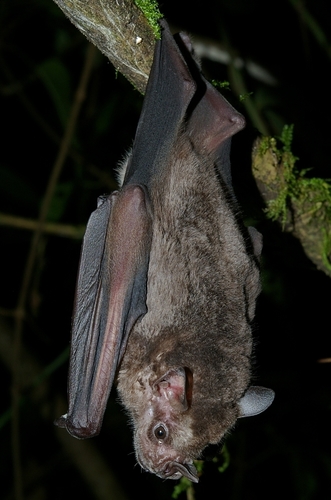
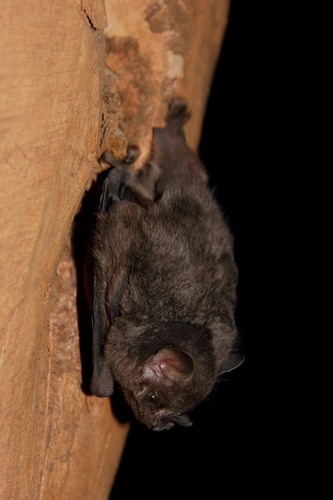
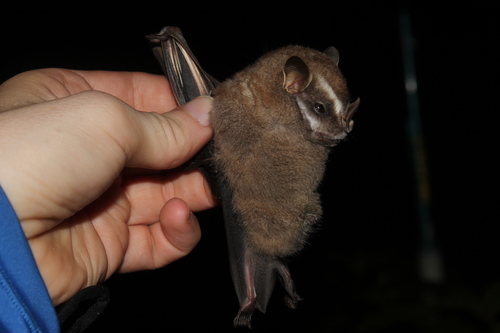
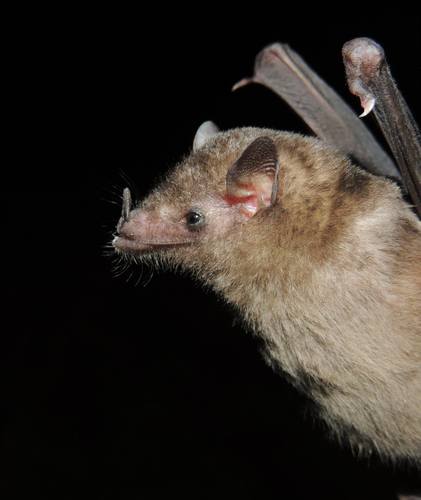
Dorsal fur is brownish-gray to dark brown; ventral fur is paler gray or whitish. Four white facial stripes are present — two supraorbital and two suborbital — characteristic of the large Artibeus group. The noseleaf is prominent and well-developed. The uropatagium bears a notable fringe of short hairs along its trailing edge, the diagnostic feature that gives the species its common name.
Size
Medium-to-large bat; forearm length 62–70 mm; total body length approximately 85–105 mm; wingspan estimated at 38–46 cm. Tail is vestigial or absent, though the uropatagium is present.
Weight
Approximately 55–80 g; females tend to be slightly heavier than males, especially during pregnancy and lactation.
Distinctive features
Distinguished from the closely related Artibeus lituratus by its smaller average size, more pronounced and consistent uropatagial fringe, and more restricted distribution within the southern Atlantic Forest. Differs from A. jamaicensis and A. planirostris by its larger body size and the distinctly fringed interfemoral membrane.
Differences between males and females
Mild sexual dimorphism; females are often marginally larger and heavier than males, particularly when gravid or lactating. No notable differences in coloration, facial stripe prominence, or other external morphology between the sexes.
Behaviour and diet of the Fringed Fruit-eating Bat
Forms small harem groups consisting of one dominant male, several adult females (typically 3–9), and their dependent young, roosting together in foliage or tree cavities. Bachelor males roost separately in smaller satellite groups. Social structure is stable across seasons, with dominant males actively defending their harem.
When it is active
Strictly nocturnal; foraging activity begins shortly after sunset and continues through the night, typically with peaks in early and late nocturnal hours. Spends daylight hours roosting in sheltered foliage clusters or tree hollows.
Diet
Primarily frugivorous; figs (Ficus spp.) constitute the dietary backbone, supplemented by a wide variety of soft fruits from families including Moraceae, Cecropiaceae, and Piperaceae. Flowers and pollen may be consumed seasonally. Small invertebrates may be ingested incidentally along with fruit material.
How it feeds and hunts
Uses a combination of echolocation and olfactory cues to detect ripe fruit in dense, dark forest. Once a fruit is located and detached, the bat typically carries it to a dedicated feeding roost away from the source tree, reducing predation exposure during consumption. Spatial memory is likely used to revisit reliable fruiting trees.
Communication
Produces ultrasonic echolocation calls (frequency-modulated sweeps) for navigation and fruit detection. Social interactions involve audible squeaking vocalizations used during roost disputes, courtship, and mother-offspring recognition. Olfactory signals from facial and gular glands likely contribute to individual recognition and harem cohesion.
Interactions with other species
A critical seed disperser for numerous Atlantic Forest plant species, notably figs and pioneer trees essential to forest regeneration. Predated upon by specialist bat-hunting owls (e.g., Strix virgata, Tyto furcata), arboreal snakes, and small carnivorous mammals. Competes for fruit resources with Artibeus lituratus and other large frugivorous bats, as well as with frugivorous birds in daytime fruiting trees.
Role in its ecosystem
Functions as a keystone mutualist in the Atlantic Forest ecosystem. As a seed disperser, it moves seeds away from parent-tree shadow, increasing seedling establishment success and maintaining plant diversity. By consuming large quantities of fruit nightly, it also shapes fruit plant community structure and forest regeneration dynamics in fragmented landscapes.
Reproduction and lifecycle
Exhibits bimodal polyestry (two reproductive peaks per year), consistent with other large Artibeus species, typically timed to coincide with high fruit availability. Gestation lasts approximately 3.5–4 months, and litters invariably consist of a single offspring. Births are concentrated in the austral spring-summer and a secondary peak in autumn.
Raising the young
Females provide all parental care; newborns are initially carried clinging to the mother during foraging flights and are later left at the roost. Nursing continues for approximately 2–3 months until the juvenile achieves nutritional independence and flight proficiency. Males play no role in pup rearing.
Maturity and lifespan
Sexual maturity is likely reached at 9–12 months of age, consistent with related large Artibeus. Wild lifespan is estimated at 5–10 years; comparable Artibeus species have lived over 12 years in captivity under optimal conditions.
Taxonomy and naming of the Fringed Fruit-eating Bat
Classification
Mammalia > Chiroptera > Phyllostomidae > Artibeus > Artibeus fimbriatus (Gray, 1838)
What research says
Recent studies
Recent phylogeographic studies of Atlantic Forest bats have confirmed A. fimbriatus as a valid, genetically distinct species rather than a southern population of A. lituratus, clarifying decades of taxonomic ambiguity. Community-level studies in the Atlantic Forest have quantified its contribution to seed dispersal and underscored its sensitivity to forest cover thresholds below which populations collapse.
Genome and DNA
Chromosome number reported as 2n = 30–31, consistent with other large Artibeus species. Molecular phylogenetic analyses using mitochondrial and nuclear markers confirm A. fimbriatus as a distinct lineage within the large Artibeus clade, clearly differentiated from A. lituratus and A. planirostris.
Compared with similar species
Most morphologically similar to Artibeus lituratus (Great Fruit-eating Bat), which is larger on average, more widespread across South and Central America, and lacks the consistently prominent uropatagial fringe. In areas of sympatry, A. fimbriatus occupies slightly different microhabitats and tends to exploit different fruit species. Compared to A. jamaicensis, A. fimbriatus is larger, more southerly in distribution, and confined to the Atlantic Forest rather than being widespread across the Neotropics.
The Fringed Fruit-eating Bat and people
The fringe of hairs on its interfemoral membrane that gave the species its name may reduce aerodynamic turbulence, allowing quieter flight through densely vegetated forest when approaching fruit trees. Like other large Artibeus, this bat can transport individual fruit items weighing up to 50% of its own body mass, carrying them in its mouth to a safe feeding roost before eating. Its roosting harems are remarkably stable social units, with dominant males maintaining exclusive associations with the same group of females across multiple seasons.
Where and how to see it
Best observed at dusk in intact or semi-intact Atlantic Forest fragments in Paraná and Santa Catarina states, Brazil, or in Misiones Province, Argentina. Forest edge habitats adjacent to large fig trees are particularly productive observation sites. Researchers commonly use mist nets in forest trails or near fruiting Ficus trees for capture surveys. Protected areas such as Iguaçu/Iguazú National Park and Serra do Mar State Park offer excellent opportunities for encountering this species.
Risks to humans
Negligible risk to humans under normal circumstances. As with all wild bats, direct handling should be strictly avoided due to the theoretical risk of rabies or other zoonotic virus transmission. No documented cases of unprovoked attack or confirmed disease transmission from this species to humans are known.
Countries where the Fringed Fruit-eating Bat is recorded
The 3 countries named in the range description of its IUCN Red List assessment.
Questions about the Fringed Fruit-eating Bat
Where does the Fringed Fruit-eating Bat live?
The Fringed Fruit-eating Bat is recorded in Argentina, Brazil and Paraguay across South America. These countries come from the range description of its IUCN Red List assessment, and they are what place the species on the interactive map.
Is the Fringed Fruit-eating Bat endangered?
The IUCN Red List assesses the Fringed Fruit-eating Bat as Least Concern. The species is widespread and abundant enough not to qualify for any threatened category. It does not mean the species is safe forever, only that nothing in the current data raises an alarm.
How many are left in the wild?
No precise global population estimate exists. This figure comes from the species assessment on the IUCN Red List; population estimates for wild mammals are ranges, not counts, and are revised at each assessment.
What habitat does the Fringed Fruit-eating Bat live in?
Primary and secondary Atlantic Forest (Mata Atlântica), including tropical and subtropical moist broadleaf forests.
What is the scientific name of the Fringed Fruit-eating Bat?
The Fringed Fruit-eating Bat is Artibeus fimbriatus, in the family Phyllostomidae, order Chiroptera.
Other species in the genus Artibeus
Other species in the family Phyllostomidae
Sources
Conservation status, range description and population estimate come from the IUCN Red List assessment for Artibeus fimbriatus. Countries are derived from that range description, not from a mapped country list. Last refreshed on .
The distribution map is drawn from the IUCN Red List spatial data compiled in 2008. IUCN (International Union for Conservation of Nature)