
Ecuadorian Sac-winged Bat
Balantiopteryx infusca
Red List assessment
Vulnerableon the IUCN Red List
- EXExtinct
- EWExtinct in the Wild
- CRCritically Endangered
- ENEndangered
- VUVulnerable
- NTNear Threatened
- LCLeast Concern
The Ecuadorian Sac-winged Bat is recorded in 2 countries across South America. The IUCN Red List assesses the Ecuadorian Sac-winged Bat as Vulnerable. No precise population estimate exists, but the species is considered uncommon to rare throughout its range, with a presumed declining trend correlated with habitat loss.
- Family
- Emballonuridae
- Order
- Chiroptera
- Genus
- Balantiopteryx
- Countries recorded
- 2
- Continents
- South America
- Red List category
- Vulnerable
- Data updated
- August 9, 2026
What is the Ecuadorian Sac-winged Bat?
The Ecuadorian Sac-winged Bat is a small insectivorous bat endemic to the Pacific slopes of the northern Andes in Ecuador and Colombia. It belongs to the sac-winged bat family Emballonuridae, characterized by a glandular wing sac used in communication. It is considered rare and has a restricted distribution, making it a species of conservation concern. Its biology remains poorly studied compared to more widespread relatives.
Where does the Ecuadorian Sac-winged Bat live?
Western Ecuador and southwestern Colombia
Restricted to the Pacific coastal lowlands and foothills of western Ecuador and adjacent southwestern Colombia (Cauca Valley region), within the Chocó biogeographic zone.
Altitude and depth
Typically found from sea level up to around 1600 meters elevation.
Seasonal movements
No long-distance migration is known; the species is presumed to be a year-round resident with possible local movements tied to prey availability during wet and dry seasons.
Habitat of the Ecuadorian Sac-winged Bat
Found in humid tropical and subtropical lowland and premontane forests, often roosting in caves, rock crevices, hollow trees, and sometimes man-made structures near forest edges. It appears to prefer areas with intact forest cover near streams and rocky outcrops.
Adaptations to its environment
Possesses specialized echolocation adapted for detecting insects in cluttered forest environments, and wing sacs that store secretions used for chemical communication and mate attraction. Its narrow wings enable fast, maneuverable flight typical of emballonurid bats hunting in forest edges and clearings.
Conservation status and numbers
Classified as Vulnerable (VU) by the IUCN due to its small, fragmented range, ongoing habitat loss, and apparent rarity across known localities. Population trend is believed to be declining as suitable forest habitat continues to be converted for agriculture.
Estimated population
No precise population estimate exists, but the species is considered uncommon to rare throughout its range, with a presumed declining trend correlated with habitat loss.
What threatens the Ecuadorian Sac-winged Bat?
Primary threats include deforestation and habitat fragmentation from agricultural expansion, logging, and urban development in the Chocó lowlands, as well as disturbance of roosting sites such as caves.
Diseases and parasites
Specific pathogens are not well documented, but like other bats it may host ectoparasites such as bat flies and mites, as well as potentially carrying viruses relevant to bat-borne disease research.
What is being done to protect it?
The species occurs in a few protected areas within its range, including some reserves in the Ecuadorian Chocó region, though targeted conservation programs specifically for this bat are lacking.
Recommended actions
Priority actions include surveys to better assess population size and distribution, protection of remaining lowland and foothill forest habitat, roost site protection, and inclusion in regional bat conservation and monitoring programs.
What the Ecuadorian Sac-winged Bat looks like
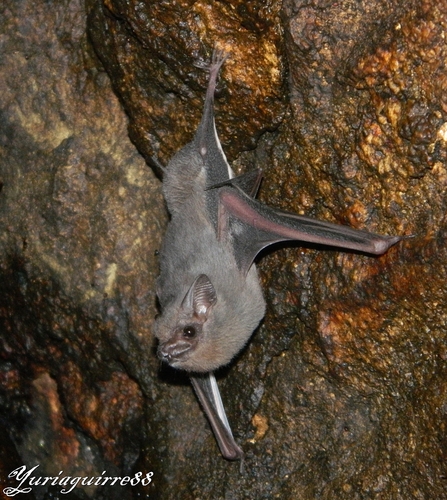
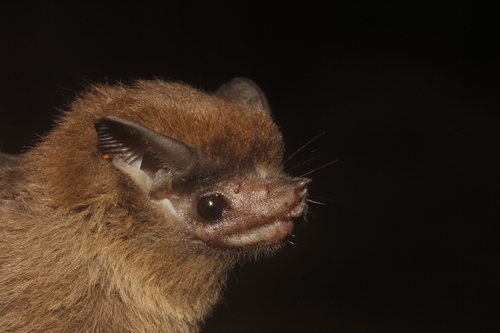
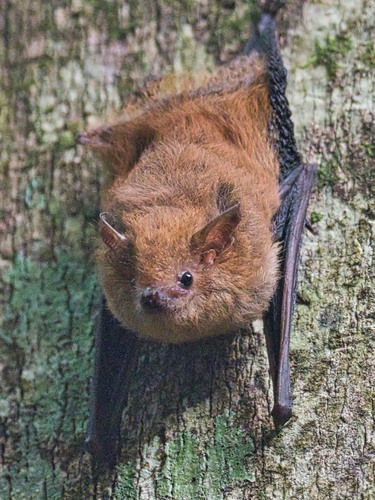
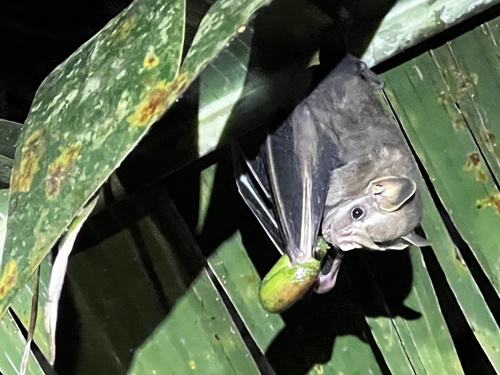
The fur is generally brownish to grayish-brown dorsally with paler underparts, and the bat has the characteristic slender build and narrow, pointed wings of emballonurids. The tail partially perforates the interfemoral membrane, a family trait, and the wing sac is visible near the wrist.
Size
Forearm length approximately 40-45 mm; total body length roughly 45-55 mm, typical of small emballonurid bats.
Weight
Estimated body mass around 4-6 grams, consistent with similarly sized Balantiopteryx species.
Distinctive features
Distinguished from congeners like Balantiopteryx plicata and B. io by subtle differences in skull morphology, dental characters, and coloration, as well as its more restricted southern range.
Differences between males and females
Sexual dimorphism is minimal, with males and females similar in size and coloration, though males may have a more developed wing sac used in scent communication.
Behaviour and diet of the Ecuadorian Sac-winged Bat
Likely roosts in small to moderate-sized colonies, as is typical for the genus, though exact group sizes for this species are not well documented.
When it is active
Nocturnal, emerging at dusk to forage and returning to roost sites before dawn.
Diet
Insectivorous, feeding primarily on small flying insects captured in flight, likely including moths, beetles, and other nocturnal insects typical of forest-edge habitats.
How it feeds and hunts
Uses echolocation to detect and intercept flying insects during agile, fast flight in open spaces near forest edges, streams, and clearings.
Communication
Communication likely involves echolocation calls for navigation and prey detection, along with scent signals released from the wing sac, a key feature used in mate attraction and territory signaling in this genus.
Interactions with other species
Faces predation from owls and other nocturnal predators, and may compete with other insectivorous bat species for food resources within its shared forest habitat.
Role in its ecosystem
Plays an important ecological role as an insectivore, helping to regulate populations of nocturnal flying insects within its forest habitat.
Reproduction and lifecycle
Reproductive biology is poorly documented, but likely follows the pattern of related emballonurids with a single pup born per litter, timed to coincide with periods of higher insect abundance.
Raising the young
Presumed maternal care typical of bats, with females nursing and roosting with their single pup until it is capable of independent flight and foraging.
Maturity and lifespan
Exact data are lacking, but similar small emballonurid bats typically reach sexual maturity within one year and can live several years in the wild, potentially up to a decade.
Taxonomy and naming of the Ecuadorian Sac-winged Bat
Classification
Class Mammalia > Order Chiroptera > Family Emballonuridae > Genus Balantiopteryx > Species Balantiopteryx infusca
Scientific synonyms
Peropteryx infusca (Thomas, 1897) is the original combination before reassignment to Balantiopteryx.
What research says
Recent studies
Recent taxonomic and phylogenetic studies on Emballonuridae have helped clarify the relationships within Balantiopteryx, though species-specific ecological research on B. infusca remains limited.
Compared with similar species
Compared to the more widespread Balantiopteryx plicata, B. infusca has a much more restricted range and is considered rarer, with subtle morphological differences distinguishing the two species.
The Ecuadorian Sac-winged Bat and people
This bat's wing sac functions almost like a natural perfume pouch, storing scent secretions used to attract mates. It is one of the rarest and least-studied bats in the Chocó biodiversity hotspot, and its restricted range makes every sighting scientifically valuable.
Where and how to see it
Best observed at dusk near forest edges, streams, or cave entrances within its range in western Ecuador or southwestern Colombia, ideally with the help of local bat researchers or guided ecotours familiar with roost locations.
Risks to humans
No notable risk to humans; it poses no direct threat and does not typically come into conflict with people.
Countries where the Ecuadorian Sac-winged Bat is recorded
The 2 countries named in the range description of its IUCN Red List assessment.
Questions about the Ecuadorian Sac-winged Bat
Where does the Ecuadorian Sac-winged Bat live?
The Ecuadorian Sac-winged Bat is recorded in Colombia and Ecuador across South America. These countries come from the range description of its IUCN Red List assessment, and they are what place the species on the interactive map.
Is the Ecuadorian Sac-winged Bat endangered?
Yes. The IUCN Red List assesses the Ecuadorian Sac-winged Bat as Vulnerable, one of the three threatened categories. The species faces a high risk of extinction in the wild. It is the first of the three threatened categories: numbers are falling, the range is shrinking, or the population is small enough that a single bad event could do lasting damage.
How many are left in the wild?
No precise population estimate exists, but the species is considered uncommon to rare throughout its range, with a presumed declining trend correlated with habitat loss. This figure comes from the species assessment on the IUCN Red List; population estimates for wild mammals are ranges, not counts, and are revised at each assessment.
What habitat does the Ecuadorian Sac-winged Bat live in?
Found in humid tropical and subtropical lowland and premontane forests, often roosting in caves, rock crevices, hollow trees, and sometimes man-made structures near forest edges.
What is the scientific name of the Ecuadorian Sac-winged Bat?
The Ecuadorian Sac-winged Bat is Balantiopteryx infusca, in the family Emballonuridae, order Chiroptera.
Other species in the genus Balantiopteryx
Other species in the family Emballonuridae
Species that share its range

Sources
Conservation status, range description and population estimate come from the IUCN Red List assessment for Balantiopteryx infusca. Countries are derived from that range description, not from a mapped country list. Last refreshed on .
The distribution map is drawn from the IUCN Red List spatial data compiled in 2008. IUCN (International Union for Conservation of Nature)