
Seychelles Sheath-tailed Bat
Coleura seychellensis
Red List assessment
Critically Endangeredon the IUCN Red List
- EXExtinct
- EWExtinct in the Wild
- CRCritically Endangered
- ENEndangered
- VUVulnerable
- NTNear Threatened
- LCLeast Concern
The Seychelles Sheath-tailed Bat is recorded in one country, Seychelles across Africa. The IUCN Red List assesses the Seychelles Sheath-tailed Bat as Critically Endangered. Estimated at only a few hundred individuals total, with a declining or at best stable trend across known colonies.
- Family
- Emballonuridae
- Order
- Chiroptera
- Genus
- Coleura
- Countries recorded
- 1
- Continents
- Africa
- Red List category
- Critically Endangered
- Data updated
- August 9, 2026
What is the Seychelles Sheath-tailed Bat?
The Seychelles Sheath-tailed Bat is a small insectivorous bat endemic to a handful of islands in the Seychelles archipelago. It is one of the rarest bats in the world, surviving in only a few tiny colonies. Once more widespread across the granitic Seychelles islands, it has undergone a dramatic historical decline. Its precarious status makes it an emblematic species for insular conservation in the Indian Ocean.
Where does the Seychelles Sheath-tailed Bat live?
Seychelles (Silhouette, Mahé and North Island)
Endemic to the Seychelles, currently confirmed only on Silhouette Island, Mahé, and North Island; historically present on additional granitic islands where it is now extinct.
Altitude and depth
Sea level to roughly 400 m, mostly in lowland and coastal habitats near roost sites.
Seasonal movements
No long-distance migration; some seasonal variation in activity linked to insect abundance and rainfall patterns, but no true hibernation given the tropical climate.
Habitat of the Seychelles Sheath-tailed Bat
Roosts in caves, rock crevices, and ruined buildings, typically near coastal forest and mixed woodland; hunts over forest edges, glacis (granite outcrops) and coastal vegetation.
Adaptations to its environment
Echolocation and agile flight allow effective nocturnal insect capture in cluttered forest and rocky habitats; roosting in caves and crevices provides thermal stability and protection from predators.
Conservation status and numbers
Critically Endangered (IUCN) due to an extremely small, fragmented population confined to very few roost sites, continuing habitat degradation, and vulnerability to stochastic events.
Estimated population
Estimated at only a few hundred individuals total, with a declining or at best stable trend across known colonies.
What threatens the Seychelles Sheath-tailed Bat?
Habitat loss from development and invasive vegetation, roost disturbance, predation by introduced species (rats, cats), pesticide use reducing insect prey, and small population size increasing extinction risk.
Diseases and parasites
Specific pathogens are not well documented, but as with many bats, ectoparasites (mites, fleas) and potential exposure to bat-associated viruses are plausible.
What is being done to protect it?
Protected under Seychelles wildlife legislation; roost sites monitored by conservation organizations; habitat restoration and invasive species control programs on Silhouette and North Island.
Recommended actions
Secure and monitor all known roosts, control invasive predators and vegetation, restore native forest corridors, reduce pesticide impacts on insect prey, and consider translocation/reintroduction to former range islands.
What the Seychelles Sheath-tailed Bat looks like
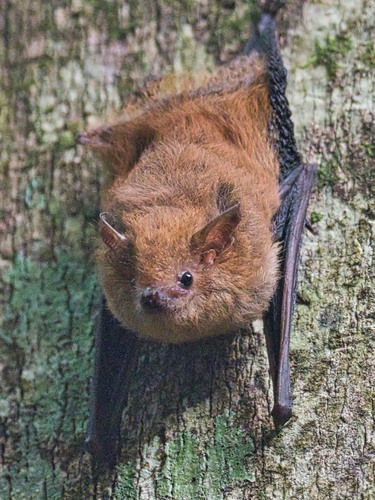
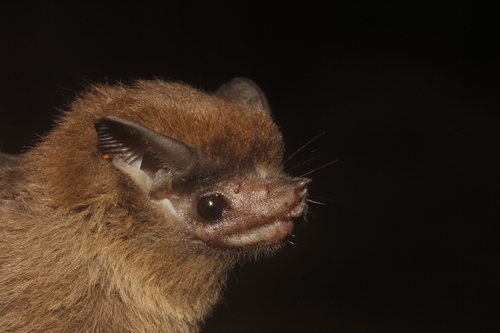
Uniform dark brown to grayish-brown fur, membranous wings, a distinctive tail that projects partly free from the tail membrane (sheath-tailed), and relatively large eyes for a bat.
Size
Body length approximately 5-6 cm, with a wingspan around 25-28 cm.
Weight
Approximately 8-12 grams.
Distinctive features
Distinguished from related emballonurids by its restricted Seychelles endemism, specific echolocation call structure, and the characteristic sheath-tail morphology shared within genus Coleura.
Differences between males and females
Minimal sexual dimorphism; males and females are similar in size and coloration.
Behaviour and diet of the Seychelles Sheath-tailed Bat
Roosts in small colonies, historically numbering dozens to a few hundred individuals, now often reduced to just a handful of bats per site; social cohesion within roosts appears important for thermoregulation.
When it is active
Strictly nocturnal, emerging at dusk to forage and returning to roost before dawn.
Diet
Insectivorous, feeding on small flying insects such as moths, beetles, and flies caught in flight.
How it feeds and hunts
Uses echolocation to detect and pursue flying insects in open and semi-open habitats near forest edges and clearings.
Communication
Uses echolocation calls for navigation and hunting, plus social vocalizations within roosts for contact and possibly alarm signaling.
Interactions with other species
Vulnerable to predation and disturbance by introduced rats, cats, and possibly barn owls; competes with other insectivorous bats for prey resources.
Role in its ecosystem
Acts as a natural insect population regulator within its ecosystem, contributing to pest control in forest and coastal habitats.
Reproduction and lifecycle
Believed to breed once per year with births likely timed to periods of higher insect abundance; gestation and litter details are poorly documented but likely a single pup per female, typical of emballonurids.
Raising the young
Females carry and nurse a single pup, which clings to the mother initially before being left at the roost while she forages; weaning occurs after several weeks.
Maturity and lifespan
Sexual maturity likely reached within the first year of life; lifespan in the wild is poorly known but probably several years, consistent with small emballonurid bats.
Taxonomy and naming of the Seychelles Sheath-tailed Bat
Classification
Mammalia > Chiroptera > Emballonuridae > Coleura > Coleura seychellensis
Scientific synonyms
Taphozous seychellensis (historical usage)
What research says
Recent studies
Recent surveys and genetic studies have focused on confirming remaining colony locations and assessing genetic diversity to guide conservation planning, given the species' critically small population.
Compared with similar species
Similar in general form to other sheath-tailed bats of genus Coleura found in Africa and Asia, but distinguished by its unique island endemism and much smaller, more fragmented population.
The Seychelles Sheath-tailed Bat and people
It is one of the rarest bats on Earth, surviving in only a few known roosts worldwide; its entire global range fits within a handful of small islands smaller than many cities.
Where and how to see it
Best observed at dusk near known roost sites on Silhouette Island with permission from conservation authorities; guided eco-tours focused on Seychelles biodiversity may offer supervised viewing opportunities.
Risks to humans
No notable risk to humans.
Countries where the Seychelles Sheath-tailed Bat is recorded
The 1 countries named in the range description of its IUCN Red List assessment.
Questions about the Seychelles Sheath-tailed Bat
Where does the Seychelles Sheath-tailed Bat live?
The Seychelles Sheath-tailed Bat is recorded in Seychelles across Africa. These countries come from the range description of its IUCN Red List assessment, and they are what place the species on the interactive map.
Is the Seychelles Sheath-tailed Bat endangered?
Yes. The IUCN Red List assesses the Seychelles Sheath-tailed Bat as Critically Endangered, one of the three threatened categories. The species faces an extremely high risk of extinction in the wild. This is the last category before extinction, and it is reached through a very small or steeply declining population, a tiny range, or both.
How many are left in the wild?
Estimated at only a few hundred individuals total, with a declining or at best stable trend across known colonies. This figure comes from the species assessment on the IUCN Red List; population estimates for wild mammals are ranges, not counts, and are revised at each assessment.
What habitat does the Seychelles Sheath-tailed Bat live in?
Roosts in caves, rock crevices, and ruined buildings, typically near coastal forest and mixed woodland; hunts over forest edges, glacis (granite outcrops) and coastal vegetation.
What is the scientific name of the Seychelles Sheath-tailed Bat?
The Seychelles Sheath-tailed Bat is Coleura seychellensis, in the family Emballonuridae, order Chiroptera.
Other species in the genus Coleura
Other species in the family Emballonuridae
Species that share its range

Sources
Conservation status, range description and population estimate come from the IUCN Red List assessment for Coleura seychellensis. Countries are derived from that range description, not from a mapped country list. Last refreshed on .
The distribution map is drawn from the IUCN Red List spatial data compiled in 2024. Nils Bouillard, Rachel Bristol