
Baird's Tapir
Tapirus bairdii
Red List assessment
Endangeredon the IUCN Red List
- EXExtinct
- EWExtinct in the Wild
- CRCritically Endangered
- ENEndangered
- VUVulnerable
- NTNear Threatened
- LCLeast Concern
The Baird's Tapir is recorded in 10 countries across North America and South America. The IUCN Red List assesses the Baird's Tapir as Endangered. Estimated fewer than 5,500 mature individuals remaining in the wild, with a continuing declining population trend across most of its range.
- Family
- Tapiridae
- Order
- Perissodactyla
- Genus
- Tapirus
- Countries recorded
- 10
- Continents
- North America and South America
- Red List category
- Endangered
- Data updated
- August 9, 2026
What is the Baird's Tapir?
Baird's Tapir is the largest native land mammal in Central America and one of four surviving tapir species worldwide. It inhabits dense tropical forests and wetlands from Mexico to Colombia, acting as a critical seed disperser known as a 'gardener of the forest.' Despite its bulky, pig-like appearance, it is a strong swimmer and closely related to horses and rhinoceroses. Its elusive, shy nature and dependence on large forest tracts make it a key indicator species for ecosystem health.
Where does the Baird's Tapir live?
Central America, from southern Mexico through Belize, Guatemala, Honduras, Nicaragua, Costa Rica, Panama, and into northwestern Colombia
Ranges from southern Mexico (Veracruz, Oaxaca, Chiapas) through Belize, Guatemala, Honduras, El Salvador, Nicaragua, Costa Rica, Panama, and into the Chocó region of northwestern Colombia and Ecuador border areas. Populations are increasingly fragmented and isolated due to habitat loss.
Altitude and depth
Sea level to approximately 3,600 meters, though most populations occur below 1,500 meters in lowland tropical forests.
Seasonal movements
No true migration or hibernation, but tapirs may shift habitat use seasonally, moving to higher ground during flood seasons and concentrating near water sources during dry periods.
Habitat of the Baird's Tapir
Lowland and montane tropical rainforests, cloud forests, mangroves, swamps, and riverine habitats with access to water for bathing and escape from predators. Prefers areas with dense understory vegetation and permanent water sources.
Adaptations to its environment
Possesses a short prehensile snout for grasping vegetation and a streamlined body suited for moving through dense underbrush. Strong swimming ability allows escape from predators like jaguars and access to aquatic vegetation, while thick skin protects against thorns and insect bites.
Conservation status and numbers
Endangered (EN) according to IUCN, with population declines estimated at over 50% over the past three generations (approximately 33 years) due to habitat loss and hunting. Listed on CITES Appendix I, prohibiting international commercial trade.
Estimated population
Estimated fewer than 5,500 mature individuals remaining in the wild, with a continuing declining population trend across most of its range.
What threatens the Baird's Tapir?
Deforestation and habitat fragmentation for agriculture and cattle ranching, illegal hunting for meat, road mortality, and human encroachment into remaining forest habitats. Climate change further threatens remaining suitable habitat ranges.
Diseases and parasites
Susceptible to various internal parasites (nematodes, trematodes) and external parasites like ticks; can also contract diseases from domestic livestock due to habitat overlap.
What is being done to protect it?
Protected under national laws in most range countries and listed on CITES Appendix I. Conservation efforts include protected areas like Corcovado National Park (Costa Rica) and Calakmul Biosphere Reserve (Mexico), along with community-based conservation programs and captive breeding initiatives.
Recommended actions
Expand and connect protected forest corridors, strengthen anti-poaching enforcement, engage local communities in conservation incentives, and conduct further population monitoring using camera traps and genetic studies.
What the Baird's Tapir looks like
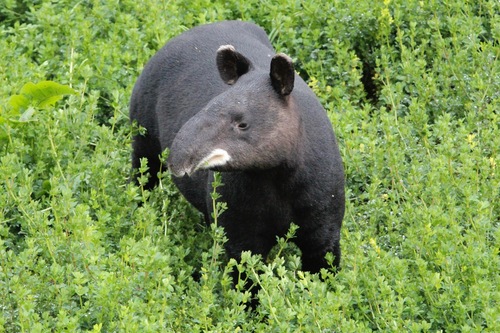
Dark brown to blackish body with a distinctive pale cream-colored patch on the face, cheeks, and throat. Body is stocky and rounded with a short tail and a flexible, elongated snout resembling a small trunk.
Size
Body length typically 2 to 2.5 meters, with a shoulder height of approximately 73 to 120 centimeters.
Weight
Adults typically weigh between 150 and 400 kilograms, with females generally slightly larger than males.
Distinctive features
Distinguished from other tapir species by its larger size, the pale facial markings, and its restricted range in Central America rather than South America or Southeast Asia. Baird's Tapir also has a slightly different skull structure compared to the closely related South American lowland tapir.
Differences between males and females
Minimal sexual dimorphism, though females tend to be marginally larger and heavier than males; coloring and markings are similar between sexes.
Behaviour and diet of the Baird's Tapir
Primarily solitary animals except during mating periods or when females are accompanied by calves. Home ranges may overlap but direct social interaction is limited outside breeding.
When it is active
Primarily nocturnal and crepuscular, resting in dense vegetation during the heat of the day and foraging actively at dawn, dusk, and night.
Diet
Herbivorous, feeding on a wide variety of leaves, fruits, seeds, aquatic plants, and shoots from over 200 plant species. Fruit consumption makes it an important seed disperser within its ecosystem.
Communication
Communicates through vocalizations such as high-pitched whistles and squeals, along with scent marking via urine and glandular secretions to signal territory and reproductive status.
Interactions with other species
Main natural predators include jaguars and, to a lesser extent, pumas, particularly targeting young or vulnerable individuals. Tapirs also share habitat with peccaries and other forest herbivores, sometimes competing for similar food resources.
Role in its ecosystem
Plays a vital ecological role as a seed disperser, helping maintain forest biodiversity and structure by spreading seeds of many plant species across large distances. Considered an ecosystem engineer due to its trail-making and vegetation-shaping behavior.
Reproduction and lifecycle
Breeding can occur year-round with no strict seasonality, though births may peak during the rainy season. Gestation lasts approximately 13 months, typically resulting in a single calf.
Raising the young
Calves are cared for solely by the mother, nursing for several months and remaining with her for up to a year before becoming independent. Young are born with white spots and stripes for camouflage, which fade with age.
Maturity and lifespan
Sexual maturity is typically reached at 3 to 4 years of age. Lifespan in the wild is around 25 to 30 years, while captive individuals can live slightly longer with proper care.
Taxonomy and naming of the Baird's Tapir
Classification
Mammalia > Perissodactyla > Tapiridae > Tapirus > Tapirus bairdii
Scientific synonyms
Tapirella bairdii; Elasmognathus bairdii
What research says
Recent studies
Recent camera-trap and genetic studies have highlighted significant population fragmentation across Central America, prompting new transboundary conservation corridor initiatives between Costa Rica and Panama.
Genome and DNA
Tapirus bairdii has a diploid chromosome number of 2n=80, similar to other tapir species, with ongoing genetic studies assessing population diversity and inbreeding risks in fragmented habitats.
Compared with similar species
Compared to the South American lowland tapir (Tapirus terrestris), Baird's Tapir is generally larger and has distinct facial coloring, while it differs from the mountain tapir (Tapirus pinchaque) by lacking a thick woolly coat suited for colder climates.
The Baird's Tapir and people
Baird's Tapirs are excellent swimmers and often submerge completely to escape predators or cool off. Their closest living relatives are actually horses and rhinoceroses, not pigs, despite superficial resemblance.
Where and how to see it
Best observed in protected reserves such as Corcovado National Park in Costa Rica or Calakmul Biosphere Reserve in Mexico, typically at dawn or dusk near rivers and water holes where tapirs come to drink and bathe.
Risks to humans
No notable risk to humans; Baird's Tapirs are shy and avoid confrontation, though they may act defensively if cornered or threatened.
Human uses
Historically hunted by indigenous and local communities for meat and hides, though this practice is now illegal in most range countries. Ecotourism centered on tapir observation has become an increasingly valuable economic and conservation tool.
Myths and legends
In some Mesoamerican indigenous cultures, tapirs are considered symbols of the forest spirit or guardians of freshwater sources, occasionally appearing in folklore as shy, magical creatures.
Countries where the Baird's Tapir is recorded
The 10 countries named in the range description of its IUCN Red List assessment.
Questions about the Baird's Tapir
Where does the Baird's Tapir live?
The Baird's Tapir is recorded in Belize, Colombia, Costa Rica, Ecuador and El Salvador, among 10 countries in total across North America and South America. These countries come from the range description of its IUCN Red List assessment, and they are what place the species on the interactive map.
Is the Baird's Tapir endangered?
Yes. The IUCN Red List assesses the Baird's Tapir as Endangered, one of the three threatened categories. The species faces a very high risk of extinction in the wild — a step below Critically Endangered, but still on a trajectory that ends badly without intervention.
How many are left in the wild?
Estimated fewer than 5,500 mature individuals remaining in the wild, with a continuing declining population trend across most of its range. This figure comes from the species assessment on the IUCN Red List; population estimates for wild mammals are ranges, not counts, and are revised at each assessment.
What habitat does the Baird's Tapir live in?
Lowland and montane tropical rainforests, cloud forests, mangroves, swamps, and riverine habitats with access to water for bathing and escape from predators.
What is the scientific name of the Baird's Tapir?
The Baird's Tapir is Tapirus bairdii, in the family Tapiridae, order Perissodactyla.
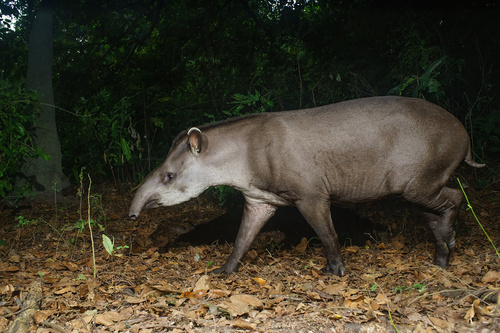
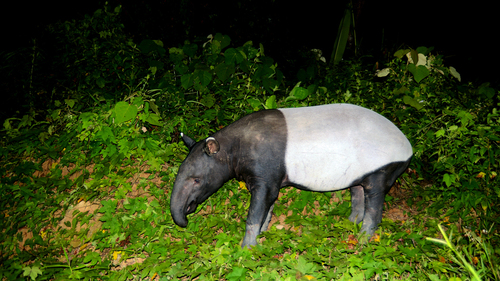
Other species in the genus Tapirus
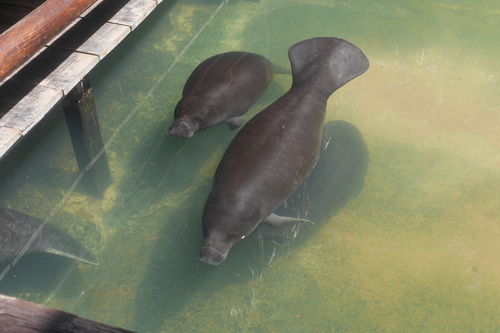
Species that share its range

Sources
Conservation status, range description and population estimate come from the IUCN Red List assessment for Tapirus bairdii. Countries are derived from that range description, not from a mapped country list. Last refreshed on .
The distribution map is drawn from the IUCN Red List spatial data compiled in 2016. IUCN SSC Tapir Specialist Group