
Thomas's Sac-winged Bat
Balantiopteryx io
Red List assessment
Vulnerableon the IUCN Red List
- EXExtinct
- EWExtinct in the Wild
- CRCritically Endangered
- ENEndangered
- VUVulnerable
- NTNear Threatened
- LCLeast Concern
The Thomas's Sac-winged Bat is recorded in 2 countries across North America. The IUCN Red List assesses the Thomas's Sac-winged Bat as Vulnerable. No precise global population estimate exists; the population is believed to be small and declining due to continued habitat degradation within its restricted range.
- Family
- Emballonuridae
- Order
- Chiroptera
- Genus
- Balantiopteryx
- Countries recorded
- 2
- Continents
- North America
- Red List category
- Vulnerable
- Data updated
- August 9, 2026
What is the Thomas's Sac-winged Bat?
Thomas's Sac-winged Bat is a small insectivorous bat endemic to a limited region of southern Mexico and Guatemala. It belongs to the sac-winged bat family Emballonuridae, characterized by a small pouch-like gland on the forearm used for scent communication. The species is notable for its restricted range and dependence on cave and karst habitats, making it particularly vulnerable to habitat disturbance. It is one of the lesser-studied members of its genus, with much of its biology inferred from related species.
Where does the Thomas's Sac-winged Bat live?
Southern Mexico (Chiapas, Oaxaca, Tabasco, Veracruz) and Guatemala
Restricted to a small area of southeastern Mexico, including parts of Chiapas, Tabasco, Oaxaca, and Veracruz, extending into adjacent lowland Guatemala. Its range is considered narrow and fragmented compared to congeners like Balantiopteryx plicata.
Altitude and depth
Typically found at low to moderate elevations, from near sea level up to approximately 800-1000 meters.
Seasonal movements
No long-distance migration is documented; the species is presumed non-migratory but may show local movements related to roost availability and insect abundance across wet and dry seasons.
Habitat of the Thomas's Sac-winged Bat
Found in tropical lowland forests, karst limestone areas, and near caves, sinkholes, and rocky outcrops that provide roosting sites. Often associated with semi-humid to humid tropical forest edges and agricultural mosaics near limestone formations.
Adaptations to its environment
Possesses specialized wing membranes and sac glands used for scent-based communication and territory marking within roosts. Echolocation adapted for fast, agile flight in cluttered forest edge and cave-entrance environments. Roosting in caves provides thermal stability and protection from predators.
Conservation status and numbers
Listed as Vulnerable (VU) by the IUCN due to its small, fragmented geographic range, ongoing habitat loss, and reliance on a limited number of cave roosts that are increasingly disturbed or destroyed.
Estimated population
No precise global population estimate exists; the population is believed to be small and declining due to continued habitat degradation within its restricted range.
What threatens the Thomas's Sac-winged Bat?
Main threats include deforestation and land conversion for agriculture and cattle ranching, disturbance or destruction of cave roosts (e.g., mining, tourism, vandalism), and habitat fragmentation reducing connectivity between roosting and foraging sites.
Diseases and parasites
Like many cave-dwelling bats, may host ectoparasites such as mites and bat flies (Streblidae), though specific studies on this species are scarce.
What is being done to protect it?
Some populations may occur within protected areas of southern Mexico and Guatemala, but targeted conservation programs specifically for this species are limited. General bat conservation initiatives in the region include cave protection and habitat restoration projects.
Recommended actions
Priority actions include surveying and protecting key cave roosts, restoring and connecting fragmented forest habitats, monitoring population trends, and raising local awareness to prevent cave disturbance.
What the Thomas's Sac-winged Bat looks like
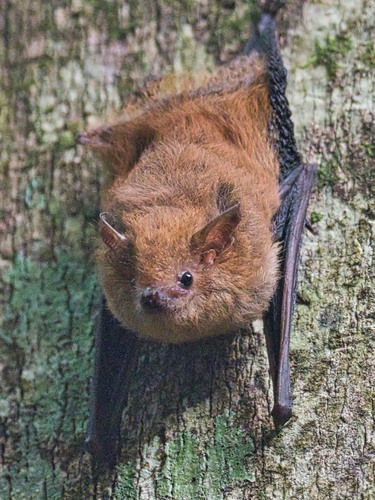
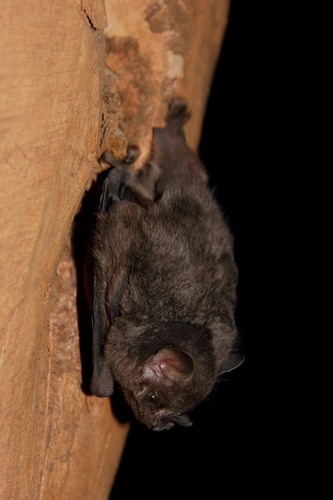
Small bat with grayish-brown to pale brown dorsal fur and lighter underparts, slender wings, and a characteristic sac gland on the forearm. The tail is partially enclosed in the interfemoral membrane, typical of the family Emballonuridae.
Size
Forearm length approximately 35-40 mm; total body length around 5-6 cm, typical of small emballonurid bats.
Weight
Approximately 4-6 grams.
Distinctive features
Distinguished from the more widespread Balantiopteryx plicata by subtle differences in size, skull morphology, and coloration, as well as its more restricted, humid forest-associated range.
Differences between males and females
Minimal sexual dimorphism; males and females are similar in size and coloration, though males may have a more developed wing sac gland.
Behaviour and diet of the Thomas's Sac-winged Bat
Roosts in small to moderate colonies within caves, rock crevices, or culverts, often alongside other bat species. Social structure within colonies is not well documented but likely involves loose aggregations rather than strict hierarchies.
When it is active
Nocturnal, emerging at dusk to forage and returning to roost before dawn.
Diet
Insectivorous, feeding primarily on small flying insects such as moths, beetles, and flies captured in flight.
How it feeds and hunts
Uses echolocation to detect and intercept flying insects in aerial hawking flight, often foraging near forest edges, over water, or around cave entrances.
Communication
Communicates via ultrasonic echolocation calls for navigation and prey detection, along with scent marking using the forearm sac gland, likely important for social and reproductive signaling.
Interactions with other species
Shares roosting caves with other bat species and may be preyed upon by snakes, owls, and small carnivorous mammals that access cave entrances.
Role in its ecosystem
Plays an important ecological role as an insect predator, helping regulate populations of nocturnal flying insects within its forest and cave-associated habitat.
Reproduction and lifecycle
Believed to have a single annual breeding season aligned with the wet season, producing typically one pup per litter after a gestation period of a few months, consistent with related emballonurid species.
Raising the young
Females roost together in maternity colonies and nurse and care for their single pup until it becomes volant, after which juvenile independence occurs within a few weeks to months.
Maturity and lifespan
Sexual maturity is likely reached within the first year, typical of small emballonurid bats; lifespan in the wild is estimated at several years, though exact data for this species is lacking.
Taxonomy and naming of the Thomas's Sac-winged Bat
Classification
Class Mammalia > Order Chiroptera > Family Emballonuridae > Genus Balantiopteryx > Species Balantiopteryx io
Scientific synonyms
Balantiopteryx io Thomas, 1904 (no widely recognized synonyms)
What research says
Recent studies
Recent bat conservation surveys in southern Mexico have included roost mapping and distribution assessments for Balantiopteryx io, but detailed ecological or genetic studies remain limited.
Compared with similar species
Closely related to Balantiopteryx plicata (Gray Sac-winged Bat) and Balantiopteryx infusca, but distinguished by its smaller, more restricted range and subtle morphological differences.
The Thomas's Sac-winged Bat and people
This bat's forearm sac gland produces scent secretions used for communication, a distinctive trait of its family. It is one of the rarest and least-studied bats in its genus, known only from a small pocket of southern Mexico and Guatemala.
Where and how to see it
Best observed at dusk near cave entrances or limestone sinkholes in Chiapas or Tabasco, Mexico, using bat detectors to identify its echolocation calls; guided ecotours focusing on cave bats may offer sighting opportunities.
Risks to humans
No notable risk to humans; like other bats, caution should be taken to avoid direct contact due to general zoonotic disease concerns associated with bat populations.
Countries where the Thomas's Sac-winged Bat is recorded
The 2 countries named in the range description of its IUCN Red List assessment.
Questions about the Thomas's Sac-winged Bat
Where does the Thomas's Sac-winged Bat live?
The Thomas's Sac-winged Bat is recorded in Guatemala and Mexico across North America. These countries come from the range description of its IUCN Red List assessment, and they are what place the species on the interactive map.
Is the Thomas's Sac-winged Bat endangered?
Yes. The IUCN Red List assesses the Thomas's Sac-winged Bat as Vulnerable, one of the three threatened categories. The species faces a high risk of extinction in the wild. It is the first of the three threatened categories: numbers are falling, the range is shrinking, or the population is small enough that a single bad event could do lasting damage.
How many are left in the wild?
No precise global population estimate exists; the population is believed to be small and declining due to continued habitat degradation within its restricted range. This figure comes from the species assessment on the IUCN Red List; population estimates for wild mammals are ranges, not counts, and are revised at each assessment.
What habitat does the Thomas's Sac-winged Bat live in?
Found in tropical lowland forests, karst limestone areas, and near caves, sinkholes, and rocky outcrops that provide roosting sites.
What is the scientific name of the Thomas's Sac-winged Bat?
The Thomas's Sac-winged Bat is Balantiopteryx io, in the family Emballonuridae, order Chiroptera.
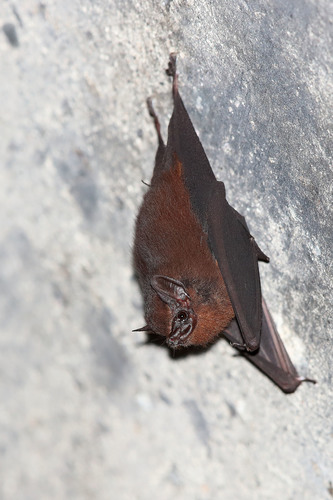
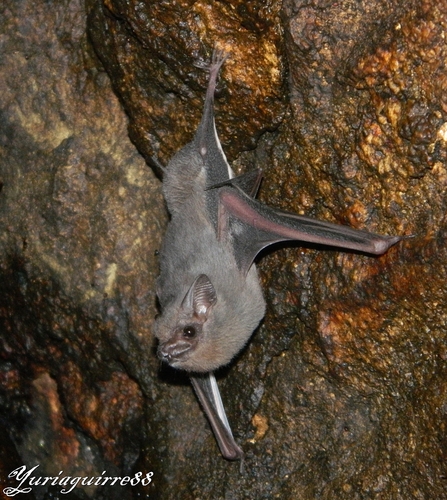
Other species in the genus Balantiopteryx
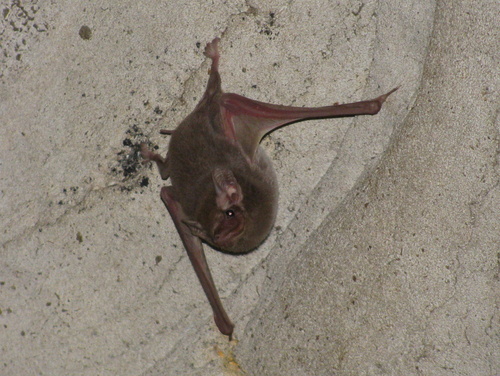
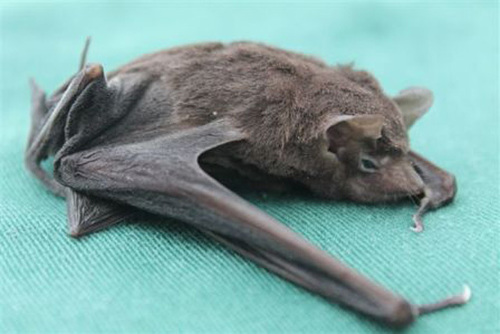
Other species in the family Emballonuridae
Species that share its range
Sources
Conservation status, range description and population estimate come from the IUCN Red List assessment for Balantiopteryx io. Countries are derived from that range description, not from a mapped country list. Last refreshed on .
The distribution map is drawn from the IUCN Red List spatial data compiled in 2008. IUCN (International Union for Conservation of Nature)