
Ecuadorean Grass Mouse
Neomicroxus latebricola
Red List assessment
Endangeredon the IUCN Red List
- EXExtinct
- EWExtinct in the Wild
- CRCritically Endangered
- ENEndangered
- VUVulnerable
- NTNear Threatened
- LCLeast Concern
The Ecuadorean Grass Mouse is recorded in one country, Ecuador across South America. The IUCN Red List assesses the Ecuadorean Grass Mouse as Endangered. No precise population estimate is available.
- Family
- Cricetidae
- Order
- Rodentia
- Genus
- Neomicroxus
- Countries recorded
- 1
- Continents
- South America
- Red List category
- Endangered
- Data updated
- August 9, 2026
What is the Ecuadorean Grass Mouse?
Neomicroxus latebricola is a small sigmodontine rodent endemic to the Ecuadorian Andes, belonging to the diverse New World mouse radiation. It inhabits humid montane forests and high-altitude grasslands (páramo) along the Andean slopes of Ecuador. The species is remarkable for its restricted geographic range and its adaptation to cold, high-altitude environments that few small mammals can tolerate. It is considered Endangered primarily due to its narrow distribution and ongoing habitat loss.
Where does the Ecuadorean Grass Mouse live?
Ecuador, Andean highlands, particularly in the eastern Cordillera and cloud forest zones of the northern and central Andes.
Endemic to Ecuador, with known occurrences along the eastern slopes and inter-Andean valleys of the Ecuadorian Andes. The range appears restricted to a relatively small area, likely encompassing portions of Napo, Pichincha, and adjacent provinces in northern and central Ecuador.
Altitude and depth
Typically found between approximately 1,800 and 3,500 meters above sea level, with core populations likely concentrated in cloud forest and upper montane zones above 2,000 m.
Habitat of the Ecuadorean Grass Mouse
Primary habitats include humid montane cloud forests, high Andean grasslands (páramo), and ecotonal zones between forest and open grassland. These habitats are characterized by dense ground cover, mosses, and thick leaf litter that provide shelter and foraging substrate for this small rodent.
Adaptations to its environment
Like other high-altitude Andean rodents, it likely possesses dense fur for thermal insulation against cold mountain temperatures. Its fossorial or semi-fossorial habits allow it to exploit the dense undergrowth and soil layers of montane habitats, reducing exposure to predators and harsh weather.
Conservation status and numbers
Listed as Endangered (EN) on the IUCN Red List, primarily due to its extremely restricted extent of occurrence (estimated well below 5,000 km²), severely fragmented habitat, and a continuing decline in the quality and area of its montane forest habitat driven by deforestation and agricultural expansion.
Estimated population
No precise population estimate is available. The population is considered small and declining, consistent with its Endangered status and restricted range.
What threatens the Ecuadorean Grass Mouse?
The primary threats include deforestation and conversion of Andean cloud forests to agricultural land (cattle ranching and smallholder farming), burning of páramo for pasture, expanding human settlements, and climate change altering the vertical distribution of suitable high-altitude habitats.
Diseases and parasites
No specific data available. Andean rodents in general are known hosts for various ectoparasites (fleas, mites, ticks) and endoparasites (helminths), and some sigmodontines are reservoirs for hantaviruses and other zoonotic agents.
What is being done to protect it?
The species may receive some incidental protection within Ecuadorian protected areas such as the Cayambe-Coca National Park and Sumaco Napo-Galeras National Park if they overlap with its range. Ecuador's national environmental legislation (TULSMA) provides broad biodiversity protection, though targeted conservation programs for this species specifically are not documented.
Recommended actions
Priority actions should include systematic field surveys to better define population size and range boundaries, protection and restoration of remaining montane cloud forest within its known range, incorporation of the species into national biodiversity monitoring programs, and research into its ecological requirements to guide habitat management.
What the Ecuadorean Grass Mouse looks like
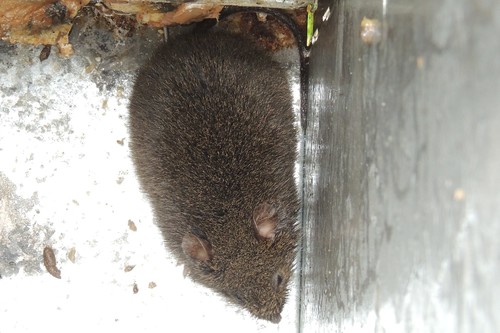
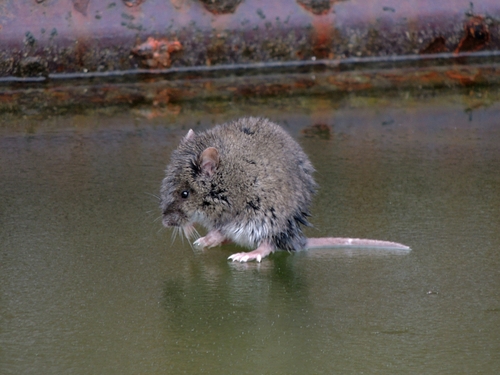
A small, compact mouse with dense, soft fur that is typically brownish to dark gray-brown on the dorsal surface and paler grayish or buffy on the ventral surface. The tail is relatively short and sparsely haired, and the ears are small and rounded.
Size
Estimated body length of approximately 80–110 mm (head and body), with a tail of similar or slightly shorter length, consistent with other Neomicroxus species. Exact measurements are poorly documented.
Weight
Estimated 15–30 g based on comparisons with closely related Neomicroxus and Microxus species; no confirmed sex-specific weight data available.
Distinctive features
Neomicroxus latebricola is distinguished from related Microxus species by cranial morphology features including molar structure and rostral proportions, and from other Andean sigmodontines by its combination of short tail, dense pelage, and specific skull characters used in the taxonomic revision elevating it to Neomicroxus.
Behaviour and diet of the Ecuadorean Grass Mouse
Likely solitary or living in small, loosely associated groups consistent with most sigmodontine rodents. No specific social behavior data are available for this species.
When it is active
Presumed to be primarily nocturnal or crepuscular, as is typical of most small sigmodontine rodents in Andean environments, retreating to burrows or dense vegetation during daylight.
Diet
Likely omnivorous, feeding on seeds, plant material (grasses, roots, fungi), and invertebrates (insects, earthworms). This dietary breadth is characteristic of Sigmodontinae rodents occupying montane grassland-forest ecotones.
How it feeds and hunts
Forages by searching through leaf litter, dense grass tussocks, and surface soils for seeds and invertebrates. May use well-defined runways through ground vegetation typical of grass mice.
Communication
Likely communicates via ultrasonic vocalizations (as in most muroids), scent marking using urine, feces, and glandular secretions to delineate territories and signal reproductive status.
Interactions with other species
Likely prey for Andean small carnivores including weasels (Mustela), small owls (e.g., Aegolius), and snakes. May compete with syntopic sigmodontine rodents such as Akodon and Thomasomys species for food resources.
Role in its ecosystem
Functions as a primary consumer and seed disperser in montane Andean ecosystems, and as an important prey item in the food web supporting higher-level predators. Its role in soil disturbance through burrowing may also influence local vegetation dynamics.
Reproduction and lifecycle
Reproductive details are not specifically documented for this species. Related Andean sigmodontines typically breed year-round with peaks tied to rainfall, have a gestation of approximately 21–25 days, and produce litters of 2–6 young.
Raising the young
Parental care is presumed to follow the typical sigmodontine pattern, with the female providing primary care including nursing and sheltering young in a grass-lined nest. Young are altricial and become independent within a few weeks.
Maturity and lifespan
Sexual maturity likely reached at 2–3 months of age, consistent with other small sigmodontines. Wild lifespan is probably 1–2 years; captive lifespan data are unavailable.
Taxonomy and naming of the Ecuadorean Grass Mouse
Classification
Mammalia > Rodentia > Cricetidae (subfamily Sigmodontinae) > Neomicroxus > Neomicroxus latebricola
Scientific synonyms
Microxus latebricola Thomas, 1914. The species was originally described under the genus Microxus and later reassigned to the newly erected genus Neomicroxus following phylogenetic revisions of Sigmodontinae.
What research says
Recent studies
The most significant recent study is the phylogenetic revision of the tribe Akodontini that led to the erection of the genus Neomicroxus, separating latebricola and related species from Microxus based on molecular and morphological evidence. Detailed ecological or behavioral studies remain largely absent from the scientific literature.
Compared with similar species
Neomicroxus latebricola is closely related to N. bogotensis (Bogotá Grass Mouse) of Colombia and N. pictus of Peru and Bolivia. It differs from Microxus species (with which it was formerly grouped) in molecular phylogenetic position and subtle craniodental features. It resembles Akodon species superficially but is smaller and has distinct molar morphology.
The Ecuadorean Grass Mouse and people
This species was effectively 'hidden' within another genus (Microxus) for over a century before molecular phylogenetics revealed it deserved its own genus. It lives in one of the world's biodiversity hotspots—the Tropical Andes—home to more endemic species per unit area than almost anywhere on Earth. Despite being Endangered, it remains so poorly studied that basic facts like its exact diet and reproductive seasonality have never been formally documented.
Where and how to see it
The best chance of observing this species is in high-altitude cloud forests and páramo zones of northern and central Ecuador, particularly in protected areas like Cayambe-Coca National Park. Night surveys using Sherman live traps placed along forest edges, grass tussocks, and stream margins offer the highest probability of detection. Very few naturalists or researchers have specifically targeted this species in the field.
Risks to humans
No notable risk to humans. Like all wild rodents, it may theoretically carry zoonotic pathogens, but no specific disease risk has been documented for this species.
Countries where the Ecuadorean Grass Mouse is recorded
The 1 countries named in the range description of its IUCN Red List assessment.
Questions about the Ecuadorean Grass Mouse
Where does the Ecuadorean Grass Mouse live?
The Ecuadorean Grass Mouse is recorded in Ecuador across South America. These countries come from the range description of its IUCN Red List assessment, and they are what place the species on the interactive map.
Is the Ecuadorean Grass Mouse endangered?
Yes. The IUCN Red List assesses the Ecuadorean Grass Mouse as Endangered, one of the three threatened categories. The species faces a very high risk of extinction in the wild — a step below Critically Endangered, but still on a trajectory that ends badly without intervention.
How many are left in the wild?
No precise population estimate is available. This figure comes from the species assessment on the IUCN Red List; population estimates for wild mammals are ranges, not counts, and are revised at each assessment.
What habitat does the Ecuadorean Grass Mouse live in?
Primary habitats include humid montane cloud forests, high Andean grasslands (páramo), and ecotonal zones between forest and open grassland.
What is the scientific name of the Ecuadorean Grass Mouse?
The Ecuadorean Grass Mouse is Neomicroxus latebricola, in the family Cricetidae, order Rodentia.
Other species in the genus Neomicroxus
Other species in the family Cricetidae
Species that share its range

Sources
Conservation status, range description and population estimate come from the IUCN Red List assessment for Neomicroxus latebricola. Countries are derived from that range description, not from a mapped country list. Last refreshed on .
The distribution map is drawn from the IUCN Red List spatial data compiled in 2019. IUCN SSC Small Mammal Specialist Group