
Malay Tapir
Tapirus indicus
Red List assessment
Endangeredon the IUCN Red List
- EXExtinct
- EWExtinct in the Wild
- CRCritically Endangered
- ENEndangered
- VUVulnerable
- NTNear Threatened
- LCLeast Concern
The Malay Tapir is recorded in 4 countries across Asia. The IUCN Red List assesses the Malay Tapir as Endangered. Fewer than 2,500 mature individuals remaining in the wild, with a continuing declining trend
- Family
- Tapiridae
- Order
- Perissodactyla
- Genus
- Tapirus
- Countries recorded
- 4
- Continents
- Asia
- Red List category
- Endangered
- Data updated
- August 9, 2026
What is the Malay Tapir?
The Malay Tapir, also known as the Asian Tapir, is the largest of the four tapir species and the only one native to Asia. It inhabits dense tropical rainforests of the Malay Peninsula and Sumatra, recognizable by its striking black-and-white coloration. This ancient-looking mammal is a living relic of a lineage that has changed little over millions of years, playing a crucial role as a seed disperser in its forest ecosystem.
Where does the Malay Tapir live?
Southeast Asia, primarily Malay Peninsula, Sumatra (Indonesia), and southern Thailand and Myanmar
Found in Peninsular Malaysia, Sumatra (Indonesia), southern Thailand, and small remnant populations in Myanmar; historically ranged more widely across Indochina but now highly fragmented.
Altitude and depth
0-1500m, mostly found in lowland forests below 300m
Habitat of the Malay Tapir
Dense lowland tropical rainforest, swamp forest, and hilly forest areas with access to rivers or water sources for cooling and escape from predators. Prefers areas with dense understory vegetation for cover and foraging.
Adaptations to its environment
Prehensile snout allows selective feeding on leaves and shoots in dense vegetation; strong swimming ability helps escape predators and cool down in tropical heat; distinctive black-and-white coloration provides disruptive camouflage in moonlit forest, breaking up its outline to predators like tigers.
Conservation status and numbers
Endangered (EN) according to IUCN Red List, with population decline of over 50% estimated over the last three generations due to habitat loss and fragmentation.
Estimated population
Fewer than 2,500 mature individuals remaining in the wild, with a continuing declining trend
What threatens the Malay Tapir?
Deforestation for palm oil plantations and logging, habitat fragmentation, poaching for meat and body parts, road mortality, and human-wildlife conflict.
Diseases and parasites
Susceptible to various internal parasites including nematodes; can contract diseases from domestic livestock in areas of habitat overlap; foot and mouth disease has been documented in some populations.
What is being done to protect it?
Protected under national laws in Malaysia, Indonesia, and Thailand; present in several protected areas including Taman Negara National Park and Way Kambas National Park; captive breeding programs exist in zoos worldwide coordinated through international studbooks.
Recommended actions
Expand and connect protected forest areas through wildlife corridors, strengthen anti-poaching enforcement, reduce human-tapir conflict through community education, and support sustainable palm oil certification to reduce habitat loss.
What the Malay Tapir looks like
Distinctive black-and-white pattern with black front half and hind legs, contrasting with a white 'saddle' covering the back and sides; short prehensile snout resembling a small trunk; rounded body with sparse, coarse hair.
Size
Body length 1.8-2.5m, shoulder height 90-107cm
Weight
250-540 kg, with females typically slightly larger than males
Distinctive features
The only tapir species with this striking black-and-white saddle pattern, unlike the uniform brown or reddish coloration of South American tapir species; also notably larger than its New World relatives.
Differences between males and females
Females are generally slightly larger and heavier than males, though the difference is not dramatic; coloration and markings are similar between sexes.
Behaviour and diet of the Malay Tapir
Primarily solitary animals, coming together only for mating; individuals maintain home ranges that may overlap but generally avoid direct contact outside breeding season.
When it is active
Primarily nocturnal and crepuscular, most active during dusk, night, and dawn; spends daylight hours resting in dense vegetation or wallowing in water.
Diet
Herbivorous, feeding on a wide variety of leaves, buds, shoots, fruits, and aquatic plants; consumes over 100 different plant species, using its prehensile snout to select and pull vegetation.
Communication
Uses vocalizations including high-pitched squeaks and whistles; scent marking through urine spraying on vegetation to communicate territory and reproductive status; visual cues through body posture.
Interactions with other species
Natural predators include tigers and occasionally clouded leopards, particularly targeting young or vulnerable individuals; competes with other large herbivores for food resources in overlapping habitats.
Role in its ecosystem
Important seed disperser for many tropical forest plant species, contributing to forest regeneration and plant diversity; its foraging habits help shape understory vegetation structure.
Reproduction and lifecycle
Breeding can occur year-round with no strict seasonality; gestation lasts approximately 390-410 days (13 months); typically gives birth to a single calf.
Raising the young
Mother provides sole parental care; calves are born with white spots and stripes for camouflage, weaned around 6-8 months, and become independent around 6-12 months of age.
Maturity and lifespan
Sexual maturity reached around 3-4 years; lifespan in the wild approximately 25-30 years, up to 30 years in captivity.
Taxonomy and naming of the Malay Tapir
Classification
Mammalia > Perissodactyla > Tapiridae > Tapirus > Tapirus indicus
Scientific synonyms
Acrocodia indica, Tapirus malayanus
What research says
Recent studies
Recent camera trap studies have improved population density estimates in fragmented habitats; genetic research is being used to assess population connectivity and inform corridor planning between isolated subpopulations.
Genome and DNA
Diploid chromosome number of 2n=52; genetic studies have helped establish phylogenetic relationships among tapir species and inform conservation genetics for captive breeding programs.
Compared with similar species
Larger and more strikingly patterned than the three Neotropical tapir species (Baird's, mountain, and South American tapirs), which are typically uniform brown or gray; shares the same general body plan and prehensile snout characteristic of all tapir species.
The Malay Tapir and people
Malay Tapir calves are born with a spotted and striped coat pattern completely different from adults, resembling a watermelon for camouflage. Despite their pig-like appearance, tapirs are actually more closely related to horses and rhinoceroses. They are excellent swimmers and can stay submerged for several minutes to escape predators.
Where and how to see it
Best observed in protected reserves such as Taman Negara National Park in Malaysia or Way Kambas National Park in Sumatra; night safaris or guided tours near water sources during dusk or dawn offer the highest chance of sightings due to the species' nocturnal habits.
Risks to humans
No notable risk to humans; tapirs are generally shy and avoid human contact, though they may act defensively if cornered or threatened.
Human uses
Historically hunted for meat and hide in some regions; currently valued primarily for ecotourism and as a flagship species for rainforest conservation efforts in Southeast Asia.
Myths and legends
In some Southeast Asian folklore, the tapir is believed to eat bad dreams, similar to the Japanese Baku legend, making it a symbol of protection against nightmares.
Countries where the Malay Tapir is recorded
The 4 countries named in the range description of its IUCN Red List assessment.
Questions about the Malay Tapir
Where does the Malay Tapir live?
The Malay Tapir is recorded in Indonesia, Malaysia, Myanmar and Thailand across Asia. These countries come from the range description of its IUCN Red List assessment, and they are what place the species on the interactive map.
Is the Malay Tapir endangered?
Yes. The IUCN Red List assesses the Malay Tapir as Endangered, one of the three threatened categories. The species faces a very high risk of extinction in the wild — a step below Critically Endangered, but still on a trajectory that ends badly without intervention.
How many are left in the wild?
Fewer than 2,500 mature individuals remaining in the wild, with a continuing declining trend This figure comes from the species assessment on the IUCN Red List; population estimates for wild mammals are ranges, not counts, and are revised at each assessment.
What habitat does the Malay Tapir live in?
Dense lowland tropical rainforest, swamp forest, and hilly forest areas with access to rivers or water sources for cooling and escape from predators.
What is the scientific name of the Malay Tapir?
The Malay Tapir is Tapirus indicus, in the family Tapiridae, order Perissodactyla.
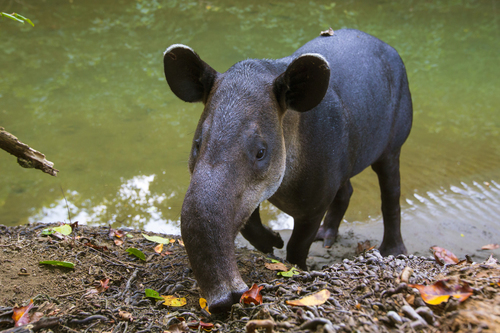
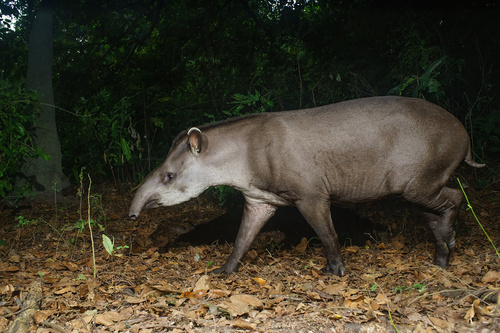
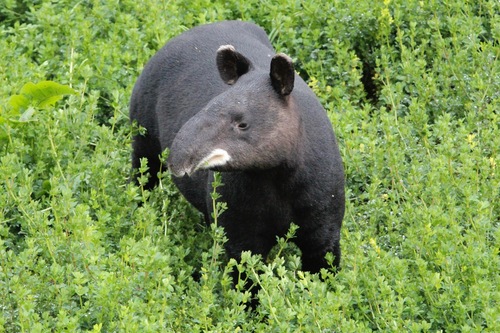
Other species in the genus Tapirus
Species that share its range
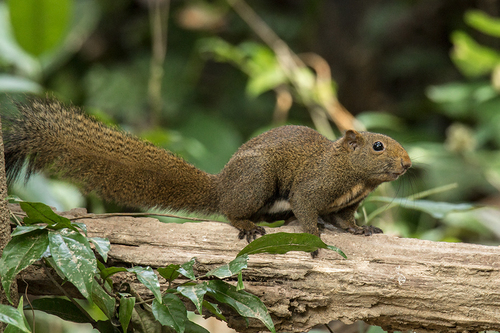
Sources
Conservation status, range description and population estimate come from the IUCN Red List assessment for Tapirus indicus. Countries are derived from that range description, not from a mapped country list. Last refreshed on .
The distribution map is drawn from the IUCN Red List spatial data compiled in 2008. IUCN (International Union for Conservation of Nature)