
Lowland Tapir
Tapirus terrestris
Red List assessment
Vulnerableon the IUCN Red List
- EXExtinct
- EWExtinct in the Wild
- CRCritically Endangered
- ENEndangered
- VUVulnerable
- NTNear Threatened
- LCLeast Concern
The Lowland Tapir is recorded in 11 countries across South America. The IUCN Red List assesses the Lowland Tapir as Vulnerable. The global population is unknown precisely but is estimated in the tens of thousands, with a continuing declining trend across most of its range due to habitat loss.
- Family
- Tapiridae
- Order
- Perissodactyla
- Genus
- Tapirus
- Countries recorded
- 11
- Continents
- South America
- Red List category
- Vulnerable
- Data updated
- August 9, 2026
What is the Lowland Tapir?
The Lowland Tapir is the largest native land mammal in South America and one of four extant tapir species. It inhabits dense tropical forests and wetlands across the Amazon Basin, where it plays a crucial ecological role as a seed disperser. Despite its bulky, pig-like appearance, it is a strong swimmer and surprisingly agile in dense vegetation. Its most distinctive feature is a short, flexible proboscis used for grasping vegetation.
Where does the Lowland Tapir live?
Amazon Basin and surrounding regions of South America, including Brazil, Bolivia, Peru, Colombia, Venezuela, Ecuador, Paraguay, and northern Argentina
Found throughout the Amazon Basin and adjacent regions of South America, spanning Brazil, Bolivia, Peru, Ecuador, Colombia, Venezuela, Guyana, Suriname, French Guiana, Paraguay, and northern Argentina. The species' range follows tropical and subtropical lowland forests east of the Andes.
Altitude and depth
Generally found from sea level up to about 500m, though some populations occur up to 1500m in foothill regions.
Seasonal movements
No true migration or hibernation occurs, but tapirs may shift habitat use seasonally, moving toward flooded forests during wet seasons and concentrating near permanent water sources during dry seasons.
Habitat of the Lowland Tapir
Lowland tapirs primarily inhabit tropical rainforests, gallery forests, flooded forests, savannas, and wetland areas near rivers and lakes. They require access to water for bathing, cooling, and escaping predators, and dense understory vegetation for cover and foraging.
Adaptations to its environment
Their prehensile snout allows selective browsing of leaves and fruits in dense vegetation, while their streamlined body and webbed toes aid swimming and moving through mud. Thick, tough skin protects against thorny vegetation and insect bites, and their coloration provides camouflage in dappled forest light.
Conservation status and numbers
Classified as Vulnerable (VU) by the IUCN due to an estimated population decline of over 30% over the past three generations, driven by habitat loss and hunting pressure across much of its range.
Estimated population
The global population is unknown precisely but is estimated in the tens of thousands, with a continuing declining trend across most of its range due to habitat loss.
What threatens the Lowland Tapir?
Major threats include deforestation for agriculture and cattle ranching, illegal hunting for meat and hides, habitat fragmentation, road mortality, and competition with livestock for resources.
Diseases and parasites
Known to host various internal parasites including nematodes and external parasites like ticks; foot-and-mouth disease and other livestock-transmitted illnesses pose emerging health risks due to increased contact with cattle.
What is being done to protect it?
Conservation efforts include protected areas such as national parks and biological reserves throughout the Amazon, CITES Appendix II trade regulations, and research/monitoring programs like the Lowland Tapir Conservation Initiative in Brazil.
Recommended actions
Priority actions include strengthening anti-poaching enforcement, expanding and connecting protected habitat corridors, reducing deforestation rates, and increasing community-based conservation education programs.
What the Lowland Tapir looks like
The Lowland Tapir has a stocky, barrel-shaped body covered in short, dark brown to grayish-brown fur, with a distinctive short erect mane running from the forehead to the back of the neck. Its most notable feature is a short, flexible trunk-like snout formed by an elongated upper lip and nose.
Size
Body length ranges from 1.8 to 2.5 meters, with a shoulder height of approximately 77 to 108 cm.
Weight
Adults typically weigh between 150 and 250 kg, with females often slightly larger than males.
Distinctive features
Distinguished from other tapir species by its shorter mane, uniformly dark coloration lacking the white markings seen in the Malayan tapir, and its relatively smaller size compared to the Baird's tapir.
Differences between males and females
Minimal sexual dimorphism exists, though females tend to be slightly larger and heavier than males; there are no distinguishing color or ornamental differences.
Behaviour and diet of the Lowland Tapir
Lowland tapirs are generally solitary animals, coming together only briefly for mating or occasionally seen near shared water sources; home ranges of individuals may overlap without direct social interaction.
When it is active
Primarily nocturnal and crepuscular, tapirs rest in dense cover during the day and become active at dusk to forage and travel to water sources.
Diet
Herbivorous, feeding on a wide variety of leaves, fruits, seeds, aquatic plants, and browse from over 200 plant species; fruit consumption makes them important seed dispersers.
Communication
Communication includes high-pitched whistles and squeaks, scent marking through urine and glandular secretions on vegetation, and body postures to signal alarm or reproductive状态.
Interactions with other species
Natural predators include jaguars and pumas, especially targeting juveniles; tapirs also have a mutualistic relationship with many plant species through seed dispersal, and their wallows create microhabitats used by other wildlife.
Role in its ecosystem
As a major seed disperser (megafaunal frugivore), the Lowland Tapir plays a keystone ecological role in maintaining forest plant diversity and structure, sometimes called a 'gardener of the forest'.
Reproduction and lifecycle
Breeding can occur year-round with some regional peaks; gestation lasts approximately 390-400 days, unusually long for a mammal of its size, resulting in a single calf per birth.
Raising the young
Calves are cared for solely by the mother, nursing for up to a year while gradually transitioning to solid food; young tapirs display distinctive white-striped and spotted coats for camouflage during their first few months.
Maturity and lifespan
Sexual maturity is reached around 3-4 years of age; lifespan in the wild is typically 25-30 years, while individuals in captivity have lived up to 35 years.
Taxonomy and naming of the Lowland Tapir
Classification
Mammalia > Perissodactyla > Tapiridae > Tapirus > Tapirus terrestris
Subspecies
Several subspecies have been proposed (e.g., T. t. terrestris, T. t. aenigmaticus, T. t. spegazzinii, T. t. colombianus), but their validity is debated and taxonomy is under revision based on genetic studies.
Scientific synonyms
Tapirus americanus, Tapirus terrestris terrestris (older classifications)
What research says
Recent studies
Recent genetic and ecological studies have focused on population connectivity across fragmented Amazonian habitats and the tapir's crucial role in long-distance seed dispersal for large-seeded tree species.
Genome and DNA
The Lowland Tapir has a diploid chromosome number of 2n=80; genetic studies have revealed significant population structuring across its range, supporting reconsideration of subspecies boundaries.
Compared with similar species
Compared to the Mountain Tapir, the Lowland Tapir is larger and lacks a thick woolly coat; compared to the Malayan Tapir, it lacks the characteristic black-and-white coloration and is generally smaller.
The Lowland Tapir and people
Tapirs are excellent swimmers and often submerge completely to escape predators or cool off; despite resembling pigs, they are more closely related to horses and rhinoceroses; baby tapirs have a striking watermelon-like striped and spotted coat pattern.
Where and how to see it
Best observed at dusk or dawn near rivers and salt licks in protected areas such as Brazil's Pantanal or Peru's Manu National Park, using quiet approach and patience due to the animal's shy, nocturnal nature.
Risks to humans
No notable risk to humans; tapirs are generally shy and non-aggressive, though they may act defensively if cornered or threatened.
Human uses
Historically hunted by indigenous and local communities for meat and hide, and occasionally kept in captivity for ecotourism and educational display in zoos and wildlife reserves.
Myths and legends
In various South American indigenous cultures, tapirs are considered spiritual guides or symbols of the forest and are featured in creation myths as powerful, mystical beings connected to rivers and fertility.
Countries where the Lowland Tapir is recorded
The 11 countries named in the range description of its IUCN Red List assessment.
Questions about the Lowland Tapir
Where does the Lowland Tapir live?
The Lowland Tapir is recorded in Argentina, Bolivia, Brazil, Colombia and Ecuador, among 11 countries in total across South America. These countries come from the range description of its IUCN Red List assessment, and they are what place the species on the interactive map.
Is the Lowland Tapir endangered?
Yes. The IUCN Red List assesses the Lowland Tapir as Vulnerable, one of the three threatened categories. The species faces a high risk of extinction in the wild. It is the first of the three threatened categories: numbers are falling, the range is shrinking, or the population is small enough that a single bad event could do lasting damage.
How many are left in the wild?
The global population is unknown precisely but is estimated in the tens of thousands, with a continuing declining trend across most of its range due to habitat loss. This figure comes from the species assessment on the IUCN Red List; population estimates for wild mammals are ranges, not counts, and are revised at each assessment.
What habitat does the Lowland Tapir live in?
Lowland tapirs primarily inhabit tropical rainforests, gallery forests, flooded forests, savannas, and wetland areas near rivers and lakes.
What is the scientific name of the Lowland Tapir?
The Lowland Tapir is Tapirus terrestris, in the family Tapiridae, order Perissodactyla.
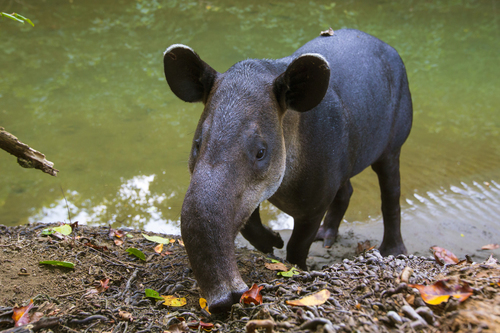
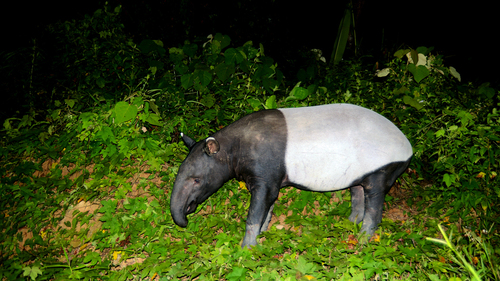
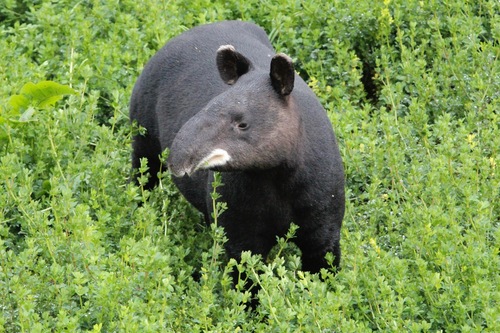
Other species in the genus Tapirus
Species that share its range


Sources
Conservation status, range description and population estimate come from the IUCN Red List assessment for Tapirus terrestris. Countries are derived from that range description, not from a mapped country list. Last refreshed on .
The distribution map is drawn from the IUCN Red List spatial data compiled in 2018. IUCN (International Union for Conservation of Nature)