
Yellow Golden Mole
Calcochloris obtusirostris
Red List assessment
Least Concernon the IUCN Red List
- EXExtinct
- EWExtinct in the Wild
- CRCritically Endangered
- ENEndangered
- VUVulnerable
- NTNear Threatened
- LCLeast Concern
The Yellow Golden Mole is recorded in 3 countries across Africa. The IUCN Red List assesses the Yellow Golden Mole as Least Concern. No precise population estimate exists, but the species is considered locally common in suitable sandy habitats; overall trend is believed stable.
- Family
- Chrysochloridae
- Order
- Afrosoricida
- Genus
- Calcochloris
- Countries recorded
- 3
- Continents
- Africa
- Red List category
- Least Concern
- Data updated
- August 9, 2026
What is the Yellow Golden Mole?
The Yellow Golden Mole is a small, fossorial mammal endemic to sandy coastal regions of southeastern Africa. It is named for the yellowish sheen of its dense fur, which is iridescent under light. This species is remarkable for its highly specialized adaptations to a subterranean lifestyle, including reduced eyes and a streamlined body shape. It plays an important role in soil aeration and invertebrate population control within its coastal habitat.
Where does the Yellow Golden Mole live?
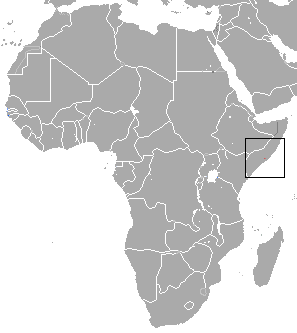
Southeastern Africa, primarily coastal Mozambique, eastern Zimbabwe, and northeastern South Africa (KwaZulu-Natal)
Found along the coastal lowlands of Mozambique, extending into northeastern KwaZulu-Natal in South Africa and parts of eastern Zimbabwe, generally restricted to areas with sandy substrates below 500m elevation.
Altitude and depth
Sea level to approximately 500m elevation; burrows typically found 10-30cm below the surface, though can dig deeper to escape heat or predators.
Seasonal movements
No true hibernation, but activity levels may decrease during colder, drier months when invertebrate prey is less abundant.
Habitat of the Yellow Golden Mole
Prefers sandy coastal grasslands, dune forests, and sandy soils near rivers and estuaries where digging is easier. Also found in coastal thicket and cultivated areas with loose, friable soil.
Adaptations to its environment
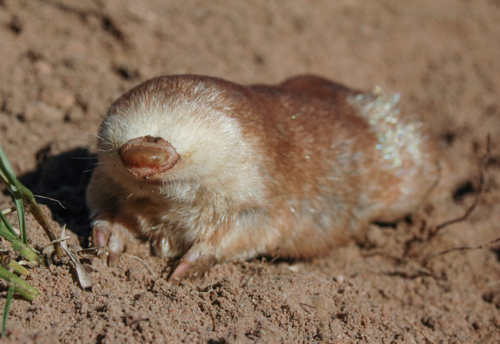
Possesses a wedge-shaped head, powerful claws, and a leathery nose pad for efficient burrowing through sand. Eyes are vestigial and covered by skin, while ears are reduced to small openings, both adaptations to prevent sand ingress during digging.
Conservation status and numbers
Listed as Least Concern by IUCN due to a relatively wide distribution and presumed stable population, though localized threats exist in parts of its range.
Estimated population
No precise population estimate exists, but the species is considered locally common in suitable sandy habitats; overall trend is believed stable.
What threatens the Yellow Golden Mole?
Habitat loss from coastal development, agriculture, and sand mining are primary threats, particularly in South African portions of its range. Predation by domestic cats and habitat fragmentation also pose localized risks.
Diseases and parasites
Specific diseases are poorly documented, though like other golden moles, it likely hosts various ectoparasites such as mites and ticks.
What is being done to protect it?
Protected within some coastal reserves in KwaZulu-Natal, South Africa, though no species-specific conservation programs are currently in place. General habitat protection measures indirectly benefit this species.
Recommended actions
Further population surveys are needed to clarify distribution and abundance, along with protection of remaining coastal dune habitats from development and mining activities.
What the Yellow Golden Mole looks like
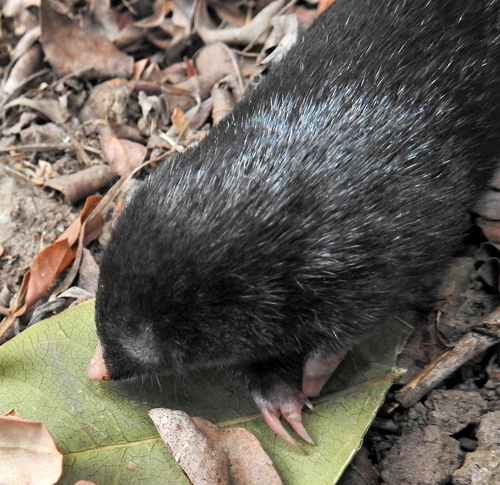
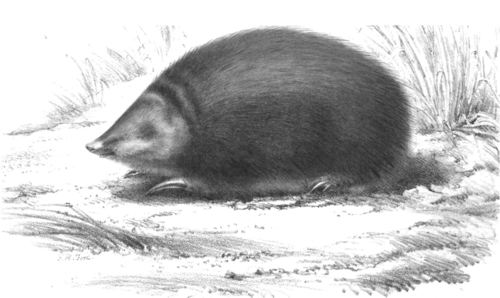
Fur is dense, short, and silky with a distinctive yellowish to golden-brown iridescent sheen, especially visible in sunlight. The body is cylindrical and streamlined, lacking external ears, eyes, or a visible tail.
Size
Body length ranges from approximately 9 to 12 cm, with no external tail.
Weight
Typically weighs between 20 and 50 grams.
Distinctive features
Distinguished from related golden mole species by its yellowish fur coloration and specific cranial features, including a relatively short, blunt rostrum (hence 'obtusirostris').
Differences between males and females
Minimal sexual dimorphism has been documented; males and females are similar in size and coloration.
Behaviour and diet of the Yellow Golden Mole
Solitary and territorial, coming together only briefly for mating; individuals maintain separate burrow systems.
When it is active
Primarily nocturnal, though may show some crepuscular activity, spending most of the time underground foraging through soil tunnels.
Diet
Insectivorous, feeding mainly on earthworms, beetle larvae, termites, and other soil-dwelling invertebrates.
How it feeds and hunts
Locates prey through vibration and scent detection while tunneling through loose sand, using its sensitive snout to probe the soil.
Communication
Primarily relies on tactile and vibrational cues within burrows; vocalizations are minimal, though some soft squeaks may occur during aggressive encounters.
Interactions with other species
Preyed upon by owls, snakes, and small carnivores such as mongooses; may compete with other burrowing insectivores for food resources in shared habitats.
Role in its ecosystem
Functions as a soil engineer, aerating sandy soils through burrowing activity and controlling populations of soil invertebrates, contributing to nutrient cycling.
Reproduction and lifecycle
Breeding season appears to correlate with wetter months when soil is easier to dig and prey is abundant; gestation lasts approximately 3-4 weeks with litters typically of 1-2 young.
Raising the young
Females raise young alone in a nest chamber within the burrow system; young are weaned within a few weeks and become independent shortly after.
Maturity and lifespan
Sexual maturity is reached within the first year of life; lifespan in the wild is estimated at 3-4 years, with limited data on captive longevity.
Taxonomy and naming of the Yellow Golden Mole
Classification
Mammalia > Afrosoricida > Chrysochloridae > Calcochloris > Calcochloris obtusirostris
Subspecies
Several subspecies have been proposed, including C. o. obtusirostris and C. o. rufus, differing slightly in coloration and distribution across Mozambique and South Africa, though taxonomy remains under review.
Scientific synonyms
Chrysochloris obtusirostris; Amblysomus obtusirostris (older generic placements)
What research says
Recent studies
Recent taxonomic studies using molecular data have helped clarify relationships within the genus Calcochloris, though species-specific ecological research remains limited.
Genome and DNA
Chromosome number and detailed genomic studies are not well documented for this species.
Compared with similar species
Similar to other golden moles such as Amblysomus species but distinguished by its yellowish fur and specific skull morphology; generally smaller than Cape golden moles.
The Yellow Golden Mole and people
Golden moles like this species have some of the most efficient burrowing mechanics among mammals, able to 'swim' through loose sand almost as if it were water. Despite their name, they are not closely related to true moles but belong to the ancient Afrotheria lineage shared with elephants and aardvarks.
Where and how to see it
Best observed indirectly through surface tunnel ridges in sandy coastal habitats of KwaZulu-Natal or Mozambique at dawn or dusk; direct sightings are rare due to their fossorial nature.
Risks to humans
No notable risk to humans.
Countries where the Yellow Golden Mole is recorded
The 3 countries named in the range description of its IUCN Red List assessment.
Questions about the Yellow Golden Mole
Where does the Yellow Golden Mole live?
The Yellow Golden Mole is recorded in Mozambique, South Africa and Zimbabwe across Africa. These countries come from the range description of its IUCN Red List assessment, and they are what place the species on the interactive map.
Is the Yellow Golden Mole endangered?
The IUCN Red List assesses the Yellow Golden Mole as Least Concern. The species is widespread and abundant enough not to qualify for any threatened category. It does not mean the species is safe forever, only that nothing in the current data raises an alarm.
How many are left in the wild?
No precise population estimate exists, but the species is considered locally common in suitable sandy habitats; overall trend is believed stable. This figure comes from the species assessment on the IUCN Red List; population estimates for wild mammals are ranges, not counts, and are revised at each assessment.
What habitat does the Yellow Golden Mole live in?
Prefers sandy coastal grasslands, dune forests, and sandy soils near rivers and estuaries where digging is easier.
What is the scientific name of the Yellow Golden Mole?
The Yellow Golden Mole is Calcochloris obtusirostris, in the family Chrysochloridae, order Afrosoricida.
Other species in the genus Calcochloris
Other species in the family Chrysochloridae



Species that share its range
Sources
Conservation status, range description and population estimate come from the IUCN Red List assessment for Calcochloris obtusirostris. Countries are derived from that range description, not from a mapped country list. Last refreshed on .
The distribution map is drawn from the IUCN Red List spatial data compiled in 2015. IUCN (International Union for Conservation of Nature)