
Rough-haired Golden Mole
Chrysospalax villosus
Red List assessment
Vulnerableon the IUCN Red List
- EXExtinct
- EWExtinct in the Wild
- CRCritically Endangered
- ENEndangered
- VUVulnerable
- NTNear Threatened
- LCLeast Concern
The Rough-haired Golden Mole is recorded in 2 countries across Africa. The IUCN Red List assesses the Rough-haired Golden Mole as Vulnerable. No precise population estimate exists, but the species is considered uncommon and patchily distributed with a declining trend due to habitat loss.
- Family
- Chrysochloridae
- Order
- Afrosoricida
- Genus
- Chrysospalax
- Countries recorded
- 2
- Continents
- Africa
- Red List category
- Vulnerable
- Data updated
- August 9, 2026
What is the Rough-haired Golden Mole?
The Rough-haired Golden Mole is a small, subterranean insectivorous mammal endemic to grassland and wetland habitats of eastern South Africa and Eswatini. It is one of two species in the genus Chrysospalax, distinguished by its coarse, shaggy fur unlike the sleek coats of most golden moles. It is remarkable for its highly specialized adaptations to a fully underground lifestyle, including a lack of external eyes and ears. Its patchy distribution and reliance on threatened grassland habitats make it a species of conservation concern.
Where does the Rough-haired Golden Mole live?
South Africa (KwaZulu-Natal, Mpumalanga, Free State) and Eswatini
Restricted to eastern South Africa, primarily KwaZulu-Natal, Mpumalanga, and parts of the Free State, with a small population extending into Eswatini. The species occurs in fragmented, isolated patches rather than a continuous range.
Altitude and depth
Found from near sea level up to about 2000 meters elevation; underground burrowing depth typically ranges from a few centimeters to about 30 cm below the surface.
Seasonal movements
No true hibernation, but activity and burrowing intensity may decrease during colder, drier months when invertebrate prey is less abundant.
Habitat of the Rough-haired Golden Mole
Inhabits moist grasslands, marshy areas, and vegetation along streams and wetlands, often in sandy or loamy soils suitable for burrowing. It prefers areas with dense grass cover and high soil moisture that support abundant invertebrate prey. It is also found in some coastal grassland and forest-edge habitats.
Adaptations to its environment
Possesses a dense, water-resistant coat, powerful claws for digging, and a leathery nose pad for pushing through soil. Eyes are vestigial and covered by skin, while ears are reduced to small openings, reflecting adaptation to a lightless underground environment. Its streamlined, muscular body allows efficient tunneling through soil.
Conservation status and numbers
Classified as Vulnerable (VU) by the IUCN due to ongoing habitat loss and fragmentation across its restricted range. Population decline is inferred from continuing degradation of grassland and wetland habitats rather than direct demographic data.
Estimated population
No precise population estimate exists, but the species is considered uncommon and patchily distributed with a declining trend due to habitat loss.
What threatens the Rough-haired Golden Mole?
Main threats include agricultural expansion, urbanization, wetland drainage, and afforestation with exotic tree plantations that destroy suitable grassland habitat. Habitat fragmentation isolates populations, reducing genetic connectivity and increasing vulnerability to local extinction.
Diseases and parasites
Specific data on diseases or parasites are limited, but like other golden moles it may host soil-associated ectoparasites and endoparasites typical of small burrowing mammals.
What is being done to protect it?
Some populations occur within protected grassland reserves in KwaZulu-Natal, and the species is included in regional biodiversity conservation planning. Research programs monitor golden mole distribution using trapping and environmental DNA sampling to inform habitat protection.
Recommended actions
Priority actions include protecting and restoring remaining grassland and wetland habitats, controlling invasive tree plantations, and conducting further population surveys to refine conservation status. Establishing habitat corridors between fragmented populations would help maintain genetic diversity.
What the Rough-haired Golden Mole looks like
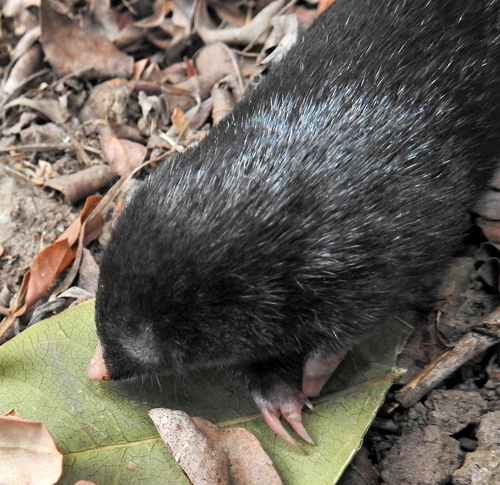
Has a robust, cylindrical body covered in coarse, shaggy grayish-brown to reddish-brown fur, unlike the sleek iridescent coats of many other golden mole species. The snout is broad and leathery, and the limbs are short with strong digging claws on the forefeet.
Size
Body length typically ranges from 15 to 24 cm, including a very short, barely visible tail.
Weight
Weighs approximately 90 to 180 grams, depending on age and sex.
Distinctive features
Distinguished from other golden moles by its notably rough, less glossy fur texture and larger body size within the family. Its coarse coat contrasts with the shimmering, smooth pelage typical of most Chrysochloridae species.
Differences between males and females
Minimal sexual dimorphism; males and females are similar in size and coloration, with only slight variation in body mass.
Behaviour and diet of the Rough-haired Golden Mole
Solitary and territorial, individuals maintain separate burrow systems and avoid contact except during mating encounters.
When it is active
Primarily nocturnal or crepuscular, though much of its activity occurs underground and is not strictly tied to daylight cycles.
Diet
Insectivorous, feeding mainly on earthworms, beetle larvae, termites, and other soil-dwelling invertebrates detected through vibration and scent.
How it feeds and hunts
Uses its sensitive snout and vibration detection to locate prey while tunneling through soil, then quickly seizes invertebrates with its jaws.
Communication
Primarily uses vibrational and tactile cues within tunnel systems, along with scent marking to signal territory and reproductive status; vocalizations are minimal.
Interactions with other species
Predators include birds of prey, snakes, and small carnivorous mammals when moles surface or are exposed by soil disturbance. It may compete with other burrowing insectivores for similar invertebrate prey resources.
Role in its ecosystem
Plays an important ecological role in soil aeration and nutrient cycling through its burrowing activity, while also controlling invertebrate populations in grassland ecosystems.
Reproduction and lifecycle
Breeding likely occurs during warmer, wetter months when food is abundant, with females giving birth to one or two young after a gestation period estimated around 5-6 weeks, though exact data are limited.
Raising the young
Females raise young alone in underground nest chambers, nursing and protecting them until they are capable of independent burrowing and foraging.
Maturity and lifespan
Sexual maturity is reached at around one year of age; lifespan in the wild is estimated at 3-4 years, with limited data from captivity.
Taxonomy and naming of the Rough-haired Golden Mole
Classification
Mammalia > Afrosoricida > Chrysochloridae > Chrysospalax > Chrysospalax villosus
Scientific synonyms
Chrysochloris villosus (Smith, 1846)
What research says
Recent studies
Recent studies have used environmental DNA and camera trap surveys to better map its fragmented distribution and assess habitat quality in KwaZulu-Natal grasslands.
Genome and DNA
Limited genetic studies exist; golden moles as a family show unique chromosomal adaptations linked to their subterranean lifestyle, but species-specific genomic data for C. villosus remain sparse.
Compared with similar species
Compared to its close relative the Giant Golden Mole (Chrysospalax trevelyani), C. villosus is smaller and inhabits grassland rather than forest habitats, and has notably coarser fur.
The Rough-haired Golden Mole and people
Despite being called a 'mole,' it is not related to true moles but belongs to a unique African lineage with iridescent fur in most species. It has no visible eyes or ears, relying entirely on touch and vibration to navigate its underground world. Its digging technique creates distinctive raised ridges in soil rather than visible mole hills.
Where and how to see it
Best observed indirectly by searching for surface ridges and tunnel disturbances in moist grasslands of KwaZulu-Natal, especially after rain when soil is soft; direct sightings are extremely rare due to its subterranean habits.
Risks to humans
No notable risk to humans; it is a small, harmless insectivore with no venom or aggressive behavior.
Countries where the Rough-haired Golden Mole is recorded
The 2 countries named in the range description of its IUCN Red List assessment.
Questions about the Rough-haired Golden Mole
Where does the Rough-haired Golden Mole live?
The Rough-haired Golden Mole is recorded in Eswatini and South Africa across Africa. These countries come from the range description of its IUCN Red List assessment, and they are what place the species on the interactive map.
Is the Rough-haired Golden Mole endangered?
Yes. The IUCN Red List assesses the Rough-haired Golden Mole as Vulnerable, one of the three threatened categories. The species faces a high risk of extinction in the wild. It is the first of the three threatened categories: numbers are falling, the range is shrinking, or the population is small enough that a single bad event could do lasting damage.
How many are left in the wild?
No precise population estimate exists, but the species is considered uncommon and patchily distributed with a declining trend due to habitat loss. This figure comes from the species assessment on the IUCN Red List; population estimates for wild mammals are ranges, not counts, and are revised at each assessment.
What habitat does the Rough-haired Golden Mole live in?
Inhabits moist grasslands, marshy areas, and vegetation along streams and wetlands, often in sandy or loamy soils suitable for burrowing.
What is the scientific name of the Rough-haired Golden Mole?
The Rough-haired Golden Mole is Chrysospalax villosus, in the family Chrysochloridae, order Afrosoricida.
Other species in the genus Chrysospalax

Other species in the family Chrysochloridae



Species that share its range
Sources
Conservation status, range description and population estimate come from the IUCN Red List assessment for Chrysospalax villosus. Countries are derived from that range description, not from a mapped country list. Last refreshed on .
The distribution map is drawn from the IUCN Red List spatial data compiled in 2015. IUCN (International Union for Conservation of Nature)