
Duthie's Golden Mole
Chlorotalpa duthieae
Red List assessment
Vulnerableon the IUCN Red List
- EXExtinct
- EWExtinct in the Wild
- CRCritically Endangered
- ENEndangered
- VUVulnerable
- NTNear Threatened
- LCLeast Concern
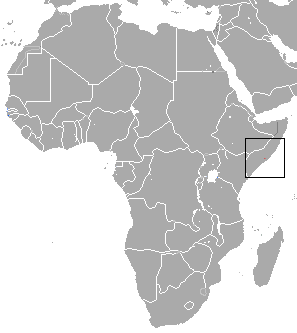
The Duthie's Golden Mole is recorded in one country, South Africa across Africa. The IUCN Red List assesses the Duthie's Golden Mole as Vulnerable. No precise population figures exist due to the species' subterranean and cryptic nature, but the population is inferred to be declining based on habitat loss trends across its limited range.
- Family
- Chrysochloridae
- Order
- Afrosoricida
- Genus
- Chlorotalpa
- Countries recorded
- 1
- Continents
- Africa
- Red List category
- Vulnerable
- Data updated
- August 9, 2026
What is the Duthie's Golden Mole?
Duthie's Golden Mole is a small, subterranean insectivorous mammal endemic to a narrow coastal band of South Africa. It is remarkable for its iridescent fur and highly specialized adaptations for a fully underground lifestyle, including vestigial eyes covered by skin. This species is one of the lesser-known golden moles, with restricted range and limited scientific study due to its cryptic burrowing habits.
Where does the Duthie's Golden Mole live?
South Africa, restricted to a narrow coastal strip of the Western Cape and southern KwaZulu-Natal regions
Endemic to South Africa, occurring in a narrow coastal strip from the southern Cape (around Knysna) extending eastward toward the KwaZulu-Natal south coast. Its range is fragmented and limited to suitable soil habitats along this coastal belt.
Altitude and depth
Occurs from sea level to approximately 300 meters elevation; as a burrowing species, it typically forages 5-20 cm below the soil surface, occasionally deeper.
Seasonal movements
No pronounced migratory behavior; activity may increase after rains when soil moisture facilitates burrowing and invertebrate availability increases.
Habitat of the Duthie's Golden Mole
Inhabits coastal forest, fynbos, and moist grassland with sandy or loamy soils suitable for burrowing. Prefers areas with good soil moisture and organic content that support invertebrate prey populations. Found in both indigenous forest edges and adjacent disturbed habitats within its narrow range.
Adaptations to its environment
Possesses a streamlined, robust body with powerful forelimbs and claws for digging, a leathery nose pad for pushing soil, and vestigial eyes covered by skin to prevent soil damage. Dense, water-repellent fur reduces soil adhesion, and specialized inner ear bones aid in detecting vibrations from prey underground.
Conservation status and numbers
Classified as Vulnerable (VU) by IUCN due to its restricted and fragmented distribution, ongoing habitat loss from urban and agricultural expansion, and small, declining population size within its narrow coastal range.
Estimated population
No precise population figures exist due to the species' subterranean and cryptic nature, but the population is inferred to be declining based on habitat loss trends across its limited range.
What threatens the Duthie's Golden Mole?
Primary threats include habitat destruction from coastal development, agriculture, and plantation forestry, as well as habitat fragmentation reducing connectivity between populations. Soil compaction and chemical pollutants from farming may also degrade suitable burrowing habitat.
Diseases and parasites
Specific disease and parasite data are largely unknown, though golden moles as a group can host various ectoparasites such as mites and endoparasitic worms.
What is being done to protect it?
Some populations occur within protected areas such as forest reserves along the southern Cape coast, offering incidental protection. Habitat conservation initiatives targeting coastal fynbos and forest ecosystems indirectly benefit this species.
Recommended actions
Recommended actions include systematic surveys to better estimate population size and distribution, protection of remaining coastal habitat fragments, and inclusion of golden mole habitat needs in regional land-use planning and development approvals.
What the Duthie's Golden Mole looks like
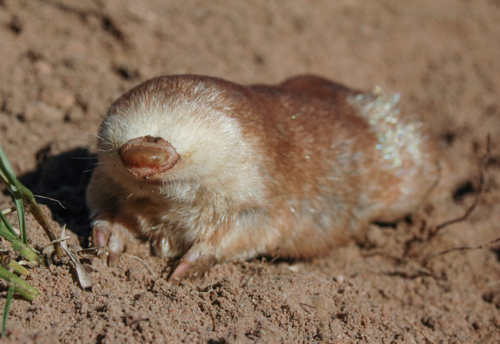
The fur has a distinctive iridescent sheen, often appearing bronze, coppery, or greenish depending on lighting, a hallmark of golden moles. The body is cylindrical and compact, with no external ears or visible eyes, and the forefeet bear enlarged digging claws.
Size
Body length ranges from approximately 12 to 14 cm, with a very short, inconspicuous tail typical of golden moles.
Weight
Adults typically weigh between 30 and 60 grams.
Distinctive features
Distinguished from related Chlorotalpa and Amblysomus species by subtle differences in skull morphology, fur coloration, and specific distribution range along the southern Cape coast. Genetic and cranial studies are often required to confidently separate it from morphologically similar golden mole species.
Differences between males and females
Sexual dimorphism is minimal, with males and females showing very similar size and coloration.
Behaviour and diet of the Duthie's Golden Mole
Generally solitary, with individuals maintaining separate burrow systems and defending territory from conspecifics outside of breeding encounters.
When it is active
Primarily active both day and night in short bursts underground, as activity is driven more by foraging needs and soil conditions than by light cycles.
Diet
Insectivorous, feeding mainly on earthworms, insect larvae, termites, and other soil-dwelling invertebrates encountered while tunneling.
How it feeds and hunts
Uses acute vibrational and tactile senses to detect prey movement in soil, tunneling actively to locate and capture invertebrates rather than relying on sight or scent alone.
Communication
Communication likely relies on vibrational cues transmitted through soil, along with limited vocalizations and scent marking to signal territory or reproductive status.
Interactions with other species
Predators likely include owls, snakes, and small carnivorous mammals that can access or dig into shallow burrow systems. Competes indirectly with other burrowing invertebrate-feeders for soil resources.
Role in its ecosystem
Plays an important role in soil aeration and turnover through its burrowing activity, and helps regulate invertebrate populations, contributing to nutrient cycling in coastal forest and fynbos ecosystems.
Reproduction and lifecycle
Breeding biology is poorly documented, but likely follows the general golden mole pattern of producing small litters of 1-2 young per breeding event, with breeding possibly linked to rainy seasons when soil conditions are favorable.
Raising the young
Presumed that females provide sole parental care, nursing and protecting young within the burrow until they are capable of independent foraging, though detailed studies are lacking.
Maturity and lifespan
Age of sexual maturity is not precisely documented but is estimated at under one year based on related species; lifespan in the wild is unknown but likely several years, similar to other small golden moles.
Taxonomy and naming of the Duthie's Golden Mole
Classification
Mammalia > Afrosoricida > Chrysochloridae > Chlorotalpa > Chlorotalpa duthieae
Scientific synonyms
Amblysomus duthieae; formerly classified under genus Amblysomus before revision to Chlorotalpa
What research says
Recent studies
Recent taxonomic revisions using molecular phylogenetics have helped refine the classification of golden mole species, including reassessment of Chlorotalpa duthieae's relationships to other southern African golden moles.
Genome and DNA
Genetic studies have contributed to clarifying its placement within Chlorotalpa versus Amblysomus, but detailed genomic data specific to this species remain limited.
Compared with similar species
Similar in general form to other golden moles such as Amblysomus species, but distinguished by subtle cranial features and a more restricted coastal distribution; overall golden moles share convergent traits with other subterranean mammals like true moles despite being unrelated.
The Duthie's Golden Mole and people
Despite its name, this mole is not truly golden but displays an iridescent sheen caused by structural properties of its fur. It has no functional external eyes, relying entirely on touch and vibration to navigate its underground world. It belongs to the Afrotheria, a group that also includes elephants and aardvarks, despite its tiny size.
Where and how to see it
Direct observation is extremely difficult due to its subterranean lifestyle; the best evidence of presence is raised soil ridges or molehill-like mounds in coastal forest and fynbos habitats after rain. Researchers typically use live-trapping methods for study rather than visual observation.
Risks to humans
No notable risk to humans; it is a harmless, non-aggressive small mammal that avoids contact with humans.
Countries where the Duthie's Golden Mole is recorded
The 1 countries named in the range description of its IUCN Red List assessment.
Questions about the Duthie's Golden Mole
Where does the Duthie's Golden Mole live?
The Duthie's Golden Mole is recorded in South Africa across Africa. These countries come from the range description of its IUCN Red List assessment, and they are what place the species on the interactive map.
Is the Duthie's Golden Mole endangered?
Yes. The IUCN Red List assesses the Duthie's Golden Mole as Vulnerable, one of the three threatened categories. The species faces a high risk of extinction in the wild. It is the first of the three threatened categories: numbers are falling, the range is shrinking, or the population is small enough that a single bad event could do lasting damage.
How many are left in the wild?
No precise population figures exist due to the species' subterranean and cryptic nature, but the population is inferred to be declining based on habitat loss trends across its limited range. This figure comes from the species assessment on the IUCN Red List; population estimates for wild mammals are ranges, not counts, and are revised at each assessment.
What habitat does the Duthie's Golden Mole live in?
Inhabits coastal forest, fynbos, and moist grassland with sandy or loamy soils suitable for burrowing.
What is the scientific name of the Duthie's Golden Mole?
The Duthie's Golden Mole is Chlorotalpa duthieae, in the family Chrysochloridae, order Afrosoricida.
Other species in the genus Chlorotalpa

Other species in the family Chrysochloridae


Species that share its range
Sources
Conservation status, range description and population estimate come from the IUCN Red List assessment for Chlorotalpa duthieae. Countries are derived from that range description, not from a mapped country list. Last refreshed on .
The distribution map is drawn from the IUCN Red List spatial data compiled in 2008. IUCN (International Union for Conservation of Nature)