
African Wild Dog
Lycaon pictus
Red List assessment
Endangeredon the IUCN Red List
- EXExtinct
- EWExtinct in the Wild
- CRCritically Endangered
- ENEndangered
- VUVulnerable
- NTNear Threatened
- LCLeast Concern
The African Wild Dog is recorded in 8 countries across Africa. The IUCN Red List assesses the African Wild Dog as Endangered. Approximately 6,600 individuals remaining in the wild (roughly 1,400 mature individuals), with a declining population trend across most range states.
- Family
- Canidae
- Order
- Carnivora
- Genus
- Lycaon
- Countries recorded
- 8
- Continents
- Africa
- Red List category
- Endangered
- Data updated
- August 9, 2026
What is the African Wild Dog?
The African Wild Dog is a highly social canid known for its distinctive mottled coat pattern, unique among carnivores with each individual having a different pattern. It is one of Africa's most efficient predators with a hunting success rate far exceeding lions. Once widespread across Africa, it now survives in fragmented populations and is one of the continent's most endangered carnivores.
Where does the African Wild Dog live?
Sub-Saharan Africa, primarily Southern and East Africa including Zimbabwe, Botswana, Tanzania, Mozambique, South Africa, and Zambia
Historically found throughout sub-Saharan Africa from Sahara margins to South Africa; now restricted mainly to Southern Africa (Botswana, Zimbabwe, Namibia, South Africa) and East Africa (Tanzania, Kenya), with small populations in Mozambique and Zambia.
Altitude and depth
0-2000m, generally found in lowland savanna ecosystems
Seasonal movements
Breeding typically occurs in the dry season (March-June in Southern Africa) when prey is more concentrated; denning behavior restricts pack movement during pup-rearing period.
Habitat of the African Wild Dog
Open savanna, grassland, semi-arid regions, and open woodland; avoids dense forest due to reliance on visual hunting and long-distance chase strategies. Requires large territories with abundant medium-sized ungulate prey.
Adaptations to its environment
Large rounded ears aid in heat dissipation and long-distance hearing; lean, long-legged build enables sustained high-speed pursuit over long distances. Unique four-toed feet (missing dewclaw) enhance running efficiency.
Conservation status and numbers
Endangered (EN) according to IUCN, with population declining due to habitat fragmentation, human conflict, and disease. Considered one of the most endangered carnivores in Africa with continuing range contraction.
Estimated population
Approximately 6,600 individuals remaining in the wild (roughly 1,400 mature individuals), with a declining population trend across most range states.
What threatens the African Wild Dog?
Habitat loss and fragmentation, human-wildlife conflict (retaliatory killing for livestock predation), infectious diseases from domestic dogs (rabies, canine distemper), road mortality, and competition with larger predators like lions and hyenas.
Diseases and parasites
Highly susceptible to rabies and canine distemper virus, often contracted from domestic dogs; can also carry various endoparasites and ectoparasites including ticks and intestinal worms.
What is being done to protect it?
Protected in numerous national parks and reserves (Kruger, Hwange, Selous); regional conservation initiatives like the Range Wide Conservation Program for African Wild Dogs and Cheetah; vaccination programs for domestic dogs near reserve boundaries; transboundary corridor projects.
Recommended actions
Expand and connect protected areas through wildlife corridors, implement community-based conflict mitigation programs, enhance disease surveillance and vaccination of domestic dogs, and strengthen anti-poaching and snare removal efforts.
What the African Wild Dog looks like
Short, coarse coat with irregular blotches of black, yellow, white, and brown; each individual has a unique coat pattern. Large rounded ears, bushy white-tipped tail, and long legs built for endurance running.
Size
Body length 71-112 cm, shoulder height 61-78 cm, tail length 30-41 cm
Weight
17-36 kg, with males slightly larger than females on average
Distinctive features
Distinguished from other African canids by its unique multicolored, blotched coat pattern, large rounded ears, and only four toes on each foot (lacking the dewclaw present in most canids).
Differences between males and females
Minimal sexual dimorphism; males are slightly larger and heavier than females, but coat pattern and general appearance are similar between sexes.
Behaviour and diet of the African Wild Dog
Highly social, living in packs of typically 6-20 individuals (sometimes larger), with a dominant breeding pair and a strict linear hierarchy. Packs cooperate extensively in hunting, pup-rearing, and defense.
When it is active
Primarily diurnal and crepuscular, hunting mainly at dawn and dusk to avoid heat and reduce competition with nocturnal predators like lions.
Diet
Carnivorous, preying mainly on medium-sized ungulates such as impala, kudu, wildebeest calves, and other antelope species; occasionally takes smaller mammals.
How it feeds and hunts
Cooperative pack hunting using stamina-based pursuit, chasing prey over long distances until exhaustion; highly coordinated with role specialization and one of the highest hunting success rates among large carnivores (up to 80%).
Communication
Uses a range of vocalizations including a distinctive 'hoo' contact call, twittering sounds, and greeting rituals; also communicates through body language, scent marking, and touch.
Interactions with other species
Competes with and is often killed by lions and spotted hyenas, which are major sources of pup and adult mortality; occasionally scavenged upon by vultures and hyenas after kills.
Role in its ecosystem
Functions as a key mesopredator that helps regulate ungulate populations; its high hunting efficiency and pack behavior make it an important part of savanna predator-prey dynamics.
Reproduction and lifecycle
Breeding season varies by region but often coincides with dry season; gestation lasts about 69-73 days, producing litters of 6-16 pups (largest litters among canids); pups are weaned around 5-10 weeks.
Raising the young
Only the dominant female typically breeds; the entire pack participates in raising pups, including regurgitating food for them and guarding the den. Subordinate adults, including non-breeding males, provide substantial alloparental care.
Maturity and lifespan
Sexual maturity around 12-18 months, though dispersal usually occurs before breeding; average lifespan in the wild is 10-11 years, similar or slightly less in captivity.
Taxonomy and naming of the African Wild Dog
Classification
Class Mammalia > Order Carnivora > Family Canidae > Genus Lycaon > Species Lycaon pictus
Subspecies
Some taxonomies recognize regional variants such as Lycaon pictus pictus (Southern Africa), Lycaon pictus lupinus (East Africa), and Lycaon pictus sharicus (West Africa), though genetic studies suggest limited subspecies differentiation.
Scientific synonyms
Hyaena picta (original description by Temminck, 1820)
What research says
Recent studies
Recent research has focused on disease transmission dynamics with domestic dogs, GPS-collar studies revealing extensive home ranges (up to 1,500 km²), and social network analysis of pack cooperative behavior.
Genome and DNA
Diploid chromosome number of 78 (2n=78), similar to other canids; genetic studies reveal relatively low genetic diversity in some fragmented populations, raising conservation concerns.
Compared with similar species
Distinct from domestic dogs and wolves by its unique four-toed feet, larger rounded ears, and highly variable coat pattern; unlike solitary hunters like leopards, it relies almost entirely on cooperative pack hunting.
The African Wild Dog and people
African Wild Dogs have one of the most successful hunting strategies among large carnivores, succeeding in up to 80% of hunts compared to lions' 30%. Their scientific name Lycaon pictus means 'painted wolf,' referencing their unique multicolored coat. Pack members engage in elaborate greeting ceremonies with excited vocalizations before hunting.
Where and how to see it
Best observed in dedicated wildlife reserves such as Kruger National Park (South Africa), Hwange National Park (Zimbabwe), or the Selous/Nyerere ecosystem (Tanzania) during early morning or late afternoon hunting hours, particularly during the dry season when prey concentrates near water sources.
Risks to humans
No notable risk to humans; wild dogs are generally not aggressive toward people and avoid human contact, though they may prey on livestock in areas near human settlements.
Human uses
Limited direct utilization by humans; primarily valued for ecotourism in wildlife reserves, though historically persecuted as vermin due to perceived threats to livestock.
Myths and legends
In some African folklore, the wild dog is seen as a symbol of teamwork and loyalty due to its strong pack cooperation; in other traditions it has been viewed negatively as a pest due to livestock predation, contributing to historic persecution.
Countries where the African Wild Dog is recorded
The 8 countries named in the range description of its IUCN Red List assessment.
Questions about the African Wild Dog
Where does the African Wild Dog live?
The African Wild Dog is recorded in Botswana, Kenya, Mozambique, Namibia and South Africa, among 8 countries in total across Africa. These countries come from the range description of its IUCN Red List assessment, and they are what place the species on the interactive map.
Is the African Wild Dog endangered?
Yes. The IUCN Red List assesses the African Wild Dog as Endangered, one of the three threatened categories. The species faces a very high risk of extinction in the wild — a step below Critically Endangered, but still on a trajectory that ends badly without intervention.
How many are left in the wild?
Approximately 6,600 individuals remaining in the wild (roughly 1,400 mature individuals), with a declining population trend across most range states. This figure comes from the species assessment on the IUCN Red List; population estimates for wild mammals are ranges, not counts, and are revised at each assessment.
What habitat does the African Wild Dog live in?
Open savanna, grassland, semi-arid regions, and open woodland; avoids dense forest due to reliance on visual hunting and long-distance chase strategies.
What is the scientific name of the African Wild Dog?
The African Wild Dog is Lycaon pictus, in the family Canidae, order Carnivora.
Other species in the family Canidae
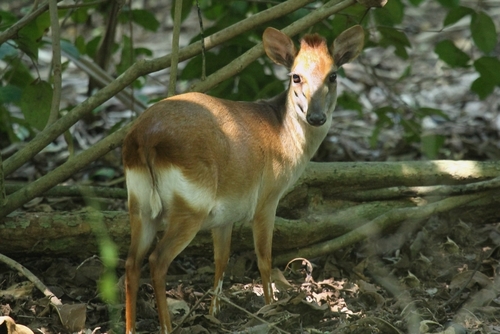
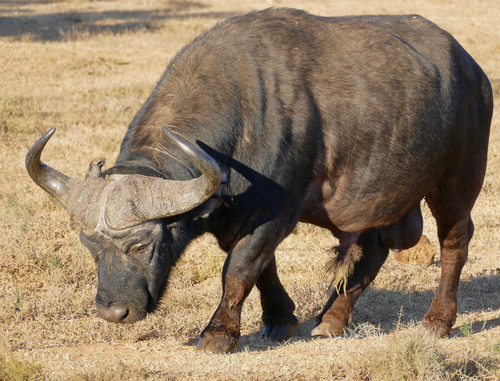
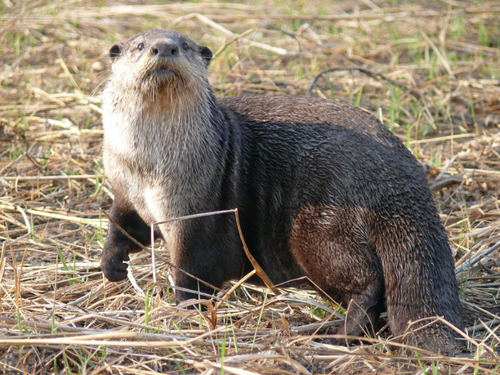
Species that share its range

Sources
Conservation status, range description and population estimate come from the IUCN Red List assessment for Lycaon pictus. Countries are derived from that range description, not from a mapped country list. Last refreshed on .
The distribution map is drawn from the IUCN Red List spatial data compiled in 2025. IUCN Canid Specialist Group