
Gunning's Golden Mole
Neamblysomus gunningi
Red List assessment
Endangeredon the IUCN Red List
- EXExtinct
- EWExtinct in the Wild
- CRCritically Endangered
- ENEndangered
- VUVulnerable
- NTNear Threatened
- LCLeast Concern
The Gunning's Golden Mole is recorded in one country, South Africa across Africa. The IUCN Red List assesses the Gunning's Golden Mole as Endangered. No reliable population estimate exists.
- Family
- Chrysochloridae
- Order
- Afrosoricida
- Genus
- Neamblysomus
- Countries recorded
- 1
- Continents
- Africa
- Red List category
- Endangered
- Data updated
- August 9, 2026
What is the Gunning's Golden Mole?
Gunning's Golden Mole is a small, highly specialized, fossorial (subterranean) mammal endemic to an extremely restricted area of the Limpopo Province of South Africa, centered on the Afromontane forests and grasslands of the Haenertsburg and Woodbush region. It belongs to the family Chrysochloridae — the golden moles — which, despite superficial resemblance to true moles, belong to the superorder Afrotheria and are more closely related to elephants, hyraxes, and manatees. The species is remarkable for one of the smallest known geographic ranges of any South African mammal, rendering it highly vulnerable to habitat loss. It was named in honor of John W.B. Gunning (1860–1920), the first Director of the Transvaal Museum in Pretoria.
Where does the Gunning's Golden Mole live?
South Africa, Limpopo Province — specifically the Haenertsburg and Woodbush Forest area near Tzaneen
Extremely restricted range confined to the Haenertsburg–Woodbush Forest complex in the Limpopo Province of South Africa. The estimated extent of occurrence is fewer than 100 km², making it one of the most geographically limited mammal species on the African continent.
Altitude and depth
Found at elevations of approximately 1,400–1,800 m above sea level along the Drakensberg escarpment foothills in Limpopo.
Habitat of the Gunning's Golden Mole
Occupies moist Afromontane forest, forest margins, and adjacent montane grasslands in the escarpment zone of Limpopo Province. It depends on deep, friable, humus-rich, and permanently moist soils suitable for burrowing, particularly within and immediately surrounding intact indigenous forest patches such as Woodbush Forest.
Adaptations to its environment
Displays classic chrysochlorid adaptations to underground life: massively developed forelimbs with enlarged, pick-like claws for digging, vestigial eyes permanently covered by fused hairy skin, no external pinnae, and a tough leathery rhinarium (nose pad) for pushing through soil. Its hypertrophied malleus and other specialized middle ear ossicles provide exceptional sensitivity to seismic vibrations, enabling prey detection and navigation underground without relying on vision or airborne sound. Dense, water-repellent, iridescent fur protects against soil abrasion and moisture.
Conservation status and numbers
Endangered (EN) on the IUCN Red List. The species qualifies under criteria B1ab(i,ii,iii) due to an extent of occurrence estimated below 5,000 km², a single known location, and a continuing decline in the extent and quality of its habitat driven by land conversion and plantation forestry.
Estimated population
No reliable population estimate exists. The total number of mature individuals is suspected to be very small — potentially fewer than 2,500 — given the extremely limited geographic range. The population trend is inferred to be declining in line with ongoing habitat degradation.
What threatens the Gunning's Golden Mole?
The primary threats are commercial timber plantations (pine and eucalyptus) replacing indigenous forest and grassland, agricultural land conversion, expanding human settlements around Tzaneen and Haenertsburg, soil compaction from livestock grazing which reduces burrowing habitat suitability, and predation pressure from introduced domestic cats and dogs near human habitation.
What is being done to protect it?
The species receives legal protection under South Africa's National Environmental Management: Biodiversity Act (NEMBA) and is listed on the IUCN Red List, which raises international awareness. Parts of the Woodbush Forest may fall under provincial or state forestry protection, offering indirect habitat security. No dedicated species-specific conservation programme is currently known to be in place.
Recommended actions
Priority actions include comprehensive field surveys using pitfall traps, tracking tunnels, and soil sampling to accurately delimit the species' range and estimate population size; legal protection and restoration of Afromontane forest and grassland habitat in the Woodbush area; control of invasive alien plants and introduced predators; raising awareness among local landowners; and developing a formal Species Conservation Plan under South African biodiversity legislation.
What the Gunning's Golden Mole looks like
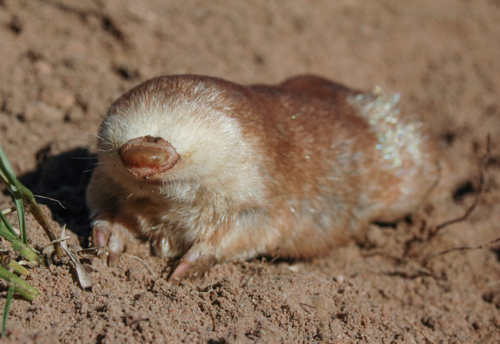
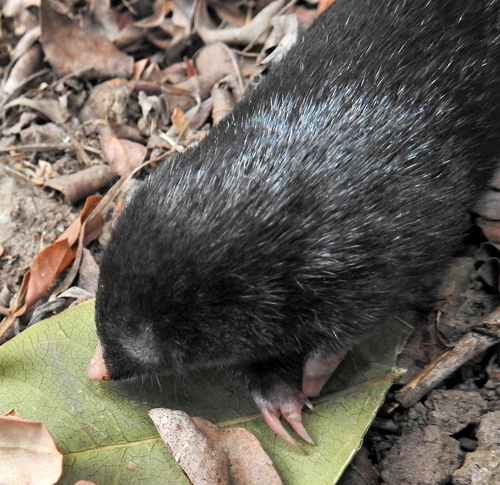
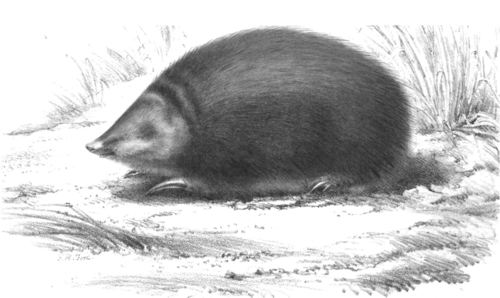
The body is compact, cylindrical, and streamlined with no visible neck or external tail. The fur is dense, silky, and short, displaying the characteristic iridescent sheen of golden moles — shifting between bronzy, greenish, and coppery tones under light. The muzzle terminates in a hardened leathery pad, the eyes are invisible beneath the skin, and the forelimbs are short and powerfully built with prominent enlarged claws.
Size
Head-body length estimated at approximately 110–130 mm; tail is absent externally, as is typical across golden moles.
Weight
Estimated body weight approximately 40–75 g, inferred from measurements of closely related Neamblysomus species; precise data for this species are unavailable.
Distinctive features
Distinguished from its congener Juliana's Golden Mole (Neamblysomus julianae) primarily by geographic range; morphological and skull characteristics (e.g., palatal width, tooth morphology) separate the two species. Compared to the larger Amblysomus genus, Neamblysomus species tend to have subtly different cranial proportions and genetic divergence confirmed by molecular studies.
Behaviour and diet of the Gunning's Golden Mole
Strictly solitary and territorial, as is universal among golden moles. Individual animals maintain exclusive burrow systems and interact with conspecifics only during brief breeding encounters.
When it is active
Entirely subterranean; surface activity is rare and presumably dangerous. Like other golden moles, it likely constructs shallow foraging galleries close to the soil surface during periods of earthworm activity, and deeper permanent burrows for resting and nesting. No strict diurnal or nocturnal pattern is established for this species.
Diet
Carnivorous and insectivorous, feeding primarily on earthworms, insect larvae (especially beetle grubs), and other soil-dwelling invertebrates encountered while tunneling through moist forest soil.
How it feeds and hunts
Forages by actively tunneling through soft soil and detecting prey via seismic sensitivity (vibrations transmitted through the substrate to its hypertrophied malleus) and tactile mechanoreception through the leathery rhinarium. It captures prey by seizing it with the jaws without the use of vision.
Communication
Communication is primarily olfactory and tactile, consistent with a subterranean lifestyle where vision and airborne acoustics are of little utility. Scent marking of burrow systems likely delineates individual territories. Some ultrasonic or low-frequency vocalizations may occur but are undocumented for this species.
Interactions with other species
Likely preyed upon by boomslang (Dispholidus typus) and other forest snakes, and by raptors and small carnivorous mammals when briefly above ground. As a predator of soil invertebrates, it contributes to regulating earthworm and insect larva populations. Its burrowing activity aerates and mixes soil, providing an important ecosystem engineering service in the forest floor.
Role in its ecosystem
Functions as a meso-predator of soil invertebrates and as an ecosystem engineer through extensive burrowing, which improves soil structure, aeration, and water infiltration in Afromontane forest and grassland habitats.
Reproduction and lifecycle
Reproductive biology is poorly documented for this species. Golden moles generally produce small litters of 1–3 altricial young, born in a grass-lined nest chamber within the deep permanent burrow. Breeding is thought to be loosely seasonal, potentially coinciding with peak earthworm availability after rains. Gestation duration is unknown for N. gunningi.
Raising the young
Young are born altricial and helpless, cared for exclusively by the mother in the nest burrow until weaning and independence. The duration of maternal care is undocumented for this species but is likely several weeks, consistent with related chrysochlorids.
Maturity and lifespan
Unknown specifically for this species. Related golden moles are thought to reach sexual maturity at approximately 1 year of age and may live 3–5 years in the wild; no captive longevity data are available for N. gunningi.
Taxonomy and naming of the Gunning's Golden Mole
Classification
Mammalia > Afrosoricida > Chrysochloridae > Neamblysomus > Neamblysomus gunningi
Scientific synonyms
Amblysomus gunningi Broom, 1908 — originally described under the genus Amblysomus before molecular phylogenetic work justified its transfer to Neamblysomus.
What research says
Recent studies
Scientific study of this species remains extremely limited owing to its rarity, restricted range, and cryptic fossorial lifestyle. IUCN Red List reassessments have consistently maintained Endangered status and underscored the urgent need for dedicated field surveys. No major recent ecological or behavioral studies have been published specifically on N. gunningi.
Genome and DNA
No published chromosome count or dedicated genomic study is available for Neamblysomus gunningi. Molecular phylogenetic analyses using mitochondrial and nuclear markers have confirmed the validity of the genus Neamblysomus as distinct from Amblysomus and established the position of Chrysochloridae within the superorder Afrotheria.
Compared with similar species
Most closely related to Juliana's Golden Mole (Neamblysomus julianae), which is also Endangered and similarly restricted to small areas of South Africa (Gauteng and Mpumalanga). Both species are smaller and more genetically distinct than the more widespread Hottentot Golden Mole (Amblysomus hottentotus), which occupies a much broader range across South Africa. All golden moles (family Chrysochloridae) are convergently similar to unrelated true moles (Talpidae) of the Northern Hemisphere — a classic example of evolutionary convergence.
The Gunning's Golden Mole and people
1) Despite spending their entire lives in darkness underground, Gunning's Golden Mole — like all chrysochlorids — possesses brilliantly iridescent fur that shimmers with metallic copper, green, and bronze hues when struck by light, a phenomenon with no clear adaptive explanation. 2) Golden moles belong to the superorder Afrotheria, making them more closely related to elephants, sea cows, and aardvarks than to European moles or shrews — a remarkable example of how similar lifestyles can evolve from very different ancestors. 3) The species' entire known global range may fit within the area of a small town, making it one of the most spatially restricted mammals on Earth.
Where and how to see it
Gunning's Golden Mole is extraordinarily difficult to observe directly due to its fully subterranean lifestyle and vanishingly small range. The best approach is to search for characteristic meandering surface ridges of shallow foraging tunnels in moist, humus-rich soil within and around the Woodbush Forest near Haenertsburg, Limpopo Province, particularly after heavy rainfall when earthworms are active near the surface. Handle the habitat with extreme care; no excavation of burrows should ever be attempted given the species' Endangered status.
Risks to humans
No notable risk to humans. It may deliver a small bite if mishandled, but poses no significant danger. It carries no known zoonotic diseases of concern.
Countries where the Gunning's Golden Mole is recorded
The 1 countries named in the range description of its IUCN Red List assessment.
Questions about the Gunning's Golden Mole
Where does the Gunning's Golden Mole live?
The Gunning's Golden Mole is recorded in South Africa across Africa. These countries come from the range description of its IUCN Red List assessment, and they are what place the species on the interactive map.
Is the Gunning's Golden Mole endangered?
Yes. The IUCN Red List assesses the Gunning's Golden Mole as Endangered, one of the three threatened categories. The species faces a very high risk of extinction in the wild — a step below Critically Endangered, but still on a trajectory that ends badly without intervention.
How many are left in the wild?
No reliable population estimate exists. This figure comes from the species assessment on the IUCN Red List; population estimates for wild mammals are ranges, not counts, and are revised at each assessment.
What habitat does the Gunning's Golden Mole live in?
Occupies moist Afromontane forest, forest margins, and adjacent montane grasslands in the escarpment zone of Limpopo Province.
What is the scientific name of the Gunning's Golden Mole?
The Gunning's Golden Mole is Neamblysomus gunningi, in the family Chrysochloridae, order Afrosoricida.
Other species in the genus Neamblysomus
Other species in the family Chrysochloridae



Species that share its range
Sources
Conservation status, range description and population estimate come from the IUCN Red List assessment for Neamblysomus gunningi. Countries are derived from that range description, not from a mapped country list. Last refreshed on .
The distribution map is drawn from the IUCN Red List spatial data compiled in 2008. IUCN (International Union for Conservation of Nature)