
De Winton's Golden Mole
Cryptochloris wintoni
Red List assessment
Critically Endangeredon the IUCN Red List
- EXExtinct
- EWExtinct in the Wild
- CRCritically Endangered
- ENEndangered
- VUVulnerable
- NTNear Threatened
- LCLeast Concern
The De Winton's Golden Mole is recorded in one country, South Africa across Africa. The IUCN Red List assesses the De Winton's Golden Mole as Critically Endangered. Population size is unknown; the species was undetected for decades and only reconfirmed alive in 2023, with no reliable abundance estimates currently available.
- Family
- Chrysochloridae
- Order
- Afrosoricida
- Genus
- Cryptochloris
- Countries recorded
- 1
- Continents
- Africa
- Red List category
- Critically Endangered
- Data updated
- August 9, 2026
What is the De Winton's Golden Mole?
De Winton's Golden Mole is a tiny, blind, subterranean mammal endemic to a narrow coastal strip of South Africa's Northern Cape. It is remarkable for having been feared extinct for nearly 90 years until its rediscovery in 2023 via environmental DNA and detection dogs. Its iridescent, water-repellent fur and complete adaptation to a sand-swimming lifestyle make it one of the most unusual mammals in Africa. It is currently one of the rarest and most poorly known mammals on Earth.
Where does the De Winton's Golden Mole live?
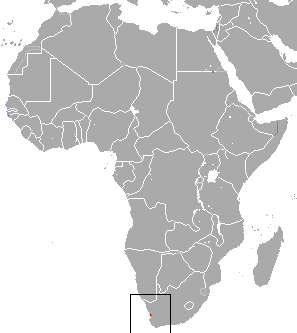
Endemic to a small stretch of the west coast of South Africa, primarily around Port Nolloth in the Northern Cape province.
Restricted to a very small coastal area near Port Nolloth in the Northern Cape province of South Africa, with historical records extending slightly north and south along the coastline.
Altitude and depth
Lives at sea level in coastal dune habitats, moving through sand at shallow subsurface depths, typically within the top few centimeters to tens of centimeters of sand.
Habitat of the De Winton's Golden Mole
Coastal sand dunes with loose, shifting sands, often near the shoreline where vegetation is sparse. It requires soft, unconsolidated substrate that allows it to 'swim' through the sand rather than dig permanent tunnels.
Adaptations to its environment
Has a streamlined, fusiform body, no external ears or eyes (which are covered by skin and fur), and a tough keratinous pad on the nose used to push through sand. Its fur is dense, silky, and water-repellent, reducing friction as it swims through loose dune sand.
Conservation status and numbers
Listed as Critically Endangered by the IUCN due to its extremely restricted range, ongoing habitat destruction, and near-total lack of recent population data prior to its 2023 rediscovery.
Estimated population
Population size is unknown; the species was undetected for decades and only reconfirmed alive in 2023, with no reliable abundance estimates currently available.
What threatens the De Winton's Golden Mole?
Primary threats include alluvial diamond mining along the coast, coastal development, and habitat degradation from off-road vehicle use on dunes, all of which destroy or fragment its narrow sandy habitat.
What is being done to protect it?
The Endangered Wildlife Trust and Stellenbosch University led a rediscovery project using environmental DNA sampling and scent-detection dogs, which successfully located living individuals in 2023, spurring renewed conservation attention.
Recommended actions
Priority actions include formal habitat protection in its known range, restrictions on coastal mining and vehicle traffic, expanded eDNA surveys to map its distribution, and long-term population monitoring.
What the De Winton's Golden Mole looks like
Small, cylindrical body covered in dense, silky fur that has a metallic golden-to-bronze iridescent sheen. It has no visible eyes or external ears, and a hardened nose pad used for burrowing.
Size
Approximately 8-9 cm in body length, making it one of the smallest golden mole species.
Weight
Estimated body weight around 20-30 grams, though precise data are limited due to rarity of specimens.
Distinctive features
Distinguished from other golden moles by its very pale, almost cream-to-golden fur coloration and its restricted coastal dune habitat, as opposed to inland or forested habitats used by related species.
Behaviour and diet of the De Winton's Golden Mole
Believed to be solitary, as is typical for golden moles, coming together only briefly for mating.
When it is active
Likely active both day and night underground, since subterranean life reduces the relevance of typical diurnal/nocturnal light cues, though specific activity patterns remain poorly studied.
Diet
Insectivorous, feeding primarily on small invertebrates such as beetle larvae, termites, and other soil-dwelling insects encountered while moving through the sand.
How it feeds and hunts
Forages by 'swimming' through loose sand, detecting prey through vibrations and possibly scent, then capturing invertebrates encountered along its subsurface path.
Communication
Communication is presumed to rely on vibrational and tactile cues given its blindness and subterranean lifestyle, though no detailed studies have been conducted.
Interactions with other species
Potential predators include birds of prey, snakes, and small carnivorous mammals that may dig or ambush moles near the surface; specific documented interactions are lacking.
Role in its ecosystem
Plays a role in soil aeration and invertebrate population control within its dune ecosystem, contributing to nutrient cycling in a nutrient-poor coastal environment.
Reproduction and lifecycle
Reproductive biology is virtually unknown; based on related golden mole species, litters are likely small (one or two young) with no defined breeding season confirmed.
Raising the young
No detailed data exists, but as with other golden moles, the female likely raises the young alone in an underground nest without paternal involvement.
Maturity and lifespan
Specific data on age of sexual maturity and lifespan are unavailable, though related golden mole species are estimated to live several years in the wild.
Taxonomy and naming of the De Winton's Golden Mole
Classification
Class Mammalia > Order Afrosoricida > Family Chrysochloridae > Genus Cryptochloris > Species Cryptochloris wintoni
Scientific synonyms
Originally described as Chrysochloris wintoni by Broom in 1907; later reclassified into the genus Cryptochloris.
What research says
Recent studies
A landmark 2023 study using environmental DNA and detection dogs confirmed the species' survival after nearly 90 years without a verified sighting, marking a major rediscovery in mammalian conservation.
Genome and DNA
Genetic material recovered via environmental DNA sampling was key to confirming the species' continued existence in 2023, though a full genome has not yet been sequenced.
Compared with similar species
Similar to other golden moles such as Grant's golden mole (Eremitalpa granti), but distinguished by its more restricted coastal range and distinct fur coloration; both species share sand-swimming adaptations.
The De Winton's Golden Mole and people
De Winton's Golden Mole was rediscovered using pioneering environmental DNA techniques and trained detection dogs after being unseen for almost a century. Its fur has a shimmering, almost metallic golden appearance despite living permanently underground. It is completely blind, with skin covering vestigial eyes.
Where and how to see it
Due to its critically endangered status, extreme rarity, and fully subterranean lifestyle, direct observation in the wild is essentially impossible for the public; sightings are limited to specialized research teams using eDNA and detection dogs near Port Nolloth.
Risks to humans
No notable risk to humans.
Countries where the De Winton's Golden Mole is recorded
The 1 countries named in the range description of its IUCN Red List assessment.
Questions about the De Winton's Golden Mole
Where does the De Winton's Golden Mole live?
The De Winton's Golden Mole is recorded in South Africa across Africa. These countries come from the range description of its IUCN Red List assessment, and they are what place the species on the interactive map.
Is the De Winton's Golden Mole endangered?
Yes. The IUCN Red List assesses the De Winton's Golden Mole as Critically Endangered, one of the three threatened categories. The species faces an extremely high risk of extinction in the wild. This is the last category before extinction, and it is reached through a very small or steeply declining population, a tiny range, or both.
How many are left in the wild?
Population size is unknown; the species was undetected for decades and only reconfirmed alive in 2023, with no reliable abundance estimates currently available. This figure comes from the species assessment on the IUCN Red List; population estimates for wild mammals are ranges, not counts, and are revised at each assessment.
What habitat does the De Winton's Golden Mole live in?
Coastal sand dunes with loose, shifting sands, often near the shoreline where vegetation is sparse.
What is the scientific name of the De Winton's Golden Mole?
The De Winton's Golden Mole is Cryptochloris wintoni, in the family Chrysochloridae, order Afrosoricida.
Other species in the genus Cryptochloris
Other species in the family Chrysochloridae




Species that share its range
Sources
Conservation status, range description and population estimate come from the IUCN Red List assessment for Cryptochloris wintoni. Countries are derived from that range description, not from a mapped country list. Last refreshed on .
The distribution map is drawn from the IUCN Red List spatial data compiled in 2015. IUCN (International Union for Conservation of Nature)