
Giant Golden Mole
Chrysospalax trevelyani
Red List assessment
Endangeredon the IUCN Red List
- EXExtinct
- EWExtinct in the Wild
- CRCritically Endangered
- ENEndangered
- VUVulnerable
- NTNear Threatened
- LCLeast Concern
The Giant Golden Mole is recorded in one country, South Africa across Africa. The IUCN Red List assesses the Giant Golden Mole as Endangered. No precise population count exists; the species is considered rare and patchily distributed, with an inferred declining trend correlated with ongoing habitat loss in its limited range.
- Family
- Chrysochloridae
- Order
- Afrosoricida
- Genus
- Chrysospalax
- Countries recorded
- 1
- Continents
- Africa
- Red List category
- Endangered
- Data updated
- August 9, 2026
What is the Giant Golden Mole?
The Giant Golden Mole is the largest species in the family Chrysochloridae, a group of subterranean insectivorous mammals endemic to Africa. It is confined to a narrow band of indigenous evergreen forest in the Eastern Cape of South Africa. Its iridescent fur, powerful digging forelimbs, and completely subterranean lifestyle make it a remarkable example of convergent evolution with true moles despite being unrelated. It is considered Endangered due to severe habitat fragmentation.
Where does the Giant Golden Mole live?
Endemic to South Africa, restricted to indigenous forest patches in the Eastern Cape Province
Found only in a small number of forest fragments in the Eastern Cape Province of South Africa, notably the Amatole Mountains, Hogsback, Alexandria Forest, and areas near King William's Town and the Great Fish River. Its total range is estimated at less than 5,000 km².
Altitude and depth
Occurs from near sea level up to about 1,500 m in montane forest; as a fossorial species it forages and nests in soil burrows typically 10-30 cm below the surface, occasionally deeper.
Seasonal movements
No true hibernation or migration; activity may be reduced during very dry periods when soil moisture and earthworm availability decline.
Habitat of the Giant Golden Mole
Restricted to moist, indigenous Afromontane and coastal evergreen forests with deep, loose, well-drained sandy or loamy soils rich in leaf litter and earthworms. It avoids open grassland, plantations, and degraded or compacted soils.
Adaptations to its environment
Possesses powerful clawed forelimbs and a leathery nose pad for tunneling, a streamlined body with no external ears or eyes (vestigial and skin-covered) to reduce friction underground, and dense water-repellent fur. Its iridescent sheen may result from flattened hair structures that reduce soil abrasion.
Conservation status and numbers
Classified as Endangered (EN) by the IUCN due to a small, severely fragmented range and ongoing decline in habitat extent and quality caused by deforestation and land conversion. Population is inferred to be decreasing based on continued forest loss within its restricted distribution.
Estimated population
No precise population count exists; the species is considered rare and patchily distributed, with an inferred declining trend correlated with ongoing habitat loss in its limited range.
What threatens the Giant Golden Mole?
Main threats include deforestation and forest degradation for agriculture, timber plantations (pine and eucalyptus), urban expansion, and road construction. Soil compaction and pesticide use from adjacent farmland also reduce prey availability and habitat suitability.
What is being done to protect it?
Protected under South African national legislation and included in regional biodiversity conservation plans for the Eastern Cape; some populations occur within protected forest reserves such as parts of the Amatole forest complex. Research programs monitor remaining forest fragments and advocate for habitat corridors.
Recommended actions
Priority actions include legal protection and expansion of remaining indigenous forest patches, restoration of degraded forest edges, control of invasive plantation encroachment, and further population surveys using camera traps or environmental DNA to refine distribution data.
What the Giant Golden Mole looks like
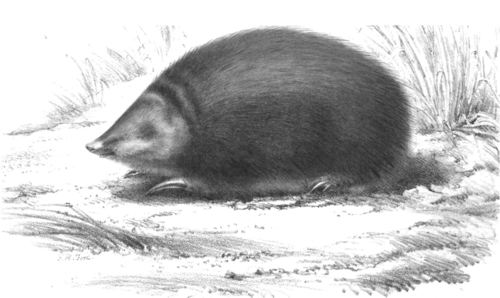
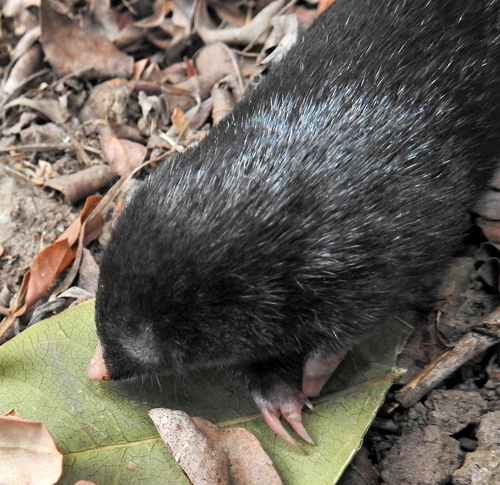
The fur is dense, coarse, and dark brown to blackish with a distinctive iridescent sheen that can appear bronze, green, or purple depending on light angle. The body is cylindrical and robust, with no external eyes, ears, or tail visible, and the snout ends in a tough, leathery pad used for digging.
Size
Body length (head and body) ranges from approximately 20 to 23.5 cm, making it the largest golden mole species; it has no visible tail.
Weight
Adults typically weigh between 380 and 500 grams.
Distinctive features
Distinguished from other golden mole species primarily by its much larger size, more robust build, and darker, more strongly iridescent coat; it is roughly twice the size of most other Chrysochloridae species.
Differences between males and females
Sexual dimorphism is minimal; males and females are similar in size and coloration, with only slight average size differences reported.
Behaviour and diet of the Giant Golden Mole
Solitary and highly territorial, defending individual burrow systems and rarely tolerating other individuals except briefly during mating.
When it is active
Primarily nocturnal and fossorial, foraging both underground in tunnels and occasionally on the forest floor surface at night under leaf litter.
Diet
Feeds mainly on earthworms, along with other soil and litter invertebrates such as beetle larvae, millipedes, and snails.
How it feeds and hunts
Locates prey using acute vibrational and tactile senses through its snout and inner ear adaptations rather than sight, tunneling through loose soil and leaf litter to encounter earthworms and invertebrates.
Communication
Communication is thought to rely mainly on tactile and vibrational cues within burrows, as visual signaling is not possible due to the absence of functional eyes; scent marking may also play a role in territory delineation.
Interactions with other species
Potential predators include owls, snakes, and small carnivorous mammals that dig into burrows; it may compete with other soil-dwelling insectivores for invertebrate prey within the same forest leaf litter layer.
Role in its ecosystem
As a soil engineer, its burrowing activity aerates forest soil and contributes to nutrient cycling, while its predation on invertebrates helps regulate soil fauna populations within its forest habitat.
Reproduction and lifecycle
Breeding biology is poorly documented in the wild; based on related species, litters likely consist of one to two young, born after a gestation of about 5-6 weeks, in a nest chamber within the burrow system.
Raising the young
Presumed that females raise young alone in a nest burrow, as is typical for golden moles, with limited direct observation confirming details of parental duration.
Maturity and lifespan
Specific data on age at sexual maturity and lifespan are lacking, but related golden mole species reach maturity within the first year and may live several years in the wild.
Taxonomy and naming of the Giant Golden Mole
Classification
Class Mammalia > Order Afrosoricida > Family Chrysochloridae > Genus Chrysospalax > Species Chrysospalax trevelyani
Scientific synonyms
Chrysochloris trevelyani (original combination)
What research says
Recent studies
Recent genetic and distribution studies have focused on delineating the fragmented forest populations to assess connectivity and inform conservation planning, though detailed genomic studies remain limited.
Compared with similar species
Compared to the more widespread Cape golden mole (Chrysochloris asiatica), the Giant Golden Mole is notably larger, restricted to forest rather than open or coastal habitats, and has a more restricted, fragmented range making it more vulnerable to habitat loss.
The Giant Golden Mole and people
It is the largest golden mole in the world, yet remains almost never seen due to its fully subterranean lifestyle. Its fur can shimmer with metallic colors despite the animal spending virtually its entire life underground in darkness.
Where and how to see it
Direct observation is extremely difficult due to its fossorial and nocturnal habits; the best chance of detecting signs (burrow mounds, tunnels) is in undisturbed indigenous forest patches of the Amatole Mountains or Hogsback region, typically after rain when soil is soft.
Risks to humans
No notable risk to humans; the species is harmless, non-venomous, and rarely encountered.
Countries where the Giant Golden Mole is recorded
The 1 countries named in the range description of its IUCN Red List assessment.
Questions about the Giant Golden Mole
Where does the Giant Golden Mole live?
The Giant Golden Mole is recorded in South Africa across Africa. These countries come from the range description of its IUCN Red List assessment, and they are what place the species on the interactive map.
Is the Giant Golden Mole endangered?
Yes. The IUCN Red List assesses the Giant Golden Mole as Endangered, one of the three threatened categories. The species faces a very high risk of extinction in the wild — a step below Critically Endangered, but still on a trajectory that ends badly without intervention.
How many are left in the wild?
No precise population count exists; the species is considered rare and patchily distributed, with an inferred declining trend correlated with ongoing habitat loss in its limited range. This figure comes from the species assessment on the IUCN Red List; population estimates for wild mammals are ranges, not counts, and are revised at each assessment.
What habitat does the Giant Golden Mole live in?
Restricted to moist, indigenous Afromontane and coastal evergreen forests with deep, loose, well-drained sandy or loamy soils rich in leaf litter and earthworms.
What is the scientific name of the Giant Golden Mole?
The Giant Golden Mole is Chrysospalax trevelyani, in the family Chrysochloridae, order Afrosoricida.
Other species in the genus Chrysospalax
Other species in the family Chrysochloridae



Species that share its range
Sources
Conservation status, range description and population estimate come from the IUCN Red List assessment for Chrysospalax trevelyani. Countries are derived from that range description, not from a mapped country list. Last refreshed on .
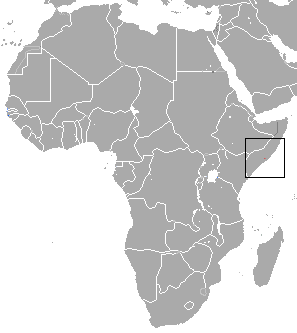
The distribution map is drawn from the IUCN Red List spatial data compiled in 2008. IUCN (International Union for Conservation of Nature)