
Van Zyl's Golden Mole
Cryptochloris zyli
Red List assessment
Endangeredon the IUCN Red List
- EXExtinct
- EWExtinct in the Wild
- CRCritically Endangered
- ENEndangered
- VUVulnerable
- NTNear Threatened
- LCLeast Concern
The Van Zyl's Golden Mole is recorded in one country, South Africa across Africa. The IUCN Red List assesses the Van Zyl's Golden Mole as Endangered. Population size is unknown but presumed very small, likely numbering in the low thousands or fewer, with a declining trend due to habitat destruction.
- Family
- Chrysochloridae
- Order
- Afrosoricida
- Genus
- Cryptochloris
- Countries recorded
- 1
- Continents
- Africa
- Red List category
- Endangered
- Data updated
- August 9, 2026
What is the Van Zyl's Golden Mole?
Van Zyl's Golden Mole is a tiny, blind, fossorial mammal endemic to a very restricted coastal region of South Africa. It is one of the rarest and least-known mammals in the world, known from only a handful of specimens. Its iridescent fur and subterranean lifestyle make it a remarkable example of adaptation to sandy desert environments. It is considered one of the most threatened small mammals on the African continent.
Where does the Van Zyl's Golden Mole live?
Restricted to a small coastal strip of the Northern Cape / Western Cape border in South Africa, near Doringbaai and Lambert's Bay
Endemic to a very small area of the western coastal strip of South Africa, between Lambert's Bay and Doringbaai in the Western Cape/Northern Cape border region. Its entire known range covers less than a few hundred square kilometers.
Altitude and depth
Occurs near sea level, from 0 to approximately 100 meters elevation, burrowing just below the sand surface.
Seasonal movements
No migration; may show reduced surface activity during extreme heat or after rain, when sand conditions affect burrowing ease.
Habitat of the Van Zyl's Golden Mole
Found in coastal sand dunes, sandy flats, and semi-arid strandveld vegetation along the west coast of South Africa. It requires loose, fine sandy soils that allow easy burrowing.
Adaptations to its environment
Possesses a streamlined, spindle-shaped body, powerful forelimbs with claws for digging, and a leathery nose pad to push through sand. Its eyes are vestigial and covered by skin, while dense, water-repellent fur and closable nostrils and ears protect against sand ingress.
Conservation status and numbers
Listed as Endangered by the IUCN due to its extremely restricted range, ongoing habitat loss, and very limited number of known localities. Population trend is believed to be declining as coastal habitats are converted for mining and development.
Estimated population
Population size is unknown but presumed very small, likely numbering in the low thousands or fewer, with a declining trend due to habitat destruction.
What threatens the Van Zyl's Golden Mole?
Major threats include coastal mining (particularly diamond and mineral sand extraction), agricultural expansion, urban and tourism development, and habitat degradation from off-road vehicle use on dunes.
What is being done to protect it?
Some of its range overlaps with areas earmarked for conservation planning in the Succulent Karoo biodiversity hotspot, and it is protected under South African biodiversity legislation, though no dedicated reserve exists solely for this species.
Recommended actions
Priority actions include conducting updated population surveys, protecting remaining coastal dune habitat from mining, establishing formal protected areas within its range, and reducing off-road vehicle disturbance.
What the Van Zyl's Golden Mole looks like
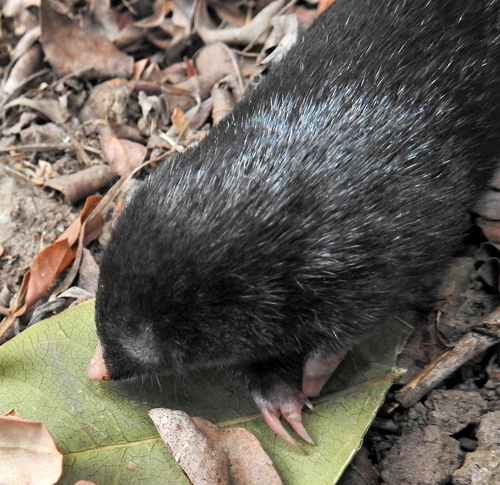
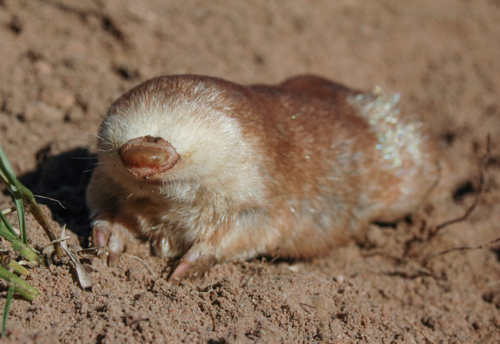
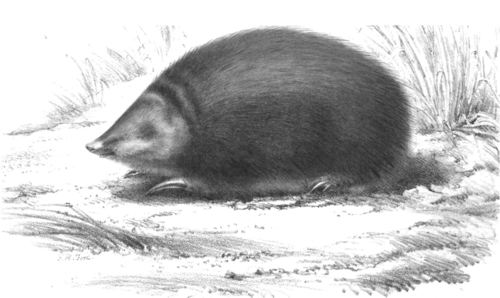
Covered in dense, silky fur with an iridescent sheen ranging from pale tan to grayish-brown, sometimes with a coppery or violet gloss. The body is compact and cylindrical, with no visible eyes, ears, or tail, and a tough keratinized nose pad.
Size
Body length ranges from approximately 7.5 to 9 cm, excluding the vestigial tail which is essentially absent externally.
Weight
Estimated weight around 20 to 30 grams, based on related golden mole species of similar size.
Distinctive features
Distinguished from related golden mole species by its pale, silvery-gray to fawn coloration and specific cranial and dental characteristics, as well as its highly restricted coastal distribution.
Differences between males and females
No significant sexual dimorphism has been documented in this species.
Behaviour and diet of the Van Zyl's Golden Mole
Believed to be solitary, like most golden moles, with individuals maintaining separate burrow systems and interacting only briefly for mating.
When it is active
Primarily active both day and night in short bursts, spending most time underground in burrows and surfacing occasionally to forage or disperse.
Diet
Insectivorous, feeding mainly on soil-dwelling invertebrates such as beetle larvae, termites, and other small arthropods encountered while burrowing.
How it feeds and hunts
Hunts by tunneling through loose sand and detecting prey through vibration sensitivity and a keen sense of smell, then capturing invertebrates directly with its snout and claws.
Communication
Likely relies on vibrational and tactile cues transmitted through soil, as well as scent marking, since visual and vocal communication are minimal in this blind, subterranean species.
Interactions with other species
Likely preyed upon by snakes, owls, and small carnivorous mammals; may compete with other burrowing insectivores for similar invertebrate prey resources.
Role in its ecosystem
Plays a role in soil aeration and turnover through its burrowing activity, and contributes to invertebrate population control within its sandy habitat ecosystem.
Reproduction and lifecycle
Reproductive biology is poorly documented, but related golden moles typically produce small litters of one to three young after a gestation period of about 4-6 weeks.
Raising the young
Presumed that females raise young alone in underground nests, as is typical for golden moles, with limited information available specific to this species.
Maturity and lifespan
Specific data unavailable, but related golden mole species reach maturity within one year and may live 3-5 years in the wild.
Taxonomy and naming of the Van Zyl's Golden Mole
Classification
Class Mammalia > Order Afrosoricida > Family Chrysochloridae > Genus Cryptochloris > Species Cryptochloris zyli
Scientific synonyms
Chrysochloris zyli (original combination)
What research says
Recent studies
Recent genetic and museum specimen studies have helped clarify its taxonomic status as distinct from the closely related De Winton's golden mole, though field research remains extremely limited due to rarity of sightings.
Compared with similar species
Closely related to De Winton's Golden Mole (Cryptochloris wintoni), from which it differs in fur coloration and skull morphology; both are among the rarest mammals in Africa.
The Van Zyl's Golden Mole and people
Van Zyl's Golden Mole has been recorded from only a few museum specimens and was long feared possibly extinct due to lack of sightings for decades. Despite being called 'golden,' its fur often has a silvery or pale sheen rather than golden coloration.
Where and how to see it
Observation in the wild is exceptionally difficult due to its rarity, subterranean habits, and restricted range; researchers typically use specialized trapping methods in coastal dune habitats near Doringbaai during cooler parts of the day.
Risks to humans
No notable risk to humans.
Countries where the Van Zyl's Golden Mole is recorded
The 1 countries named in the range description of its IUCN Red List assessment.
Questions about the Van Zyl's Golden Mole
Where does the Van Zyl's Golden Mole live?
The Van Zyl's Golden Mole is recorded in South Africa across Africa. These countries come from the range description of its IUCN Red List assessment, and they are what place the species on the interactive map.
Is the Van Zyl's Golden Mole endangered?
Yes. The IUCN Red List assesses the Van Zyl's Golden Mole as Endangered, one of the three threatened categories. The species faces a very high risk of extinction in the wild — a step below Critically Endangered, but still on a trajectory that ends badly without intervention.
How many are left in the wild?
Population size is unknown but presumed very small, likely numbering in the low thousands or fewer, with a declining trend due to habitat destruction. This figure comes from the species assessment on the IUCN Red List; population estimates for wild mammals are ranges, not counts, and are revised at each assessment.
What habitat does the Van Zyl's Golden Mole live in?
Found in coastal sand dunes, sandy flats, and semi-arid strandveld vegetation along the west coast of South Africa.
What is the scientific name of the Van Zyl's Golden Mole?
The Van Zyl's Golden Mole is Cryptochloris zyli, in the family Chrysochloridae, order Afrosoricida.
Other species in the genus Cryptochloris

Other species in the family Chrysochloridae



Species that share its range
Sources
Conservation status, range description and population estimate come from the IUCN Red List assessment for Cryptochloris zyli. Countries are derived from that range description, not from a mapped country list. Last refreshed on .
The distribution map is drawn from the IUCN Red List spatial data compiled in 2015. Gary Bronner; IUCN (International Union for Conservation of Nature)