
Sclater's Golden Mole
Chlorotalpa sclateri
Red List assessment
Least Concernon the IUCN Red List
- EXExtinct
- EWExtinct in the Wild
- CRCritically Endangered
- ENEndangered
- VUVulnerable
- NTNear Threatened
- LCLeast Concern
The Sclater's Golden Mole is recorded in 2 countries across Africa. The IUCN Red List assesses the Sclater's Golden Mole as Least Concern. No precise population estimate exists, but the species is considered common within suitable habitat and its population trend is believed to be stable.
- Family
- Chrysochloridae
- Order
- Afrosoricida
- Genus
- Chlorotalpa
- Countries recorded
- 2
- Continents
- Africa
- Red List category
- Least Concern
- Data updated
- August 9, 2026
What is the Sclater's Golden Mole?
Sclater's Golden Mole is a small, fossorial insectivorous mammal endemic to the highland grasslands of southern Africa. It is renowned for its iridescent fur and highly specialized subterranean lifestyle, being almost entirely blind and relying on tactile and vibrational cues to navigate underground tunnels. It plays an important role in soil aeration and invertebrate population control in its native grassland ecosystems.
Where does the Sclater's Golden Mole live?
South Africa and Lesotho
Endemic to southern Africa, primarily in the highlands of Lesotho and the eastern Free State, KwaZulu-Natal, and Eastern Cape provinces of South Africa. Its range is centered on the Drakensberg and surrounding plateau regions.
Altitude and depth
Occurs at elevations from about 1,200 m to over 3,000 m; burrows are typically shallow, ranging from just below the surface to around 30 cm deep, with deeper nesting chambers.
Seasonal movements
No true hibernation or long-distance migration occurs, but activity levels may decrease during cold, dry winter months when soil invertebrate prey is less abundant.
Habitat of the Sclater's Golden Mole
Found in montane grasslands, rocky highveld, and sandy or loamy soils suitable for burrowing, often near vleis (wetlands) or streams. It prefers areas with loose, friable soil that facilitate tunnel construction and rapid subsurface movement.
Adaptations to its environment
Has a streamlined, robust body with powerful forelimbs and claws for digging, a leathery nose pad for pushing soil, and no external ears or eyes to reduce injury underground. Its dense, water-repellent fur and iridescent sheen help it move efficiently through soil while its keen sense of touch and vibration detection compensate for the lack of vision.
Conservation status and numbers
Listed as Least Concern by the IUCN due to its relatively wide distribution and presumed stable population, although some subpopulations face localized habitat degradation. Its adaptability to various soil types across a broad highland range supports this classification.
Estimated population
No precise population estimate exists, but the species is considered common within suitable habitat and its population trend is believed to be stable.
What threatens the Sclater's Golden Mole?
Main threats include habitat loss from agricultural expansion, overgrazing, and soil compaction due to livestock, as well as urban development in parts of its range. Climate change altering soil moisture and vegetation cover could also affect prey availability.
Diseases and parasites
Specific disease data are scarce, but like other small mammals, it may host ectoparasites such as mites and ticks; no major disease outbreaks have been documented.
What is being done to protect it?
Some populations occur within protected areas such as the Golden Gate Highlands National Park and other conservation zones in the Drakensberg region. Broader grassland conservation initiatives in South Africa indirectly benefit this species.
Recommended actions
Recommended actions include maintaining and restoring native grassland habitats, controlling overgrazing, and conducting further population surveys to refine subspecies distinctions and monitor local threats.
What the Sclater's Golden Mole looks like
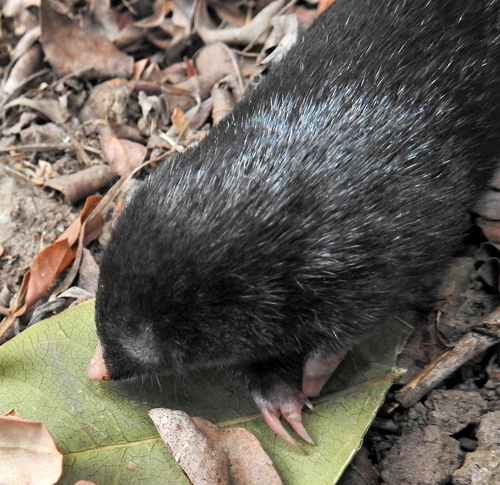
The fur is dense, soft, and iridescent, often showing bronze, coppery, or greenish sheens depending on the light and subspecies. The body is cylindrical and compact, with a wedge-shaped head, a leathery nose pad, and no visible eyes or ears.
Size
Adults typically measure 10–14 cm in body length, with no external tail.
Weight
Body weight ranges from approximately 30 to 60 grams depending on sex and subspecies.
Distinctive features
Distinguished from related golden mole species by subtle differences in fur coloration, skull morphology, and the number of claws on the forefeet. Molecular studies are often needed to confirm species identity due to high morphological similarity among Chrysochloridae species.
Differences between males and females
Sexual dimorphism is minimal, with males and females showing similar size and coloration; slight size differences may exist but are not consistently documented.
Behaviour and diet of the Sclater's Golden Mole
Sclater's Golden Mole is solitary and highly territorial, with individuals maintaining separate burrow systems and rarely tolerating conspecifics except during mating.
When it is active
It is primarily nocturnal and crepuscular, though activity can occur underground at any time since light levels are irrelevant to its behavior.
Diet
It is insectivorous, feeding mainly on earthworms, beetle larvae, termites, and other soil-dwelling invertebrates encountered while tunneling.
How it feeds and hunts
Prey is detected primarily through vibration and tactile sensitivity via the snout and whiskers as the mole moves through soil, allowing it to locate and capture invertebrates efficiently underground.
Communication
Communication is thought to rely mainly on vibrational and tactile signals transmitted through soil, along with scent marking to establish territory boundaries, since vision and vocal communication are minimal.
Interactions with other species
Predators include birds of prey, snakes, and small carnivores such as mongooses that dig them out of shallow burrows. They may also compete with other fossorial insectivores for similar invertebrate prey resources.
Role in its ecosystem
As a soil engineer, it contributes to aeration and nutrient cycling in grassland ecosystems through its burrowing activity, indirectly benefiting plant growth and soil health.
Reproduction and lifecycle
Breeding likely occurs during the wetter, warmer months when food is abundant, with females giving birth to small litters of 1–3 young after a gestation period estimated at around 4 weeks, though exact reproductive data are limited.
Raising the young
Females are the sole caregivers, nursing and protecting the young in a nest chamber until they are weaned and capable of independent burrowing, after which juveniles disperse to establish their own territories.
Maturity and lifespan
Sexual maturity is reached within the first year of life, and lifespan in the wild is estimated at around 3–4 years, though data from captivity are lacking.
Taxonomy and naming of the Sclater's Golden Mole
Classification
Mammalia > Afrosoricida > Chrysochloridae > Chlorotalpa > Chlorotalpa sclateri
Subspecies
Several subspecies have been described, including C. s. sclateri, C. s. montana, and C. s. wilsoni, distinguished mainly by pelage color and geographic range across the eastern and central highlands of South Africa and Lesotho; taxonomy remains under review.
Scientific synonyms
Amblysomus sclateri; Chrysochloris sclateri
What research says
Recent studies
Recent taxonomic revisions using molecular data have questioned the validity of some subspecies and even genus-level placement within Chrysochloridae, suggesting ongoing reclassification may occur.
Genome and DNA
Specific genomic studies on Chlorotalpa sclateri are limited, though golden moles as a family have been used in broader phylogenetic studies of Afrotheria due to their unique evolutionary lineage.
Compared with similar species
It closely resembles other golden moles such as Amblysomus species but can be differentiated by fur iridescence, cranial features, and geographic range; molecular analysis is often required for definitive identification.
The Sclater's Golden Mole and people
Golden moles like this species can 'swim' through loose sand almost as if it were water, and their iridescent fur is not for display but a byproduct of structural light interference in their hair shafts. Despite being called 'moles,' they are more closely related to elephants and aardvarks than to true moles.
Where and how to see it
Observing this species in the wild is difficult due to its subterranean habits; the best chance is spotting fresh burrow mounds in grasslands of the Drakensberg or Lesotho highlands at dawn or dusk after rain, when soil is soft and invertebrate activity is high.
Risks to humans
No notable risk to humans; it is harmless, non-venomous, and rarely encountered directly.
Human uses
There are no significant recorded human uses of this species, as it is not hunted, farmed, or used in traditional medicine to any notable extent.
Myths and legends
There are no widely documented myths or legends specifically about Sclater's Golden Mole, though golden moles in general are sometimes referenced in African folklore symbolizing hidden or unseen forces due to their subterranean lifestyle.
Countries where the Sclater's Golden Mole is recorded
The 2 countries named in the range description of its IUCN Red List assessment.
Questions about the Sclater's Golden Mole
Where does the Sclater's Golden Mole live?
The Sclater's Golden Mole is recorded in Lesotho and South Africa across Africa. These countries come from the range description of its IUCN Red List assessment, and they are what place the species on the interactive map.
Is the Sclater's Golden Mole endangered?
The IUCN Red List assesses the Sclater's Golden Mole as Least Concern. The species is widespread and abundant enough not to qualify for any threatened category. It does not mean the species is safe forever, only that nothing in the current data raises an alarm.
How many are left in the wild?
No precise population estimate exists, but the species is considered common within suitable habitat and its population trend is believed to be stable. This figure comes from the species assessment on the IUCN Red List; population estimates for wild mammals are ranges, not counts, and are revised at each assessment.
What habitat does the Sclater's Golden Mole live in?
Found in montane grasslands, rocky highveld, and sandy or loamy soils suitable for burrowing, often near vleis (wetlands) or streams.
What is the scientific name of the Sclater's Golden Mole?
The Sclater's Golden Mole is Chlorotalpa sclateri, in the family Chrysochloridae, order Afrosoricida.
Other species in the genus Chlorotalpa
Other species in the family Chrysochloridae


Species that share its range

Sources
Conservation status, range description and population estimate come from the IUCN Red List assessment for Chlorotalpa sclateri. Countries are derived from that range description, not from a mapped country list. Last refreshed on .
The distribution map is drawn from the IUCN Red List spatial data compiled in 2008. IUCN (International Union for Conservation of Nature)