
Temchuk's Bolo Mouse
Necromys temchuki
Red List assessment
Least Concernon the IUCN Red List
- EXExtinct
- EWExtinct in the Wild
- CRCritically Endangered
- ENEndangered
- VUVulnerable
- NTNear Threatened
- LCLeast Concern
The Temchuk's Bolo Mouse is recorded in 3 countries across South America. The IUCN Red List assesses the Temchuk's Bolo Mouse as Least Concern. No precise population estimate exists; the species is presumed to have a stable population given its Least Concern status, but data are limited due to its recent taxonomic recognition and the difficulty of surveying small rodents.
- Family
- Cricetidae
- Order
- Rodentia
- Genus
- Necromys
- Countries recorded
- 3
- Continents
- South America
- Red List category
- Least Concern
- Data updated
- August 9, 2026
What is the Temchuk's Bolo Mouse?
Temchuk's Bolo Mouse is a small terrestrial rodent endemic to the grasslands and savanna-like habitats of eastern Paraguay. It was described relatively recently as science refined the taxonomy of the genus Necromys, a group of South American sigmodontine rodents. It is notable mainly to specialists as part of the diverse and poorly known small mammal fauna of the Paraguayan Cerrado and Chaco transition zones. Despite its restricted known range, it appears tolerant of some habitat disturbance, contributing to its Least Concern status.
Where does the Temchuk's Bolo Mouse live?
Eastern Paraguay, with possible range extension into adjacent areas of Argentina and Brazil
Endemic to eastern Paraguay, with records concentrated in the departments bordering Brazil and Argentina; some authorities suggest a possible but unconfirmed extension of range into adjacent Misiones (Argentina) or western Brazil.
Altitude and depth
Generally found at low to moderate elevations, roughly 100-300 meters above sea level, typical of the Paraguayan interior plains.
Seasonal movements
No migratory behavior is known; as with many sigmodontine rodents, breeding activity likely peaks during the warmer, wetter months (spring-summer) when food resources are more abundant.
Habitat of the Temchuk's Bolo Mouse
Inhabits open grasslands, Cerrado savanna, and transitional scrub habitats, often in areas with dense grass cover providing shelter and foraging opportunities. It may also use edges of agricultural land and secondary vegetation where native grassland remnants persist.
Adaptations to its environment
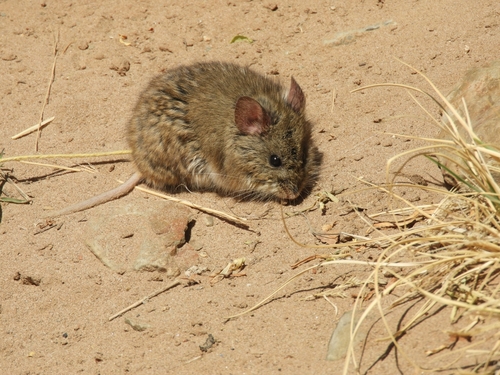
Possesses a compact body and strong hind limbs suited for moving quickly through dense grass, along with a diet flexible enough to exploit seasonal changes in seed and insect availability. Its fur coloration likely provides camouflage against the soil and dry grass typical of Cerrado habitats.
Conservation status and numbers
Listed as Least Concern by the IUCN, reflecting its relatively wide distribution within suitable habitat in Paraguay and the absence of evidence for significant population decline, though data remain limited due to the species' recent description and cryptic nature.
Estimated population
No precise population estimate exists; the species is presumed to have a stable population given its Least Concern status, but data are limited due to its recent taxonomic recognition and the difficulty of surveying small rodents.
What threatens the Temchuk's Bolo Mouse?
Habitat loss from agricultural expansion, cattle ranching, and conversion of native grasslands to soy or pasture represents the main threat, though the species appears somewhat adaptable to modified landscapes.
Diseases and parasites
Specific pathogens have not been well studied, but like other sigmodontine rodents, it may host ectoparasites such as mites and fleas, and could be a reservoir for regional hantaviruses, though this has not been confirmed for this species.
What is being done to protect it?
No species-specific conservation programs exist, but it likely benefits indirectly from protected areas within its range, such as reserves in eastern Paraguay that conserve Cerrado and Atlantic Forest transition habitats.
Recommended actions
Further taxonomic and distributional studies are needed to clarify its range and habitat requirements, along with monitoring of grassland habitat loss to ensure early detection of any population decline.
What the Temchuk's Bolo Mouse looks like
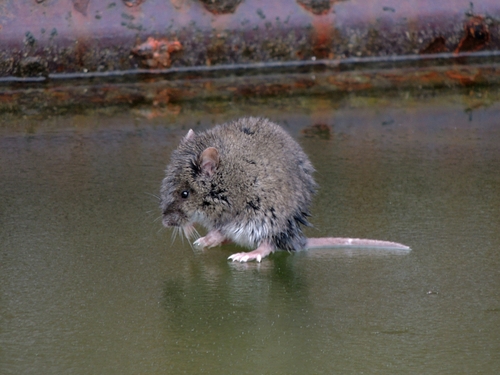
Has soft, grayish-brown to brownish dorsal fur with paler, grayish-white underparts, a relatively short tail, and small rounded ears typical of grassland-dwelling sigmodontine rodents.
Size
Approximately 8-11 cm in head-body length, with a tail roughly equal to or slightly shorter than body length, typical for small Necromys species.
Weight
Estimated body weight of around 20-40 grams, consistent with similarly sized congeners in the genus Necromys.
Distinctive features
Distinguished from closely related Necromys species primarily through subtle cranial and dental morphological differences, as well as genetic divergence identified through molecular studies rather than obvious external features.
Differences between males and females
No pronounced sexual dimorphism has been documented; males and females are similar in size and coloration, as is typical for the genus.
Behaviour and diet of the Temchuk's Bolo Mouse
Likely solitary or loosely social, based on behavior patterns observed in related Necromys species, with individuals maintaining separate home ranges except during breeding.
When it is active
Presumed to be primarily nocturnal or crepuscular, consistent with the activity patterns of most small sigmodontine rodents, though direct behavioral studies are lacking.
Diet
Omnivorous, likely feeding on seeds, grasses, and invertebrates such as insects, similar to the diet documented in other Necromys species inhabiting grassland ecosystems.
How it feeds and hunts
Forages on the ground by searching leaf litter and grass cover for seeds and small invertebrates rather than employing active predatory hunting strategies.
Communication
Likely relies on scent marking and short-range vocalizations for communication, as documented in related sigmodontine rodents, though specific studies on this species are lacking.
Interactions with other species
Serves as prey for a variety of predators including owls, small carnivorous mammals, and snakes native to the Paraguayan grasslands; may compete with other small rodents for food and shelter.
Role in its ecosystem
Plays an ecological role as a seed disperser and prey species within grassland food webs, contributing to nutrient cycling and supporting predator populations in Cerrado ecosystems.
Reproduction and lifecycle
Breeding biology is poorly documented but likely resembles related Necromys species, with litters of several pups after a gestation period of around 20-25 days, and breeding concentrated in warmer months.
Raising the young
Presumed maternal care typical of small rodents, with females nursing and protecting young in a nest until weaning, after which juveniles disperse to establish their own territories.
Maturity and lifespan
Sexual maturity is likely reached within a few months of birth, consistent with small rodents, with a wild lifespan probably under 2 years; captive lifespan data are unavailable.
Taxonomy and naming of the Temchuk's Bolo Mouse
Classification
Mammalia > Rodentia > Cricetidae > Sigmodontinae > Necromys > Necromys temchuki
Scientific synonyms
Previously included within a broader concept of Necromys lasiurus or Bolomys lasiurus before taxonomic revision separated South American 'bolo mice' into distinct species.
What research says
Recent studies
Recent taxonomic revisions of the genus Necromys using molecular and morphological data have helped clarify the status of N. temchuki as a distinct species within the Paraguayan grassland rodent fauna.
Genome and DNA
Molecular phylogenetic studies using mitochondrial DNA have been used to distinguish this species from closely related Necromys taxa, though a full genome has not been sequenced.
Compared with similar species
Closely resembles other Necromys species such as Necromys lasiurus and Necromys amoenus, but is distinguished by subtle cranial and genetic differences rather than obvious external traits.
The Temchuk's Bolo Mouse and people
This species was named in honor of a researcher (Temchuk) who contributed to Paraguayan mammalogy, and it remains one of the lesser-known rodents described in South America in recent decades. Its discovery highlights how much biodiversity remains to be documented even in relatively well-studied regions like Paraguay.
Where and how to see it
Best observed through live-trapping surveys conducted by researchers in the grasslands of eastern Paraguay, particularly during cooler evening hours; casual wildlife observation is unlikely due to its small size and cryptic habits.
Risks to humans
No notable risk to humans, though as with many wild rodents, handling should be avoided due to the general potential for zoonotic disease transmission.
Countries where the Temchuk's Bolo Mouse is recorded
The 3 countries named in the range description of its IUCN Red List assessment.
Questions about the Temchuk's Bolo Mouse
Where does the Temchuk's Bolo Mouse live?
The Temchuk's Bolo Mouse is recorded in Argentina, Brazil and Paraguay across South America. These countries come from the range description of its IUCN Red List assessment, and they are what place the species on the interactive map.
Is the Temchuk's Bolo Mouse endangered?
The IUCN Red List assesses the Temchuk's Bolo Mouse as Least Concern. The species is widespread and abundant enough not to qualify for any threatened category. It does not mean the species is safe forever, only that nothing in the current data raises an alarm.
How many are left in the wild?
No precise population estimate exists; the species is presumed to have a stable population given its Least Concern status, but data are limited due to its recent taxonomic recognition and the difficulty of surveying small rodents. This figure comes from the species assessment on the IUCN Red List; population estimates for wild mammals are ranges, not counts, and are revised at each assessment.
What habitat does the Temchuk's Bolo Mouse live in?
Inhabits open grasslands, Cerrado savanna, and transitional scrub habitats, often in areas with dense grass cover providing shelter and foraging opportunities.
What is the scientific name of the Temchuk's Bolo Mouse?
The Temchuk's Bolo Mouse is Necromys temchuki, in the family Cricetidae, order Rodentia.
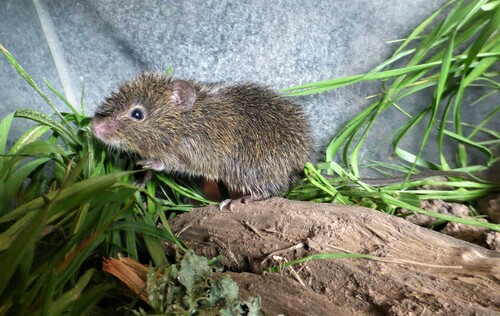
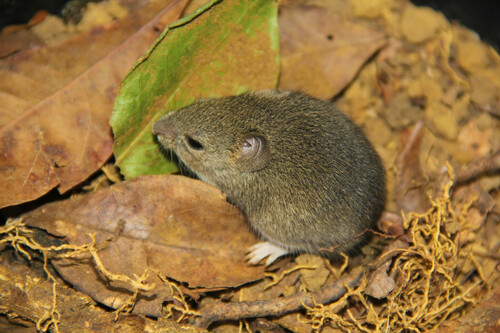
Other species in the genus Necromys
Other species in the family Cricetidae
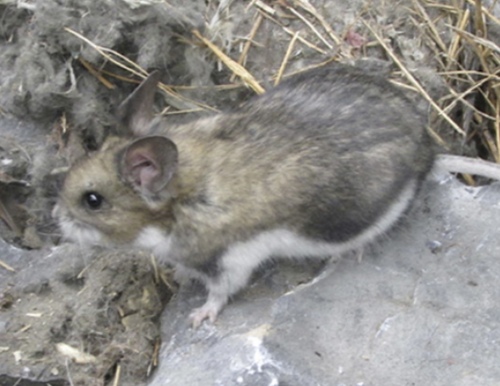
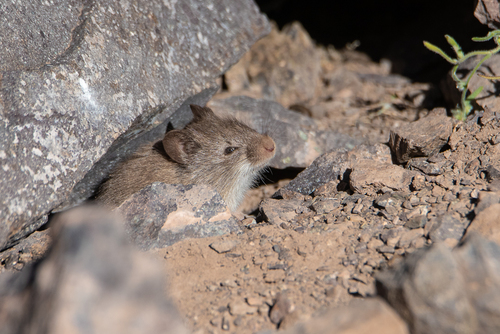
Sources
Conservation status, range description and population estimate come from the IUCN Red List assessment for Necromys temchuki. Countries are derived from that range description, not from a mapped country list. Last refreshed on .
The distribution map is drawn from the IUCN Red List spatial data compiled in 2008. IUCN (International Union for Conservation of Nature)